

Morning yoga routines: 5, 10, 15 and 20 minutes, timed to the second
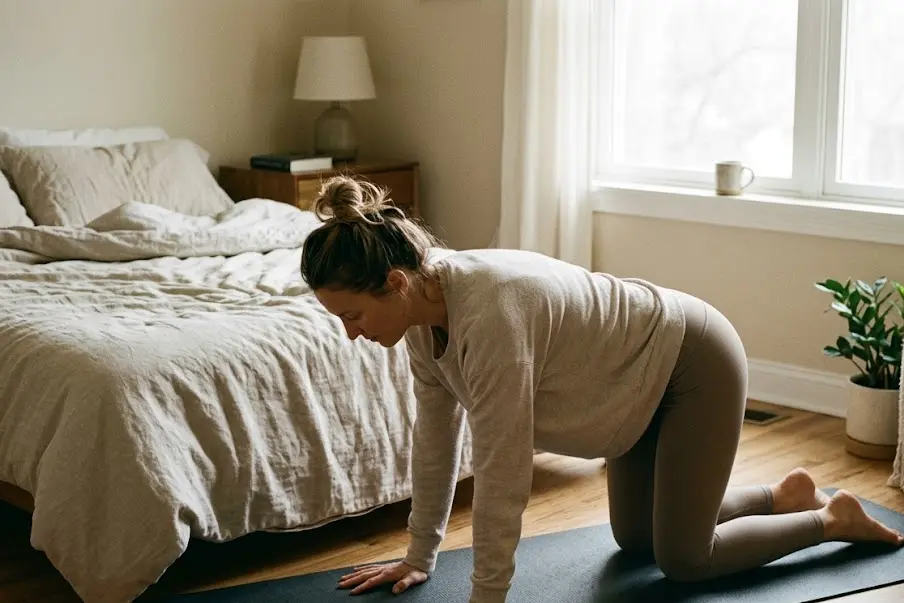
Most morning yoga advice says "hold for a few breaths" and leaves you guessing how long the whole thing takes. This page does the opposite. Each routine below lists every pose with a time in seconds, a breath cue and a link to a full pose guide, and the times add up exactly to the length on the label.
Pick one, set a timer, and go. You don't need to be flexible, and you don't need to finish every pose perfectly. Bend your knees whenever a pose asks for more than your hamstrings have at 7 a.m.
Pick your routine
| Routine | Length | Best for | Floor needed? | Gets you to |
|---|---|---|---|---|
| Bedside routine for stiff mornings | 5 min (300 s) | Stiff backs, sore joints, older adults, anyone who won't get on the floor first thing | No | Upright and moving |
| 5-minute wake-up | 5 min (300 s) | Busy mornings, total beginners | A little | Every joint moved once |
| 10-minute full-body | 10 min (600 s) | A daily default | Yes | Spine, hips, legs and balance |
| 15-minute energizing flow | 15 min (900 s) | Days you want to feel warm and awake | Yes | Sun Salutations plus standing poses |
| 20-minute strength + mobility | 20 min (1,200 s) | 2–3 mornings a week, or weekends | Yes | Legs, core, upper back and hips |
If you're new, start with the 5-minute wake-up for a week or two. If getting down to the floor is hard in the morning, start with the bedside routine and nothing else.
Want the order worked out for you? The free 28-day yoga plan puts these routines on a calendar, from 5 minutes a day in week 1 to 20 minutes by week 4. You can tick days off on the page or print it.
How "per side" works: "30 s/side = 60 s" means 30 seconds on the right, 30 seconds on the left. The 60 is what counts toward the total. Transitions are built into each pose's time, so move straight on.
Before you start (60 seconds of reading)
- Move first, hold later. Every routine opens with moving poses before any longer holds. Cleveland Clinic describes static stretching on muscles that aren't warmed up as "really more of a relaxation movement" and suggests holds of about 15 to 30 seconds inside a warm-up rather than 60 to 90 [4]. That's why most holds here are 15–45 seconds.
- Get up slowly. Your blood pressure is normally at its lowest when you wake up, and the brief drop that can happen when you stand (orthostatic hypotension) is more common and stronger in the morning [5]. Come up from folds and from lying down slowly, and pause sitting before you stand.
- Nothing should hurt. Stretch feels like pulling. Sharp, pinching or electric pain means back off or skip the pose.
- Breathe through your nose if you can, and never hold your breath to get deeper into a pose.
- Props that help: a sturdy chair, a block or a thick book, and a folded blanket under your knees.
5-minute bedside routine for stiff mornings
Prefer a timer? Follow along with the timed version: it counts down each pose and tells you when to switch sides.
Done in bed, then sitting on the edge of the bed with both feet on the floor. No mat. Good for days when your back or joints feel locked up. More ideas in our guide to bed or couch yoga.
| # | Pose | Time (s) | Breath cue | Guide |
|---|---|---|---|---|
| 1 | Lying on your back: slow breathing, hand on belly | 30 | Inhale into your hand, exhale longer than the inhale | Three-Part Breath |
| 2 | Ankle circles, both feet | 30 | Breathe normally; 15 s each direction | Ankle Circles |
| 3 | Knee to chest | 20/side = 40 | Exhale to draw the knee in, inhale to ease off | Knee to Chest |
| 4 | Knees-bent twist, both knees fall to one side | 20/side = 40 | Exhale as the knees lower | Reclined Twist |
| 5 | Roll onto your side, push up to sitting | 15 | Exhale as you push up | — |
| 6 | Seated shoulder rolls | 30 | Inhale shoulders up and back, exhale down | Shoulder Rolls |
| 7 | Seated Cat-Cow, hands on thighs | 40 | Inhale chest forward, exhale round your back | Cat-Cow |
| 8 | Seated side bend, one arm overhead | 15/side = 30 | Inhale reach up, exhale lean | — |
| 9 | Seated twist, hand to opposite knee | 15/side = 30 | Inhale sit tall, exhale turn | Seated Twist |
| 10 | Sit still, feet flat, then stand slowly | 15 | Three easy breaths before you stand | — |
| Total | 300 s = 5:00 |
How-to notes
- Rolling up (step 5): bend both knees, roll onto your side, drop your feet off the edge and push yourself up with your arms. This keeps your back out of a sit-up and gives your blood pressure a moment to adjust.
- Twist (step 4): keep both shoulders on the mattress. A soft bed makes this gentler, not harder.
5-minute wake-up
Prefer a timer? Follow along with the timed version: it counts down each pose and tells you when to switch sides.
A quick pass through every major joint: neck, shoulders, spine, hips, hamstrings and ankles.
| # | Pose | Time (s) | Breath cue | Guide |
|---|---|---|---|---|
| 1 | Seated breathing, cross-legged or on a cushion | 30 | Slow inhale through the nose, longer exhale | Three-Part Breath |
| 2 | Neck half circles (ear to shoulder, chin to chest, other ear) | 30 | Exhale as the chin drops | Neck Rolls |
| 3 | Cat-Cow on hands and knees | 60 | Inhale cow (belly down), exhale cat (back round) | Cat-Cow |
| 4 | Thread the Needle | 30/side = 60 | Exhale to slide the arm under | Thread the Needle |
| 5 | Downward Dog, knees bent, pedal the feet | 30 | Breathe steadily | Downward Dog |
| 6 | Ragdoll, knees well bent | 30 | Exhale to let the head hang | Ragdoll |
| 7 | Mountain with arms overhead, then side lean | 30 | Inhale reach up, exhale lean one way, then the other | Mountain Pose |
| 8 | Tree Pose (foot on ankle or calf is fine) | 15/side = 30 | Breathe slowly; fix your eyes on one spot | Tree Pose |
| Total | 300 s = 5:00 |
How-to notes
- Neck (step 2): half circles only, across the front. Don't drop your head all the way back.
- Ragdoll (step 6): bend your knees as much as you need to let your belly rest near your thighs. Come up slowly, head last. If you have osteoporosis or a disk problem, see the safety section and use a flat-back hinge instead.
- Tree (step 8): keep the lifted foot above or below the knee, never pressing on the side of the knee. Touch a wall if you wobble.
10-minute full-body routine
Prefer a timer? Follow along with the timed version: it counts down each pose and tells you when to switch sides.
This is the one to make your daily default. It works the spine in all directions (forward, back, sideways, twisting), opens the hips, wakes up the legs and finishes with balance. Prefer a shorter guided version? See our Quick 10-Minute Flow and Morning Flow pose pages.
| # | Pose | Time (s) | Breath cue | Guide |
|---|---|---|---|---|
| 1 | Seated breathing | 45 | Inhale belly, ribs, chest; exhale in reverse | Three-Part Breath |
| 2 | Cat-Cow | 60 | Inhale cow, exhale cat | Cat-Cow |
| 3 | Thread the Needle | 30/side = 60 | Exhale to slide under | Thread the Needle |
| 4 | Downward Dog | 45 | Breathe steadily; bend knees as needed | Downward Dog |
| 5 | Low Lunge, back knee down | 30/side = 60 | Inhale lift chest, exhale sink hips | Low Lunge |
| 6 | Ragdoll, knees bent | 30 | Exhale to hang | Ragdoll |
| 7 | Mountain, arms up and side lean | 15/side = 30 | Inhale reach, exhale lean | Mountain Pose |
| 8 | Chair Pose | 30 | Breathe steadily; don't hold your breath | Chair Pose |
| 9 | Warrior II | 30/side = 60 | Exhale to bend the front knee | Warrior II |
| 10 | Triangle Pose | 30/side = 60 | Inhale lengthen, exhale tip sideways | Triangle Pose |
| 11 | Tree Pose | 30/side = 60 | Slow breathing, eyes on one spot | Tree Pose |
| 12 | Lying knees-bent twist | 30/side = 60 | Exhale as the knees lower | Reclined Twist |
| Total | 600 s = 10:00 |
How-to notes
- Low Lunge (step 5): put a blanket under the back knee. Keep the front knee roughly over the ankle. See knee-friendly modifications if kneeling hurts.
- Chair Pose (step 8): sit your hips back as if toward a chair, weight in your heels. Arms can stay at your chest.
- Triangle (step 10): the lower hand goes on your shin, a block or a chair seat, not the floor unless it gets there easily. The goal is a long side body, not touching the floor.
- Getting up after the twist: hug your knees, roll to one side and press up slowly.
15-minute energizing flow
Prefer a timer? Follow along with the timed version: it counts down each pose and tells you when to switch sides.
Adds Sun Salutations, which link poses to the breath and warm you up faster than holding poses one at a time. If you have wrist trouble, use the wrist-free modifications or swap the salutations for 3 extra minutes of the standing poses.
| # | Pose | Time (s) | Breath cue | Guide |
|---|---|---|---|---|
| 1 | Seated breathing | 60 | Slow inhale, longer exhale | Three-Part Breath |
| 2 | Cat-Cow | 60 | Inhale cow, exhale cat | Cat-Cow |
| 3 | Downward Dog, pedal the feet | 45 | Breathe steadily | Downward Dog |
| 4 | Ragdoll, then roll up slowly | 30 | Exhale to hang, inhale to rise | Ragdoll |
| 5 | Sun Salutation A, knees-down option | 4 rounds x 45 = 180 | One movement per breath (see notes) | Sun Salutation A |
| 6 | Crescent Lunge | 30/side = 60 | Inhale arms up, exhale sink | Crescent Lunge |
| 7 | Warrior II | 30/side = 60 | Exhale to bend the front knee | Warrior II |
| 8 | Reverse Warrior | 15/side = 30 | Inhale to reach up and back | Reverse Warrior |
| 9 | Triangle Pose | 30/side = 60 | Inhale lengthen, exhale tip | Triangle Pose |
| 10 | Goddess Pose | 45 | Exhale to sink, inhale to lift | Goddess Pose |
| 11 | Chair Pose | 30 | Breathe steadily | Chair Pose |
| 12 | Tree Pose | 30/side = 60 | Slow breathing | Tree Pose |
| 13 | Bridge Pose, 3 lifts of about 15 s with a short rest | 60 | Inhale lift hips, exhale lower | Bridge Pose |
| 14 | Lying knees-bent twist | 30/side = 60 | Exhale as the knees lower | Reclined Twist |
| 15 | Rest on your back | 60 | Let the breath go back to normal | Corpse Pose |
| Total | 900 s = 15:00 |
How-to notes
- Sun Salutation A (step 5), one round: inhale arms up; exhale fold with bent knees; inhale half lift (hands on shins, flat back); exhale step back to plank and lower knees, chest and chin, or lower all the way down; inhale low Cobra; exhale Downward Dog for 3 breaths; step forward, inhale half lift, exhale fold, inhale rise to standing. About 45 seconds a round at a steady pace. If yours take longer, do 3 rounds.
- Crescent Lunge (step 6): short stance is fine. Drop the back knee to the floor for a lower-effort version (that turns it into Low Lunge).
- Goddess (step 10): turn the toes out and keep the knees pointing the same way as the toes.
- Bridge (step 13): lift only as high as feels comfortable in your lower back. Press through your feet, not your neck, and don't turn your head while your hips are up.
20-minute strength and mobility
Prefer a timer? Follow along with the timed version: it counts down each pose and tells you when to switch sides.
More holds and more leg and core work. Try it two or three mornings a week, alternating with the 10-minute routine. It includes two poses rated intermediate on our glossary (Warrior III and Side Plank); use the supported versions in the notes.
| # | Pose | Time (s) | Breath cue | Guide |
|---|---|---|---|---|
| 1 | Seated breathing | 60 | Slow inhale, longer exhale | Three-Part Breath |
| 2 | Cat-Cow | 60 | Inhale cow, exhale cat | Cat-Cow |
| 3 | Thread the Needle | 30/side = 60 | Exhale to slide under | Thread the Needle |
| 4 | Downward Dog | 45 | Breathe steadily | Downward Dog |
| 5 | Plank (knees down is fine) | 30 | Steady breathing, belly firm | Plank |
| 6 | Child's Pose | 30 | Breathe into your back | Child's Pose |
| 7 | Sun Salutation A, knees-down option | 4 rounds x 45 = 180 | One movement per breath | Sun Salutation A |
| 8 | Chair Pose, 3 holds of 20 s with a 10 s stand between | 90 | Breathe steadily through each hold | Chair Pose |
| 9 | High Lunge | 30/side = 60 | Inhale lift, exhale sink | High Lunge |
| 10 | Warrior II | 45/side = 90 | Exhale to bend the front knee | Warrior II |
| 11 | Reverse Warrior | 15/side = 30 | Inhale to reach back | Reverse Warrior |
| 12 | Triangle Pose | 30/side = 60 | Inhale lengthen, exhale tip | Triangle Pose |
| 13 | Goddess Pose | 45 | Exhale sink, inhale lift | Goddess Pose |
| 14 | Warrior III, hands on a chair back | 20/side = 40 | Steady breathing | Warrior III |
| 15 | Locust Pose, 3 lifts of about 15 s with a short rest | 60 | Inhale lift, exhale lower | Locust Pose |
| 16 | Bridge Pose, 3 lifts of about 15 s with a short rest | 60 | Inhale lift hips, exhale lower | Bridge Pose |
| 17 | Side Plank, bottom knee down | 20/side = 40 | Steady breathing | Side Plank |
| 18 | Lying knees-bent twist | 30/side = 60 | Exhale as the knees lower | Reclined Twist |
| 19 | Happy Baby | 40 | Slow breathing | Happy Baby |
| 20 | Rest on your back | 60 | Let the breath settle | Corpse Pose |
| Total | 1,200 s = 20:00 |
How-to notes
- Plank (step 5): hands under shoulders, knees down if your lower back sags. Rest in Child's Pose earlier if you need to.
- Warrior III (step 14): stand facing the back of a sturdy chair, hands on it, then hinge forward as you lift one leg behind you. Keep the standing knee soft.
- Locust (step 15): lie face down, arms by your sides. Lift chest and legs a few inches; keep your neck long and look at the floor just ahead.
- Side Plank (step 17): from lying on your side, prop up on your forearm with the bottom knee down, then lift the hips. Full-arm and straight-leg versions are optional.
- Happy Baby (step 19): hold the backs of your thighs instead of your feet if your feet are hard to reach.
Safety: stiff mornings, back issues and who should skip what
Yoga is "generally considered a safe form of physical activity for healthy people," according to the National Center for Complementary and Integrative Health (NCCIH), and serious injuries are rare. The most common injuries are sprains and strains. NCCIH also notes that yoga-related emergency visits are more common in people 65 and older, and that pregnant people, older adults and people with health conditions should talk with their health care providers about which poses to change or avoid [1].
Stiff mornings. Use the bedside routine, or do the first two poses of any routine twice as slowly. Keep knees bent in every fold. Come up from folds and from the floor slowly, because blood pressure drops when standing are more common in the morning [5].
Osteoporosis. Harvard Health recommends yoga as a balance and flexibility exercise for people with osteoporosis, but says that if you have already broken bones in your spine, you should avoid activities in which you bend forward, reach down or twist, and ask your doctor about other limits [2]. If you have osteoporosis, talk with your doctor or physical therapist before doing the folds and twists on this page. A safer swap for Ragdoll and the folds in Sun Salutation: stand with soft knees, hands on your thighs, and hinge forward from the hips with a flat back.
Herniated or bulging disk, or other lumbar spine problems. Cleveland Clinic's advice for people with a herniated disk is "Don't bend at the waist. Bend your knees while keeping your back straight," and it lists repetitive bending or twisting among the causes [3]. NCCIH lists lumbar spine disease among conditions that may need pose changes [1]. Skip deep forward folds (Ragdoll, the fold in Sun Salutation) and use the flat-back hinge above. Cleveland Clinic also advises avoiding long periods of bed rest, so gentle movement within a comfortable range is usually encouraged, but follow your own clinician's plan [3].
See a doctor promptly if back pain comes with loss of bladder or bowel control, numbness, tingling or weakness in your legs or feet, or trouble standing or walking [3]. These are not symptoms to stretch through.
Skip if:
- Head-below-heart poses (Downward Dog, Ragdoll, forward folds): NCCIH lists glaucoma and severe high blood pressure among conditions that may need modifications [1]. If either applies to you, ask your doctor first. Swap Downward Dog for Child's Pose or Puppy Pose and keep your head above your heart in folds.
- Backbends (Cobra, Locust, Bridge, Crescent Lunge with a big arch): skip or keep them very small if bending backward brings on back pain or pain down a leg. Keep Bridge low and Cobra to a few inches.
- Balance poses (Tree, Warrior III): if balance is an issue, NCCIH lists it among conditions that may need changes [1]. Do them next to a wall or with a chair, every time.
- Pregnancy: NCCIH advises avoiding poses that involve long periods lying on your back [1]. Skip the lying twist, Bridge, Happy Baby and the final rest, or ask your prenatal care provider. Our prenatal-safe page has alternatives.
No headstands, shoulderstands or forceful breathing appear in these routines. NCCIH advises beginners to avoid those extreme practices [1].
What a short morning routine can and can't do
Honest version: there's no strong research on morning yoga specifically, or on 5-minute sessions. NCCIH summarizes research suggesting yoga may help with general wellness by relieving stress and supporting good health habits, and that it may help mental and emotional health, sleep and balance. It also notes that in healthy people, studies have found improvements in at least one balance outcome [1]. Most of that research is on longer programs, not 5-minute sessions.
What a short morning routine does reliably is get you moving before the day takes over, and give you a small daily habit you can grow. For most people, that is the point.
If you'd rather do the slow, stretchy version in the evening, see Yoga for Better Sleep: 7 Poses Before Bed. If you're torn about timing for a sitting practice, we compare the two in Morning vs Evening: When's the Best Time for Mindful Meditation at Home?
How to make morning yoga stick
The best-known real-world study on habits comes from University College London. Volunteers repeated a daily behavior they chose, in the same context every day. How automatic it felt rose quickly at first and leveled off after an average of 66 days, with considerable variation between people and behaviors. Missing an occasional day did not seriously set people back [6].
Practical takeaways from that research and from the GP-practice advice built on it [6]:
- Attach it to something you already do every morning. "After I start the coffee maker" or "after I brush my teeth" works better than "sometime in the morning."
- Start smaller than you think. The 5-minute wake-up or the bedside routine is enough. You can add time once it feels automatic.
- Do the same routine for a while. Repeating one routine in the same spot is how it becomes automatic. Switch only once it feels easy.
- Expect about 10 weeks, not 21 days. That is how long the habit research suggests, on average, before it starts to feel automatic.
- A missed day is not a reset. Pick it back up the next morning.
- Track it simply. A tick on a calendar is plenty. The 28-day plan has a printable one.
A few practical setup tips (from experience, not research):
- Leave your mat unrolled, or a chair in place, the night before.
- Drink a glass of water first.
- Keep your phone in another room, or use it only as the timer.
- If your space is small or cluttered, see How to Create a Peaceful Home Space for Daily Meditation and Yoga.
- Wondering about eating first? See What to Eat Before and After Yoga.
Want something new each day?
If one routine every day sounds boring, our Daily Yoga page gives you a different short practice for each day of the week. For a slightly longer read on why 15 minutes a day is a realistic target, see The Power of Daily Practice: How Just 15 Minutes of Yoga Can Transform Your Life.
Want to add a minute of stillness after you move? Try the 5-Minute Morning Meditation or a breathing pacer like square breathing. For more poses to build your own routine, browse the poses library.
Sources
- National Center for Complementary and Integrative Health (NCCIH). "Yoga: Effectiveness and Safety." https://www.nccih.nih.gov/health/yoga-effectiveness-and-safety
- Harvard Health Publishing. "Effective exercises for osteoporosis." https://www.health.harvard.edu/pain/effective-exercises-for-osteoporosis
- Cleveland Clinic. "Herniated Disk (Bulging Disk): Symptoms & Treatment." https://my.clevelandclinic.org/health/diseases/12768-herniated-disk
- Cleveland Clinic Health Essentials. "Dynamic vs. Static Stretching: Is One Better?" https://health.clevelandclinic.org/dynamic-stretching-vs-static-stretching
- Cleveland Clinic. "Orthostatic Hypotension (Postural Hypotension)." https://my.clevelandclinic.org/health/diseases/9385-low-blood-pressure-orthostatic-hypotension
- Gardner B, Lally P, Wardle J. "Making health habitual: the psychology of 'habit-formation' and general practice." British Journal of General Practice, 2012;62(605):664–666. https://pmc.ncbi.nlm.nih.gov/articles/PMC3505409/ (summarizes Lally P, van Jaarsveld CHM, Potts HWW, Wardle J. "How are habits formed: Modelling habit formation in the real world." European Journal of Social Psychology, 2010;40:998–1009, https://doi.org/10.1002/ejsp.674. The original paper's page returned HTTP 403, so every claim here is limited to what Gardner 2012 reports.)
Want new practices by email?
We email now and then when we publish a new routine, practice or guide. No spam, unsubscribe any time.
Join the YogaMag newsletterFrequently Asked Questions
Popular posts
Related posts




No comments yet. Be the first to comment!