

In this article
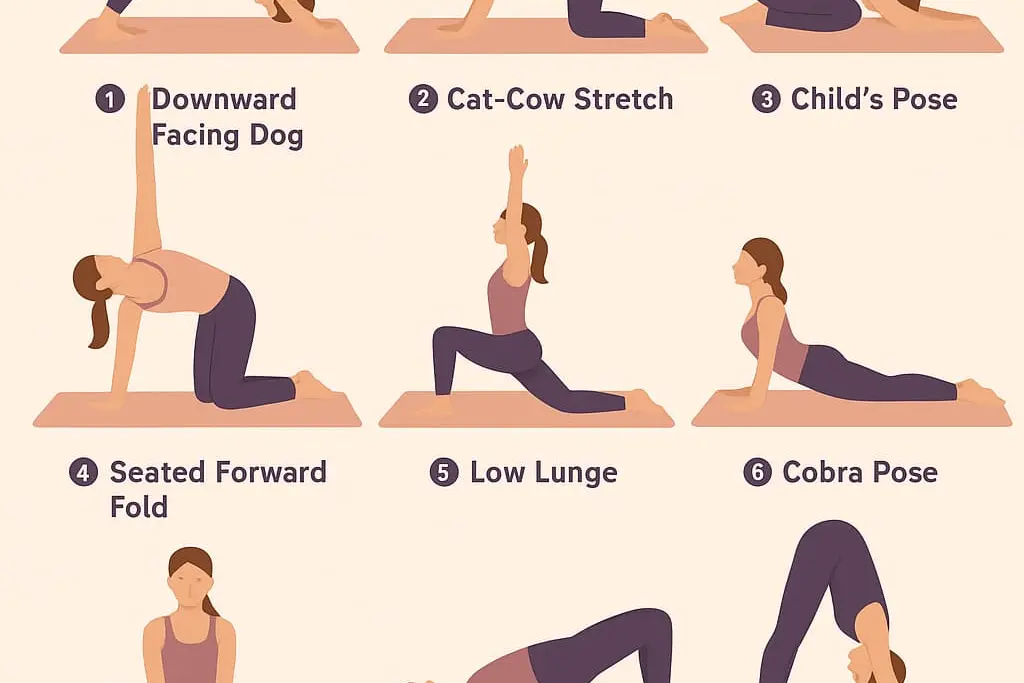
If you want to touch your toes, sit on the floor without your back aching, or just feel less stiff after a day at a desk, yoga is a practical way to get there. This guide covers what actually makes you more flexible, 15 poses grouped by body area, two routines you can follow as written, and a simple four-week plan with a way to track your progress.
You don't need to be flexible to start. You need a mat, ideally a strap (a belt or towel works too), one or two blocks (or thick books), and a folded blanket.
Reviewed by the YogaMag editorial team against the sources listed below, in line with our editorial policy. This page has not been reviewed by a doctor or physical therapist.
Quick answers
- Top yoga poses for flexibility, by body area:
- Hamstrings and calves: Downward-Facing Dog, Standing Forward Fold, Supine Hand-to-Foot (with a strap), Head-to-Knee.
- Hips: Low Lunge, Figure Four, supported Pigeon, Bound Angle, Happy Baby.
- Back and spine: Cat-Cow, Sphinx, Supine Spinal Twist, Child's Pose.
- Shoulders and chest: Puppy Pose, Thread the Needle.
- Does yoga improve flexibility? Yes, gradually. Most early gains come from your body getting used to the stretch, not from muscles getting longer. In one small 16-week trial, twice-weekly yoga improved sit-and-reach by about 1.4 inches.
- How long and how often: hold each stretch 30 to 60 seconds, warm up first, and practice most days. Expect weeks to months, not days.
- Where to start: the 10-minute routine below, using the easier version of any pose that feels like too much.
How flexibility actually improves
It helps to know what's going on in your body, because it changes how you practice.
Most early gains come from your nervous system getting used to the stretch. Researchers call this stretch tolerance. A 2025 meta-analysis in Sports Medicine found that regular static stretching increased how much stretch people could tolerate and slightly reduced muscle stiffness, but did not change the length of muscle fibers. In plain terms: your muscles aren't being pulled longer like taffy. Your body is learning that a deeper position is safe. That is why forcing a stretch tends to backfire and slow, relaxed holds work better.
Consistency matters more than intensity. Harvard Health recommends stretching daily if possible, or at least three or four times a week, and says it takes weeks to months to get flexible. A 2025 expert consensus on stretching suggests 2 to 3 sets a day, each held 30 to 120 seconds, if your goal is the largest long-term gain in range of motion.
Warm muscles stretch better and more safely. Harvard Health warns that stretching cold muscles can hurt them and suggests five to 10 minutes of light activity, such as a quick walk, first. In the routines below, Cat-Cow and gentle movement do that job.
Holding vs. moving. Static stretching means moving into a position and holding it. Dynamic stretching means moving a joint through its range repeatedly. Cleveland Clinic describes dynamic stretching as a good warm-up before exercise and static stretching as a good cool-down. For long-term range of motion, the 2025 consensus panel advises static or PNF (contract-relax) stretching over dynamic. Yoga uses both: flowing movements like Cat-Cow and Sun Salutations are dynamic, and held poses are static.
Don't bounce. Harvard Health notes that bouncing in a stretch can cause injury. Ease in, breathe, and stay still.
Tension, not pain. You should feel a pull in the muscle. You should not feel sharp, pinching, or joint pain. If you do, ease off. If pain continues, stop and talk to your doctor (Harvard Health).
A realistic timeline
- After one session: You'll often feel looser. Part of this is short-term and fades within hours.
- After a few weeks of regular practice: Stretches usually feel easier and you may reach a little farther. This is mostly stretch tolerance improving.
- After a few months: Changes are more noticeable. In one small randomized trial, 40 female college students who did 70-minute yoga sessions twice a week for 16 weeks improved their sit-and-reach score by 3.5 cm (about 1.4 inches), while the control group didn't change significantly. That's one study in one group of people, but it gives a sense of scale: steady, modest progress.
- If you stop: A 2025 review found that people who stopped stretching for 2 to 6 weeks lost some of their gains but stayed above their starting point.
How fast you progress depends on your starting point, how often you practice, and your body. Compare yourself only to yourself.
Which yoga style is best for flexibility?
Any style that includes held stretches will help. Yin yoga uses long, passive holds, which matches what the research suggests for range of motion. Hatha yoga is slower-paced and good for learning the poses. Faster vinyasa classes are a good warm-up and build strength, but you may need to add longer holds afterward.
Check with your doctor first if you're pregnant, are recovering from an injury or surgery, or have a condition such as lower-back (lumbar spine) disease, severe high blood pressure, balance problems, or glaucoma. The NIH's National Center for Complementary and Integrative Health (NCCIH) lists these as conditions that may need pose modifications. NCCIH also says adults 65 and older have a higher rate of yoga-related injuries treated in emergency rooms, so take extra care with balance and go slowly. During pregnancy, NCCIH advises avoiding hot yoga and poses that involve long periods lying on your back.
The 15 poses, by body area
For each pose: move in slowly, breathe steadily through your nose if you can, and stop at the first clear stretch. Each exhale is a chance to relax a little more, not to push harder.
Hamstrings and calves
Tight hamstrings are the main reason people can't touch their toes. The trick for all of these is to fold from your hips with a long spine, rather than rounding your back to reach farther.
1. Downward-Facing Dog (Adho Mukha Svanasana)
Stretches: hamstrings, calves, back, shoulders
- Start on hands and knees, wrists under shoulders, knees under hips.
- Spread your fingers, tuck your toes, and lift your hips up and back into an upside-down V.
- Keep your knees bent at first. Get your back long, then straighten your legs only as much as you can without your back rounding.
- Let your head hang between your arms.
Hold: 5 to 10 slow breaths (about 30 to 60 seconds). You can "pedal" your feet, bending one knee then the other, for the first few breaths. Easier version: Keep knees well bent, or put your hands on a chair seat or a wall. Common mistake: Locking the legs straight and rounding the back. Heels don't need to touch the floor. Skip or modify if: You have wrist or shoulder pain (try forearms on the floor, or use the chair version), or you feel dizzy with your head below your heart.
2. Standing Forward Fold (Uttanasana)
Stretches: hamstrings, calves, lower back
- Stand with feet hip-width apart, knees soft.
- Hinge forward from your hips, as if closing a drawer with your hips.
- Let your head and arms hang. Rest hands on shins, blocks, or the floor, or hold opposite elbows (Ragdoll).
Hold: 30 to 60 seconds. Easier version: Bend your knees a lot and rest your belly on your thighs; put hands on blocks. Common mistake: Straight-legged reaching for the floor with a rounded back. Skip or modify if: You have a lower-back condition or feel lightheaded when your head is down. Come up slowly, knees bent.
3. Supine Hand-to-Foot (Supta Padangusthasana) with a strap
Stretches: hamstrings, calves. This is the safest hamstring stretch for most beginners because the floor supports your back.
- Lie on your back. Bend your left knee with the foot on the floor (or keep it straight if that's comfortable).
- Loop a strap around the ball of your right foot and raise the leg toward the ceiling.
- Hold the strap with both hands, shoulders relaxed on the floor, and stop where you feel a stretch behind the thigh.
Hold: 45 to 60 seconds per side. Easier version: Keep a slight bend in the raised knee. Common mistake: Pulling the leg so far that your hips lift or tilt off the floor. Skip or modify if: Lying flat on your back is uncomfortable later in pregnancy; do it seated instead with the strap.
4. Head-to-Knee (Janu Sirsasana)
Stretches: hamstrings of one leg, back. It's a one-leg version of Seated Forward Fold and is often easier for beginners.
- Sit on a folded blanket with your right leg straight and your left foot against your inner right thigh.
- Sit tall, turn your chest toward your right leg, and hinge forward from your hips.
- Rest your hands on your shin or hold a strap around your foot.
Hold: 45 to 60 seconds per side. Easier version: Bend the straight knee slightly or put a rolled blanket under it. Common mistake: Collapsing your chest toward your knee. Lead with your belly button, not your head. Skip or modify if: Your bent knee hurts; support it with a block under the thigh.
Hips
Sitting for long periods leaves many people tight at the front of the hip (hip flexors) and the outer hip and glutes. These poses work both.
5. Low Lunge (Anjaneyasana)
Stretches: front of the back hip (hip flexors), front of the thigh
- From hands and knees, step your right foot forward between your hands. Lower the left knee onto a blanket.
- Stack your right knee over your right ankle.
- Bring your hands to your front thigh or overhead and gently move your hips forward until you feel a stretch at the front of the left hip.
Hold: 30 to 60 seconds per side. Easier version: Keep hands on blocks on either side of the front foot. Progression: Lizard Pose: front foot to the outside of your hand, hands or forearms on blocks. Common mistake: Arching the lower back instead of moving the hips. Gently draw your tailbone down. Skip or modify if: Kneeling hurts; double the blanket, or do it standing as a short lunge.
6. Figure Four Stretch (Reclined Pigeon)
Stretches: outer hip, glutes. A gentler alternative to Pigeon that suits most beginners.
- Lie on your back with both knees bent, feet on the floor.
- Cross your right ankle over your left thigh, just above the knee. Flex your right foot.
- Stay here, or lift your left foot and hold behind your left thigh, drawing it toward you.
Hold: 45 to 60 seconds per side. Easier version: Keep the left foot on the floor, or do it seated in a chair. Common mistake: Lifting your head and shoulders to reach; use a strap behind the thigh instead. Skip or modify if: You feel pain in the knee of the crossed leg. Move the ankle farther from the knee or keep the bottom foot down.
7. Pigeon Pose (supported)
Stretches: outer hip, glutes; front of the back hip
- From hands and knees, bring your right knee toward your right wrist and rest your right shin on the floor at an angle (foot near the left hip is fine).
- Slide your left leg straight back.
- Put a folded blanket or block under your right hip so your hips are level.
- Stay upright on your hands, or fold forward onto forearms or a bolster (Sleeping Pigeon).
Hold: 60 to 90 seconds per side once comfortable; start with 30. Easier version: Figure Four (pose 6) gives a similar stretch with less load on the knee. Common mistake: Sinking to one side with no support under the front hip, which twists the knee. Skip or modify if: You have any knee pain in this position. Use Figure Four instead.
8. Bound Angle (Butterfly, Baddha Konasana)
Stretches: inner thighs, groin
- Sit on a folded blanket. Bring the soles of your feet together and let your knees fall out.
- Hold your ankles or shins and sit tall.
- For more stretch, hinge forward from the hips with a long back.
Hold: 60 to 90 seconds. Easier version: Move your feet farther from your body; put blocks under your knees. Common mistake: Pressing the knees down with your hands. Let gravity do it. Skip or modify if: You feel strain in the knees or groin; support the knees on blocks. For a reclined, restful version, see Reclined Bound Angle.
9. Happy Baby (Ananda Balasana)
Stretches: inner thighs, hips, lower back
- Lie on your back and draw your knees toward your armpits.
- Hold the outer edges of your feet (or your ankles, shins, or a strap over each foot), soles facing the ceiling.
- Keep your head and lower back resting on the floor. Rock gently side to side if it feels good.
Hold: 30 to 60 seconds. Easier version: Hold the backs of your thighs; or do one leg at a time. Common mistake: Pulling so hard that your tailbone and lower back lift off the floor. Skip or modify if: Lying on your back is not advised for you during pregnancy.
Back and spine
10. Cat-Cow (Marjaryasana-Bitilasana)
Moves: the whole spine. This is a dynamic warm-up, not a held stretch.
- Start on hands and knees.
- Inhale: let your belly drop, lift your chest and gaze slightly forward (Cow).
- Exhale: round your back toward the ceiling and let your head drop (Cat).
Do: 8 to 10 slow rounds, about 1 minute, matching movement to breath. Easier version: Do it seated in a chair with hands on your knees. Common mistake: Moving only the neck. Start the movement from your pelvis. Skip or modify if: Your knees or wrists hurt; pad the knees, use fists or the seated version.
11. Sphinx Pose (with Cobra as a progression)
Stretches: front of the body; gently extends the spine
- Lie on your stomach. Place your elbows under your shoulders, forearms parallel.
- Press your forearms down and lift your chest. Keep your shoulders away from your ears.
- Let your legs and glutes stay relaxed.
Hold: 45 to 60 seconds. Progression: Cobra Pose: hands under shoulders, elbows bent and close to your body, lifting only as high as is comfortable for your lower back. Common mistake: Pushing up too high and crunching the lower back. Skip or modify if: Bending backward causes back pain; skip it, or keep the lift very small. Not advised lying on your stomach during pregnancy.
12. Supine Spinal Twist
Stretches: back, outer hip, chest
- Lie on your back and hug your knees in.
- Lower both knees to the right. Stretch your arms out in a T.
- Turn your head left if that's comfortable for your neck.
Hold: 45 to 60 seconds per side. Easier version: Put a pillow or block under your knees. Common mistake: Forcing the top shoulder to the floor. Let it lift a little. Skip or modify if: Twisting aggravates a back condition; keep the twist small, or skip it.
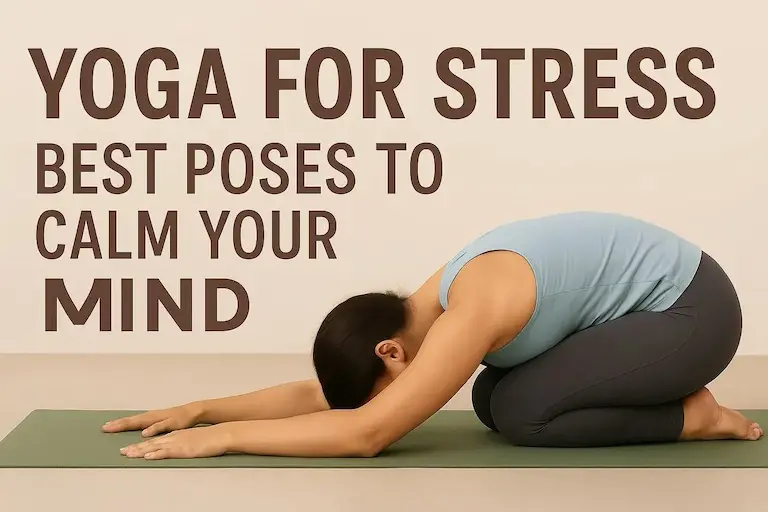
13. Child's Pose (Balasana)
Stretches: back, hips, thighs. Also a resting pose between harder stretches.
- Kneel with big toes together and knees apart (or together, whichever feels better).
- Sit your hips back toward your heels and fold forward.
- Rest your forehead on the mat or a block. Arms forward or alongside your body.
Hold: 1 to 2 minutes. Easier version: Put a rolled blanket between your hips and heels, or a pillow under your chest. Common mistake: Holding tension in the shoulders. Let them drop. Skip or modify if: Kneeling or deep knee bending hurts; try it with a cushion behind your knees or skip it.
Shoulders and chest
14. Puppy Pose (Uttana Shishosana)
Stretches: shoulders, upper back, chest
- From hands and knees, keep your hips over your knees.
- Walk your hands forward and lower your chest toward the floor.
- Rest your forehead (or chin) on the mat or a block. Keep your arms active.
Hold: 30 to 60 seconds. Easier version: Rest your forearms on a chair seat, or place hands on blocks. Common mistake: Letting the lower back sag deeply; keep a little belly support. Skip or modify if: You have a shoulder injury or pain lifting your arms overhead.
15. Thread the Needle
Stretches: back of the shoulder, upper back
- Start on hands and knees.
- Slide your right arm under your left arm, palm up, and lower your right shoulder and ear to the mat.
- Keep your hips over your knees. Left hand can stay planted or reach forward.
Hold: 30 to 60 seconds per side. Easier version: Place a folded blanket under the head and shoulder. Common mistake: Putting weight on your neck. Your shoulder takes the weight. Skip or modify if: You have neck pain. Keep your head on a cushion and the twist small.
For more stretches you can do at your desk, follow the 5-Minute Desk Stretch Routine or use our desk stretch timer. If getting to the floor is hard, chair yoga covers seated versions.
Two routines
Use a timer. Times include both sides where noted. If a pose doesn't work for you, swap in its easier version.
10-minute daily routine
Good for mornings, after a walk, or before bed. Covers hamstrings, hips, and back.
| # | Pose | Time |
|---|---|---|
| 1 | Cat-Cow | 1:00 |
| 2 | Downward-Facing Dog (pedal the feet) | 1:00 |
| 3 | Low Lunge | 0:45 per side (1:30) |
| 4 | Standing Forward Fold, knees soft | 1:00 |
| 5 | Figure Four Stretch | 0:45 per side (1:30) |
| 6 | Supine Hand-to-Foot with strap | 0:45 per side (1:30) |
| 7 | Supine Spinal Twist | 0:45 per side (1:30) |
| 8 | Child's Pose | 1:00 |
| Total | 10:00 |
20-minute deeper session
Do this two or three times a week, ideally after a walk or workout when you're already warm.
| # | Pose | Time |
|---|---|---|
| 1 | Cat-Cow | 1:00 |
| 2 | 3 slow Sun Salutations (knees down is fine) | 3:00 |
| 3 | Low Lunge | 1:00 per side (2:00) |
| 4 | Standing Forward Fold | 1:00 |
| 5 | Puppy Pose | 1:00 |
| 6 | Thread the Needle | 0:45 per side (1:30) |
| 7 | Sphinx Pose | 1:00 |
| 8 | Pigeon (supported) or Figure Four | 1:30 per side (3:00) |
| 9 | Head-to-Knee | 1:00 per side (2:00) |
| 10 | Bound Angle | 1:30 |
| 11 | Happy Baby | 1:00 |
| 12 | Supine Spinal Twist | 1:00 per side (2:00) |
| Total | 20:00 |
Want to rest afterward? Add a few minutes in Corpse Pose.
A simple 4-week plan
This plan is about building a habit and getting comfortable with the poses. It doesn't promise a specific result by the end, because that varies too much from person to person.
Week 1: Learn the poses. Do the 10-minute routine on 4 or 5 days. Use the easier versions. Hold each stretch about 30 seconds per side if 45 feels like too much. Take your first progress check (below) on day one.
Week 2: Build the habit. Do the 10-minute routine on 5 or more days. Add the 20-minute session once. Aim for 45-second holds.
Week 3: Add time. Do the 10-minute routine most days and the 20-minute session twice. Where a stretch feels easy, hold up to 60 seconds or do it twice. Try one progression (Lizard instead of Low Lunge, or Cobra after Sphinx) if it feels fine.
Week 4: Settle in and check. Keep the same schedule. At the end of the week, repeat your progress check under the same conditions as week 1.
After week 4, keep going. Regular practice is what keeps the gains, so pick a schedule you can actually stick to.
How to track your progress
Your own numbers are the only useful comparison. Pick one or two checks and do them the same way each time: same time of day, same clothes, after the same short warm-up (a few minutes of walking plus Cat-Cow).
- Sit-and-reach check (hamstrings and lower back): Sit on the floor with legs straight and the soles of your feet against a box or a wall-mounted stack of books. Lay a yardstick or tape measure on top, pointing toward you. Reach forward slowly with both hands, one on top of the other, without bouncing, and note where your fingertips reach. Take the best of two tries.
- Standing forward fold check: Fold forward with straight (not locked) knees and measure the distance from your fingertips to the floor, or note the landmark you reach (knee, mid-shin, ankle, floor).
- Side-by-side photos: Take a photo of Low Lunge or Figure Four from the same spot each time. Changes are often easier to see than to measure.
- How it feels: Write down one note, such as "hamstrings eased up in Down Dog after about 30 seconds" or "could rest my forehead on the block in Child's Pose." This is real progress even when the tape measure doesn't move.
Check every 2 to 4 weeks, not daily. Day-to-day results vary with sleep, activity, and time of day.
Tips that make the biggest difference
- Warm up first. A short walk, Cat-Cow, or a couple of Sun Salutations before deep holds.
- Breathe slowly and stay still. No bouncing.
- Use props. A strap, block, or blanket lets you stretch the right muscle without straining something else.
- Short and frequent wins. Ten minutes most days beats one long session a week.
- Balance stretching with strength. If you also want to build strength, see our guide to yoga poses for flexibility and strength.
- New to yoga? Start with our beginner yoga poses guide or browse the poses library. NCCIH notes that learning yoga without supervision has been associated with higher injury risk, so a few classes with a qualified teacher can help. You can find one in our US teacher directory.
Want a ready-made option? The 15-Minute Flexibility Routine for Hips and Hamstrings is a timed follow-along you can use instead.
This guide is general information, not medical advice. Read how we research and update articles in our editorial policy.
Sources
- Harvard Health Publishing. "The importance of stretching." https://www.health.harvard.edu/staying-healthy/the-importance-of-stretching
- Cleveland Clinic. "Dynamic vs. Static Stretching: Is One Better?" https://health.clevelandclinic.org/dynamic-stretching-vs-static-stretching
- National Center for Complementary and Integrative Health (NIH). "Yoga: Effectiveness and Safety." https://www.nccih.nih.gov/health/yoga-effectiveness-and-safety
- Ingram LA, Tomkinson GR, d'Unienville NMA, et al. "Mechanisms Underlying Range of Motion Improvements Following Acute and Chronic Static Stretching: A Systematic Review, Meta-analysis and Multivariate Meta-regression." Sports Medicine, 2025;55(6):1449–1466. https://pmc.ncbi.nlm.nih.gov/articles/PMC12152101/
- Warneke K, Thomas E, Blazevich AJ, et al. "Practical recommendations on stretching exercise: A Delphi consensus statement of international research experts." Journal of Sport and Health Science, 2025;14:101067. https://pmc.ncbi.nlm.nih.gov/articles/PMC12305623/
- Konrad A, Warneke K, Donti O, et al. "Detraining Effects Following Chronic Stretching Training on Range of Motion: A Systematic Review and Meta-Analysis." Sports Medicine – Open, 2025;11:141. https://pmc.ncbi.nlm.nih.gov/articles/PMC12638565/
- Luo X, Huang X. "The effects of a yoga intervention on balance and flexibility in female college students during COVID-19: A randomized controlled trial." PLoS ONE, 2023;18(3):e0282260. https://journals.plos.org/plosone/article?id=10.1371/journal.pone.0282260
Something wrong or unclear? Tell us.
Frequently asked questions


No comments yet. Be the first to comment!