

Beginner Yoga Poses and Their Benefits: 15 Poses With Steps, Hold Times, and Who Should Skip Each
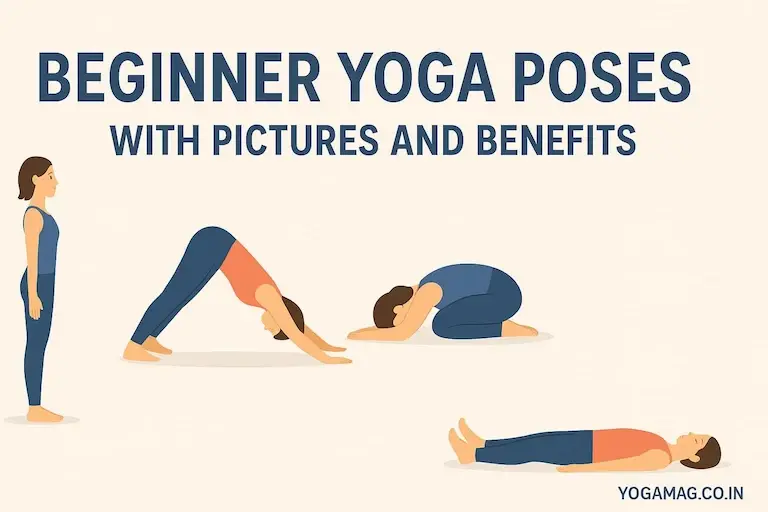
These are the 15 poses most beginner classes in the US are built on. For each one you'll find numbered steps, how long to hold it, an easier version, the most common mistakes, what it's actually good for, and when to skip it. A 15-minute routine at the end strings them together.
A note on "benefits": most poses do simple, physical things. They stretch some muscles and make others work. That's what the benefit lines below describe. Where we mention a health effect (stress, sleep, back pain), we link the research and keep the claim as modest as the evidence. Yoga is not a treatment for any condition.
Reviewed by the YogaMag editorial team against the sources listed below, in line with our editorial policy. This page has not been reviewed by a doctor or physical therapist.
Quick reference: 15 beginner yoga poses
| Pose | Sanskrit | What it's good for | Hold (beginner) | Skip or modify if |
|---|---|---|---|---|
| Mountain Pose | Tadasana | Learning standing alignment and posture awareness | 5 breaths | Dizzy when standing still: keep eyes open, stand near a wall |
| Tree Pose | Vrksasana | Balance practice, ankle and hip stability | 3–5 breaths per side | Balance problems: hold a wall or chair |
| Standing Forward Fold | Uttanasana | Stretching the backs of the legs | 3–5 breaths | Glaucoma, osteoporosis, recent back injury |
| Low Lunge | Anjaneyasana | Stretching the front of the hip | 3–5 breaths per side | Knee pain when kneeling: pad the knee or skip |
| Warrior I | Virabhadrasana I | Leg strength, hip-flexor stretch | 3–5 breaths per side | Knee or hip injury, shoulder pain with arms up |
| Warrior II | Virabhadrasana II | Leg strength and endurance | 3–5 breaths per side | Knee or hip injury |
| Triangle Pose | Utthita Trikonasana | Side-body and hamstring stretch | 3–5 breaths per side | Neck pain (keep gaze down), balance issues |
| Cat-Cow | Marjaryasana–Bitilasana | Gentle spine mobility, warm-up | 5–8 rounds | Wrist pain: use fists or forearms |
| Downward-Facing Dog | Adho Mukha Svanasana | Stretching calves and hamstrings, shoulder strength | 3–5 breaths | Glaucoma, uncontrolled high blood pressure, wrist or shoulder injury, late pregnancy |
| Child's Pose | Balasana | Resting between poses, gentle back stretch | 30–60 seconds | Knee injury, pregnancy (widen knees) |
| Cobra Pose | Bhujangasana | Gentle back strengthening and chest opening | 3 breaths, 2–3 times | Pregnancy, recent back or abdominal surgery |
| Bridge Pose | Setu Bandha Sarvangasana | Glute and hamstring strength | 3–5 breaths, 2–3 times | Neck injury |
| Seated Forward Fold | Paschimottanasana | Hamstring stretch, a calm way to end | 5–8 breaths | Osteoporosis, disk problems, sciatica flare |
| Supine Spinal Twist | Supta Matsyendrasana | Gentle rotation for the back and hips | 5–8 breaths per side | Osteoporosis, recent back injury, pregnancy |
| Corpse Pose | Savasana | Rest and relaxation at the end of practice | 3–5 minutes | Pregnancy after the first trimester: lie on your side |
"Breaths" means slow, comfortable breaths through the nose, about 4 to 6 seconds each. A strength or balance pose usually takes 3 to 5 of them.
Before you start
- Space and gear. A non-slip mat, clothes you can move in, and bare feet. A block, a strap, and a blanket are optional. Books, a belt, and a bath towel work too.
- Timing. Most people feel better practicing a couple of hours after a big meal.
- Pain rule. Stretching should feel like mild pulling. Sharp, pinching, or shooting pain means come out of the pose. Most yoga injuries come from pushing too hard (Cleveland Clinic).
- Breathe. If you notice you're holding your breath, back off until you can breathe smoothly.
- Check with your doctor first if you're pregnant, 65 or older, recovering from an injury or surgery, or managing a condition such as glaucoma, high blood pressure, osteoporosis, a disk problem, or balance issues. NCCIH lists knee or hip injuries, lumbar spine disease, severe high blood pressure, balance problems, and glaucoma as conditions that may call for modified poses (NCCIH). That doesn't rule out yoga. It means you should know which versions to use.
If you'd like a broader primer on etiquette, styles, and what a first class looks like, read our beginner's guide to yoga. Hatha classes are a good place to start, because they move slowly and teach these foundation poses (Cleveland Clinic). See our Hatha yoga overview.
Standing poses
1. Mountain Pose (Tadasana)
Mountain Pose is just standing, done on purpose. Most standing poses start here, so it's where you learn where your feet, pelvis, and shoulders should be.
How to do it
- Stand with your feet hip-width apart, toes pointing forward.
- Spread your toes and press evenly through the big toe, little toe, and heel.
- Firm your thigh muscles slightly without locking the knees.
- Let your tailbone point down so your lower back isn't over-arched.
- Lift your chest a little, roll your shoulders back and down, and let your arms hang with palms facing forward.
- Keep your chin level and imagine the crown of your head lifting.
Hold: 5 slow breaths.
Easier version: Stand with your back against a wall to feel where your head, shoulder blades, and hips line up.
Common mistakes: Locking the knees, sticking the ribs forward, and lifting the chin.
What it's good for: Mountain Pose teaches posture and body awareness, which carries over to every other standing pose. For a full breakdown, see our Mountain Pose guide.
Skip or modify if: You feel lightheaded when you stand still. Keep your eyes open and stand near a wall.
2. Tree Pose (Vrksasana)
Tree Pose is the first balance pose most people learn. Wobbling is normal and is part of how you practice balance.
How to do it
- Start in Mountain Pose and shift your weight onto your left foot.
- Turn your right knee out and place your right sole on your left ankle, calf, or inner thigh. Never place it on the side of the knee.
- Press the foot and leg into each other.
- Bring your palms together at your chest, or rest your hands on your hips.
- Fix your gaze on one point on the floor a few feet ahead.
- Lower the foot and switch sides.
Hold: 3–5 breaths per side.
Easier version: Keep your right toes on the floor with your heel resting on your left ankle, like a kickstand. Or rest a hand on a wall or chair.
Common mistakes: Pressing the foot into the side of the knee, letting the standing hip jut out to the side, and holding your breath.
What it's good for: Tree Pose gives you balance practice. NCCIH reports that in a review of studies in healthy people, 11 of 15 found yoga improved at least one balance measure (NCCIH).
Skip or modify if: You have balance problems or a history of falls. Practice next to a wall or behind a sturdy chair every time.
3. Standing Forward Fold (Uttanasana)
How to do it
- Stand in Mountain Pose with your hands on your hips.
- Bend your knees generously and hinge forward from the hips, keeping your back long.
- Let your hands rest on blocks, shins, or the floor.
- Let your head hang heavy.
- To come up, bend your knees, bring your hands to your hips, and rise with a flat back.
Hold: 3–5 breaths.
Easier version: Keep your knees bent as much as you need and rest your hands on blocks or a chair seat.
Common mistakes: Locking the knees and rounding hard from the upper back to reach the floor, or standing up too fast.
What it's good for: It stretches the hamstrings and calves.
Skip or modify if:
- You have glaucoma or high eye pressure. Head-down poses raise eye pressure quickly. In a 2015 study, Downward Dog raised pressure the most of four common poses and Standing Forward Fold was second. Pressure returned to baseline within about two minutes of sitting up (Jasien et al., PLoS ONE). Ask your eye doctor before doing head-down poses.
- You have osteoporosis or osteopenia. Forward bending carries a slightly increased risk of spinal fracture (UPMC HealthBeat). Skip it or ask a teacher about a hip-hinge version with a flat back.
- You have a recent back injury. Skip it.
- You get dizzy. Come up slowly.
4. Low Lunge (Anjaneyasana)
How to do it
- From hands and knees, step your right foot forward between your hands.
- Line up your right knee above your ankle.
- Slide your left knee back until you feel a stretch in the front of your left hip.
- Keep your hands on blocks, or bring them to your front thigh and lift your chest.
- Switch sides.
Hold: 3–5 breaths per side.
Easier version: Pad the back knee with a folded blanket, and keep your hands on blocks.
Common mistakes: Letting the front knee move far past the toes and sinking into the lower back.
What it's good for: It stretches the hip flexors, the muscles at the front of the hip that get tight from long hours of sitting.
Skip or modify if: Kneeling hurts your knee. Use thick padding, or do the lunge standing with the back knee lifted and your hands on a chair.
5. Warrior I (Virabhadrasana I)
How to do it
- From Mountain Pose, step your left foot back about 3 to 4 feet.
- Turn your back foot out about 45 degrees and press the outer edge down.
- Bend your front knee toward a right angle, keeping it over the ankle.
- Square your hips toward the front as much as is comfortable.
- Reach your arms overhead, shoulder-width apart, with shoulders relaxed away from the ears.
- Switch sides.
Hold: 3–5 breaths per side.
Easier version: Shorten your stance, keep your hands on your hips, and bend the front knee less.
Common mistakes: Letting the front knee collapse inward, lifting the back heel, and crunching the shoulders up.
What it's good for: It strengthens the legs and stretches the hip flexors of the back leg. Our glossary lists it as intermediate because the hip position takes practice. The short-stance version works well for beginners.
Skip or modify if: You have a knee or hip injury. If raising your arms hurts your shoulder, keep your hands on your hips.
6. Warrior II (Virabhadrasana II)
How to do it
- Stand with your feet about 4 feet apart, facing the long side of the mat.
- Turn your right foot to point toward the front of the mat. Turn your left toes in slightly.
- Bend your right knee toward a right angle, keeping it over the ankle and pointing toward your second toe.
- Reach your arms out at shoulder height, palms down.
- Look over your right fingertips.
- Switch sides.
Hold: 3–5 breaths per side.
Easier version: Bend the front knee less, or rest your hands on your hips.
Common mistakes: Letting the knee drift inward and leaning the torso over the front leg.
What it's good for: It builds strength and endurance in the legs and shoulders.
Skip or modify if: You have a knee or hip injury. Make the stance shorter and the bend shallower.
7. Triangle Pose (Utthita Trikonasana)
How to do it
- Set up your feet as for Warrior II, but keep both legs straight with soft knees.
- Reach your right arm forward over your right leg, then lower your right hand to your shin or to a block.
- Reach your left arm up toward the ceiling.
- Keep both sides of your waist long.
- Look down or straight ahead. Look up only if your neck is comfortable.
- Switch sides.
Hold: 3–5 breaths per side.
Easier version: Rest your bottom hand on a block, and keep your top hand on your hip.
Common mistakes: Collapsing the lower side of the waist to reach the floor, and locking the front knee.
What it's good for: It stretches the hamstrings, inner thighs, and the side of the body, and teaches you to stay steady with a wide stance.
Skip or modify if: You have neck pain (keep your gaze down) or balance issues (practice with your back body near a wall).
Floor poses on hands and knees
8. Cat-Cow (Marjaryasana–Bitilasana)
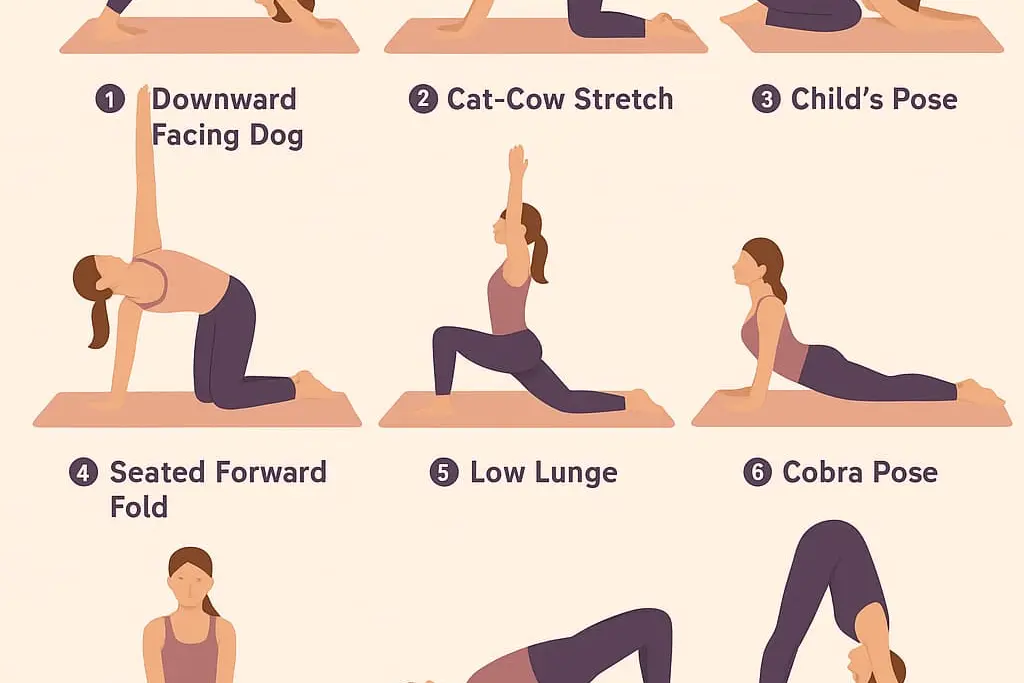
Cat-Cow is the warm-up most beginner classes use. You move slowly between rounding and arching your spine, one breath per movement. To set up, start in Tabletop.
How to do it
- Come to hands and knees with wrists under shoulders and knees under hips.
- Inhale (Cow): let your belly lower, lift your chest and tailbone, and look slightly forward.
- Exhale (Cat): round your spine toward the ceiling, tuck your chin, and press the floor away.
- Move slowly with your breath.
Hold: 5–8 slow rounds.
Easier version: If your wrists hurt, come onto your fists or forearms. Pad sore knees with a blanket. You can also do it seated in a chair with your hands on your knees.
Common mistakes: Rushing the movement, and cranking the neck back in Cow.
What it's good for: It moves the spine gently through bending and arching, which makes it a good warm-up. If you'd like more for the back, see our back care sequence.
Skip or modify if: Your wrists or knees hurt (use the chair version). If you have osteoporosis, keep the Cat rounding small or skip it.
9. Downward-Facing Dog (Adho Mukha Svanasana)
Downward Dog is one of the best-known poses in yoga, but it isn't easy for beginners. It puts weight on the wrists and shoulders, and tight hamstrings make it hard to straighten the back. Bend your knees as much as you need.
How to do it
- Start on hands and knees with your hands slightly ahead of your shoulders.
- Spread your fingers and press through your whole hand, especially the base of the index finger.
- Tuck your toes and lift your hips up and back.
- Keep your knees bent so your back stays long. Straightening your legs is optional.
- Let your heels reach toward the floor. They don't need to touch it.
- Relax your neck and let your head hang between your upper arms.
Hold: 3–5 breaths. Rest in Child's Pose afterward.
Easier version: Put your hands on a wall or the back of a sturdy chair and walk your feet back until your body forms an L. Use Puppy Pose as a gentler option on the floor.
Common mistakes: Locking the knees and rounding the back, sinking into the shoulders, and putting all the weight on the heels of the hands.
What it's good for: It stretches the calves and hamstrings and builds strength in the shoulders and arms.
Skip or modify if:
- You have glaucoma. This pose produced the largest jump in eye pressure of the four poses tested in a 2015 study, from about 17 to 28 mmHg on average. The pressure came back down within about two minutes. The authors couldn't say whether it harms people with glaucoma (Jasien et al.). Use the wall version and ask your eye doctor.
- You have uncontrolled high blood pressure, wrist pain, carpal tunnel, or a shoulder injury. Use the wall version.
- You're in late pregnancy. Check with your provider (NCCIH).
10. Child's Pose (Balasana)
Child's Pose is a resting pose you can go back to at any point. Taking it during practice is a normal part of class.
How to do it
- Kneel with your big toes touching. Keep your knees together or let them spread wide.
- Sit your hips back toward your heels.
- Fold forward and rest your forehead on the floor, a block, or your stacked fists.
- Stretch your arms forward or rest them alongside your body.
- Breathe into your back.
Hold: 30–60 seconds, or as long as you like as a rest.
Easier version: Put a rolled blanket between your thighs and calves if your hips don't reach your heels, and a pillow or bolster under your chest.
Common mistakes: Forcing the hips down when the knees complain, and squeezing the forehead into the mat.
What it's good for: It gently stretches the hips, thighs, and lower back, and gives you a place to slow your breathing.
Skip or modify if: You have a knee injury. Try lying on your back with knees to chest instead (see Knee to Chest). If you're pregnant, take your knees wide so there's room for the belly.
Poses lying face down and face up
11. Cobra Pose (Bhujangasana)
How to do it
- Lie on your stomach with your legs hip-width apart and the tops of your feet on the mat.
- Place your hands under your shoulders and hug your elbows toward your ribs.
- Press your hips and the tops of your feet down.
- Inhale and lift your chest a few inches, using your back muscles more than your arms.
- Keep your neck long and your gaze slightly forward and down.
- Exhale and lower.
Hold: 3 breaths, then lower. Repeat 2–3 times.
Easier version: Sphinx Pose. Rest on your forearms with your elbows under your shoulders.
Common mistakes: Pushing up as high as possible with straight arms and shrugging the shoulders. The goal is a gentle backbend.
What it's good for: It strengthens the muscles along the spine and stretches the chest and the front of the shoulders.
Skip or modify if: You're pregnant. Pregnancy calls for an evaluation by your provider and modified poses (NCCIH), and lying on the belly isn't practical. Also skip it after recent back or abdominal surgery. If you have a back condition where arching causes pain, stay in a low Sphinx or skip it.
12. Bridge Pose (Setu Bandha Sarvangasana)
How to do it
- Lie on your back with your knees bent and feet flat, hip-width apart, close enough that your fingertips can brush your heels.
- Rest your arms alongside your body, palms down.
- Press through your feet and lift your hips.
- Keep your knees pointing forward, not falling out or in.
- Keep your head still. Don't turn it while you're in the pose.
- Lower slowly, one section of the spine at a time.
Hold: 3–5 breaths, then lower. Repeat 2–3 times.
Easier version: Supported Bridge. Slide a block under your sacrum (the flat bone at the base of your spine) and rest on it.
Common mistakes: Letting the knees splay out, pushing the hips so high that the lower back pinches, and turning the head.
What it's good for: It strengthens the glutes and hamstrings and stretches the front of the hips and chest.
Skip or modify if: You have a neck injury. Use the low supported version or skip it.
13. Seated Forward Fold (Paschimottanasana)
How to do it
- Sit with your legs straight in front of you (see Staff Pose). If your lower back rounds, sit on a folded blanket.
- Bend your knees as much as you need.
- Inhale and sit tall.
- Exhale and hinge forward from your hips, leading with your chest.
- Hold your shins or feet, or a strap looped around your feet.
- Stop where your back starts to round a lot.
Hold: 5–8 breaths.
Easier version: Sit on a blanket, keep your knees bent, and use a strap.
Common mistakes: Pulling hard with the arms to get the head to the knees, and rounding the lower back.
What it's good for: It stretches the hamstrings and back of the body, and it's a calm way to wind down near the end of practice.
Skip or modify if: You have osteoporosis or osteopenia, because rounded forward bends carry a slightly higher fracture risk (UPMC HealthBeat). Also skip it if you have a disk problem or a sciatica flare-up, unless your clinician or a qualified teacher has shown you a safe version.
14. Supine Spinal Twist (Supta Matsyendrasana)
How to do it
- Lie on your back with your knees bent and feet flat.
- Stretch your arms out to the sides at shoulder height.
- Shift your hips an inch to the left, then let both knees lower to the right.
- Keep both shoulders heavy on the mat.
- Turn your head to the left only if your neck is comfortable.
- Bring your knees back to center and switch sides.
Hold: 5–8 breaths per side.
Easier version: Put a pillow or block under your knees so they don't drop all the way.
Common mistakes: Forcing the knees to the floor and lifting the opposite shoulder.
What it's good for: It gently rotates the spine and stretches the outer hips and lower back.
Skip or modify if: You have osteoporosis (UPMC notes twisting carries a slightly increased fracture risk), a recent back injury, or a disk problem. If you're pregnant, do it only with your provider's OK, because lying flat on your back for long periods isn't advised (NCCIH).
15. Corpse Pose (Savasana)
Savasana looks like a nap but it's the last pose in nearly every class. Your job is to lie still and let your breathing settle.
How to do it
- Lie on your back with your legs a little apart and your arms a few inches from your sides, palms up.
- Put a rolled blanket under your knees if your lower back feels tight.
- Close your eyes.
- Let your breathing return to normal.
- Each time your mind wanders, bring it back to the feeling of your body on the floor. A short body scan helps.
- To come out, roll onto your right side, pause, and press up to sitting.
Hold: 3–5 minutes.
Easier version: Support your knees and head with blankets, or lie on your side with a pillow between your knees.
Common mistakes: Skipping it, and sitting up quickly.
What it's good for: It gives you a few minutes to rest after moving. More generally, Cleveland Clinic notes that yoga can activate a relaxation response that counters chronic stress (Cleveland Clinic). Several studies have found that yoga helps with sleep (NCCIH). For an evening version, see Yoga for Better Sleep: 7 Poses Before Bed.
Skip or modify if: You're pregnant, especially after the first trimester. Lie on your left side instead of your back (NCCIH).
What the research says about yoga's benefits
The benefits above are mostly what each pose stretches or strengthens. For whole yoga practice, here's what research summaries from US health organizations support.
- Stress. A 2020 review summarized by NCCIH found beneficial effects on perceived stress in all of the studies it included (NCCIH).
- Anxiety and mood. Yoga reduced anxiety symptoms in a 2019 review, although NCCIH notes there's little evidence of benefit for people with diagnosed anxiety disorders. It "can be a helpful addition to treatment for depression," not a replacement for it (NCCIH).
- Sleep. Multiple studies have found yoga helpful for sleep (NCCIH).
- Balance. Most studies in healthy people show improvement in at least one balance measure, and newer studies support benefits for older adults living at home (NCCIH).
- Low back and neck pain. For low back pain the evidence shows a slight benefit, about the same as other exercise. A review of neck pain studies found reduced pain and better range of motion (NCCIH).
- Strength and flexibility. In a small study of sedentary adults who practiced at least twice a week for eight weeks, muscle strength, endurance, flexibility, and cardiorespiratory fitness all improved (Harvard Health).
Results depend on how often you practice and what kind of yoga you do. Yoga doesn't replace medical care for any condition.
A 15-minute beginner yoga routine
This sequence uses the poses above in an order that warms you up first and ends lying down. Go slowly. If you only have 5 minutes, do steps 1, 2, and 10. That's roughly the "two-pose" routine (Mountain Pose and Cat-Cow) many beginners start with, plus a short rest.
| Step | Pose | Time |
|---|---|---|
| 1 | Mountain Pose, with slow breathing | 1 minute |
| 2 | Cat-Cow | 8 slow rounds (about 1 minute) |
| 3 | Downward-Facing Dog (knees bent) → Child's Pose | 5 breaths, then 30 seconds |
| 4 | Low Lunge | 5 breaths per side (about 1 minute) |
| 5 | Warrior II → Triangle (same side, then switch) | 5 breaths each, both sides (about 3 minutes) |
| 6 | Tree Pose (near a wall) | 5 breaths per side (about 1 minute) |
| 7 | Cobra or Sphinx | 3 rounds of 3 breaths (about 1 minute) |
| 8 | Bridge Pose | 3 rounds of 5 breaths (about 1.5 minutes) |
| 9 | Supine Spinal Twist | 5–8 breaths per side (about 1.5 minutes) |
| 10 | Corpse Pose | 3–5 minutes |
Once this feels familiar, add Warrior I after the Low Lunge, or swap in a Seated Forward Fold before the twist. For more structured follow-ups, try our Quick 10-Minute Flow, the Morning Flow, or the Three-Part Breath for a simple breathing exercise. All poses are collected in the poses library. If you're building a daily habit, What to Expect in Your First 30 Days covers what tends to change and what doesn't.
Want a timer to follow? The 10-Minute Full-Body Morning Routine uses many of these poses, and our free 28-Day Beginner Yoga Plan builds from 5 minutes a day to 20, with a timer for every session. Or use the Routine Finder to pick one for the time you have.
Sources
- National Center for Complementary and Integrative Health (NIH). "Yoga: Effectiveness and Safety." https://www.nccih.nih.gov/health/yoga-effectiveness-and-safety
- Harvard Health Publishing. "Yoga – Benefits Beyond the Mat." https://www.health.harvard.edu/staying-healthy/yoga-benefits-beyond-the-mat
- Cleveland Clinic Health Essentials. "The Benefits of Yoga and How To Find the Perfect Style for You." https://health.clevelandclinic.org/how-to-find-the-best-yoga-class-for-you
- Jasien JV, Jonas JB, de Moraes CG, Ritch R. "Intraocular Pressure Rise in Subjects with and without Glaucoma during Four Common Yoga Positions." PLoS ONE, 2015. https://pmc.ncbi.nlm.nih.gov/articles/PMC4689525/
- UPMC HealthBeat. "What to Know About Yoga and Osteoporosis." https://share.upmc.com/2021/07/osteoporosis-and-yoga/
Read how we research and update articles in our editorial policy.
Want new practices by email?
We email now and then when we publish a new routine, practice or guide. No spam, unsubscribe any time.
Join the YogaMag newsletterFrequently Asked Questions
Popular posts
Related posts




No comments yet. Be the first to comment!