

Yoga for Lower Back Pain and Sciatica: Gentle Poses, What to Avoid, and When to See a Doctor
Lower back pain is common, and many people try yoga for it. That makes sense: US physician guidelines list yoga as one of the non-drug options for chronic low back pain. But the evidence also shows that the benefits are modest, that some poses can make things worse, and that sciatica (nerve pain down the leg) needs a more careful approach than ordinary back stiffness.
This guide covers what the research actually says, the warning signs that mean you should see a doctor before doing any of this, a gentle sequence for general lower back pain, a separate set of options for sciatica, the poses to avoid or modify, and a simple 10-minute routine you can build on over four to six weeks.
This page is general information, not a diagnosis or a treatment plan. If you are unsure what is causing your pain, a physician or physical therapist is the right first stop.
Reviewed by the YogaMag editorial team against the sources listed below, in line with our editorial policy. This page has not been reviewed by a doctor or physical therapist.
See a doctor first, or get urgent care
Call 911 or go to the emergency room now if you have back pain or sciatica together with any of these:
- Loss of control of your bladder or bowels, or trouble starting to urinate (new for you)
- Numbness around your genitals, inner thighs or buttocks (the "saddle" area)
- Weakness or numbness in both legs, or leg weakness that is severe or getting worse
- Sciatica in both legs at the same time
These can be signs of cauda equina syndrome, a rare problem in which the nerves at the base of the spine are compressed. OrthoInfo (AAOS) calls it "a medical emergency that requires immediate attention." Ask someone else to drive you rather than driving yourself.
Contact your doctor right away (before starting yoga) if you have back pain with:
- Fever you can't explain
- Pain after a severe blow, fall, or other injury
- A history of cancer
- Weight loss you didn't intend
- Pain that is worse when you lie down, or that wakes you at night
- Severe pain that won't let you get comfortable
- Redness or swelling on your back or spine
- Burning with urination or blood in your urine
- Pain traveling down your leg below the knee, or weakness or numbness in your buttock, thigh, leg or pelvis
- Steroid use or injected drug use
- Pain that feels different and worse than past episodes, or that has lasted longer than four weeks
Sources: MedlinePlus (acute low back pain; sciatica), NIAMS, OrthoInfo (AAOS), NHS. The emergency tier is adapted for US readers from OrthoInfo (AAOS) and the NHS sciatica page; MedlinePlus lists the whole set under "contact your provider right away".
What the evidence says, honestly
For chronic low back pain (12 weeks or longer), yoga is a reasonable option. In its 2017 guideline, the American College of Physicians (ACP) recommends that people with chronic low back pain start with non-drug treatments. Yoga is on that list, alongside exercise, tai chi, mindfulness-based stress reduction, physical therapy-style approaches and others. The ACP rated the evidence behind yoga as low quality, while general exercise had moderate-quality evidence. (ACP guideline)
The benefits are real but modest. A 2017 Cochrane review found that, in trials comparing yoga with no exercise (9 trials, 810 people):
- Compared with no exercise, yoga produced small to moderate improvements in back-related function at three to four months and at six months.
- Pain improved slightly. The improvement did not reach the 15-point (out of 100) change the authors had set in advance as clinically important.
- People doing yoga were somewhat more likely to report a side effect, mostly a temporary increase in back pain. Yoga was not associated with serious adverse events.
NCCIH (part of the NIH) summarizes more recent reviews the same way: a 2022 review found yoga "slightly better than no exercise, but the small difference may not be important to patients," and a 2020 federal (AHRQ) report found yoga improved pain and function in the short term, with effects similar to exercise and massage.
What that means for you: yoga is one sensible way to stay active with a sore back, roughly comparable to other exercise. It is not a cure, and it is unlikely to work dramatically on its own. Choose it if you enjoy it and will do it regularly.
For new (acute) back pain, the advice is different. The ACP guideline for acute and subacute back pain (under 12 weeks) recommends superficial heat first, with massage, acupuncture or spinal manipulation as options. Yoga is not specifically listed for this stage. What the NIH's arthritis and musculoskeletal institute (NIAMS) does recommend is to avoid bed rest, "limit activities or exercise that cause pain," and "gradually increase physical activity as tolerated." Gentle movement like the floor poses below fits that advice; a vigorous class does not.
Lower back pain vs. sciatica: why the difference matters
General (non-specific) lower back pain is pain, stiffness or aching in the lower back itself. It often comes from muscles, joints and soft tissues, and most episodes improve with time and staying active.
Sciatica is a symptom, not a diagnosis. It is pain, numbness, tingling or weakness that travels from the lower back or buttock down the back of one leg, caused by pressure on or irritation of the sciatic nerve or the nerve roots that form it. The pain can feel burning or like an electric shock, and it is often worse with coughing, sneezing, sitting or bending. A herniated (slipped) disk is a common cause; others include spinal stenosis (narrowing of the spinal canal), spondylolisthesis and, less often, piriformis syndrome. (MedlinePlus, Cleveland Clinic, OrthoInfo)
The cause changes which movements feel better:
- With a herniated disk, bending forward with a rounded back tends to increase pressure on the disk and often aggravates symptoms. Gentle back-bending (like Sphinx) is often better tolerated.
- With spinal stenosis, the opposite can be true: bending backward narrows the spinal canal and may feel worse, while gentle forward bending may ease symptoms. (Spine-health)
This is why there is no single "sciatica sequence" that suits everyone, and why a diagnosis from a clinician is worth getting if symptoms persist.
A simple rule while practicing: if a pose makes pain, tingling or numbness travel further down your leg, stop and back out. A physical therapist quoted by Yoga International describes symptoms that move back up toward the lower back as a better sign than symptoms that spread down the leg (Yoga International).
Before you start: how to practice safely
- Talk to your doctor first if you have ongoing back pain, as Harvard Health advises, and tell any yoga teacher about your pain and limits.
- Go slowly into each pose. Harvard Health notes most problems happen when people "drop" quickly into a pose instead of easing in.
- Mild stretch is fine; sharp, shooting, or spreading pain is not. Stop any pose that causes it.
- Avoid combining twisting with back-bending, which Harvard Health says can compress the joints of the spine.
- Use props. A blanket, block, strap and a sturdy chair make most of these poses gentler.
- Breathe slowly through your nose throughout. If you are holding your breath, ease off. Three-part breath is a calm way to start.
If you would like a timed, follow-along routine for stiff days, our routine finder lists gentle ones you can do in bed or in a chair. It is not a diagnostic tool and does not replace an exam.
Gentle sequence for general lower back pain (8 poses)
The photos on this page are AI-generated illustrations. We checked each one against the written steps.
This sequence stays mostly on the floor, avoids deep forward folds and keeps twists small. It takes about 15 to 20 minutes. Cleveland Clinic's list of physical therapy examples for back and nerve pain includes several of these shapes (bridging, cat-cow, knee-to-chest and a gentle lying-down back extension). If you have leg symptoms, read the sciatica section first.
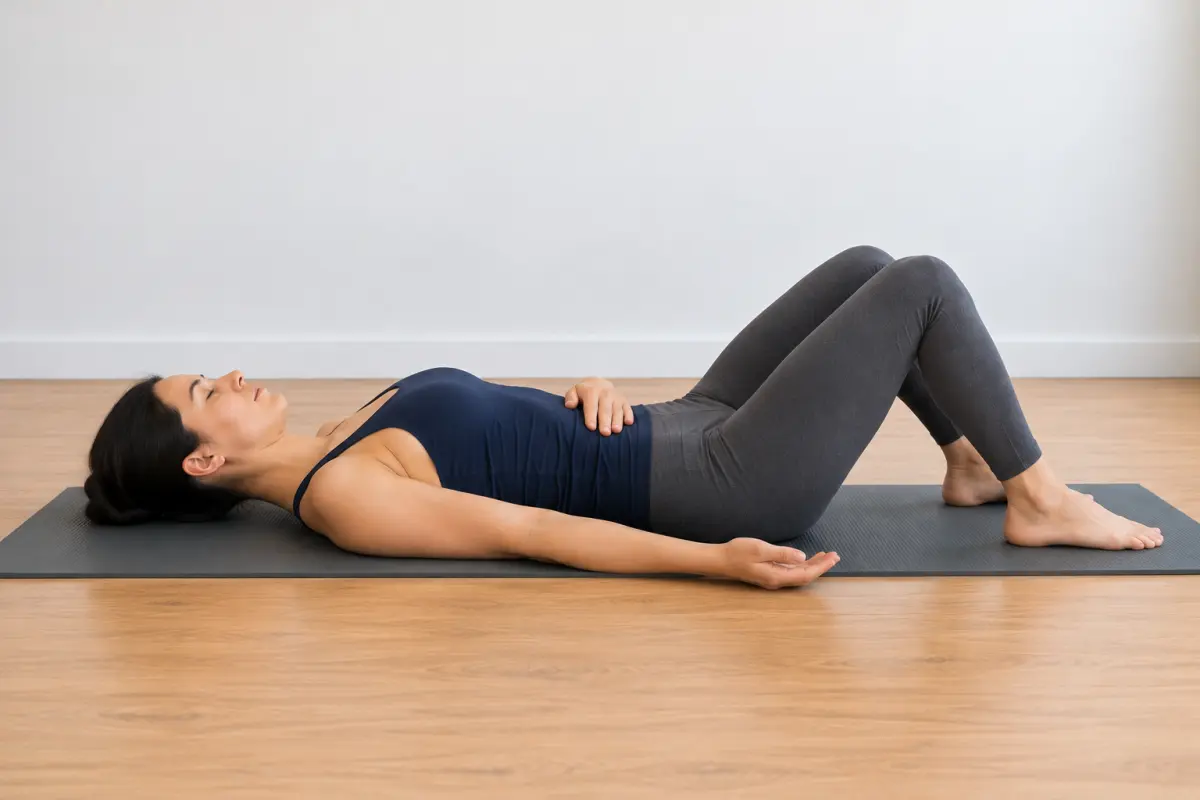
1. Constructive rest with belly breathing
Link: Constructive Rest
- Lie on your back on a mat or rug, knees bent, feet flat and hip-width apart.
- Let your knees rest toward each other so your legs don't have to work.
- Place one hand on your belly. Rest your arms by your sides.
- Breath: Slow breaths through the nose; let the belly rise on the inhale and fall on the exhale.
- Hold: 1 to 2 minutes.
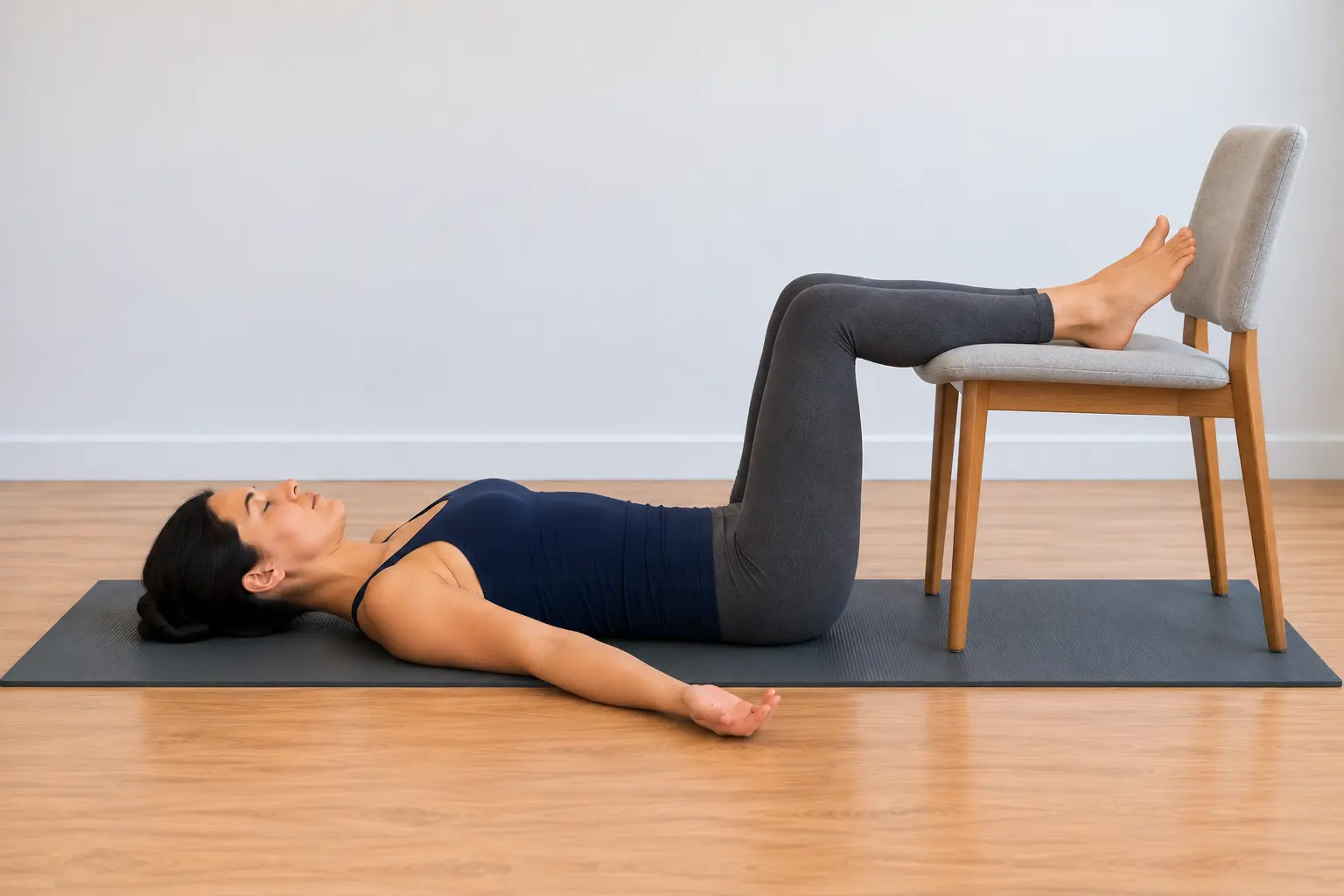
- Easier option: Put a folded blanket under your head, or rest your calves on a chair seat (Legs on Chair).
- Stop if: Lying on your back increases pain. Try lying on your side with a pillow between your knees.
2. Pelvic tilts
- From constructive rest, exhale and gently press your lower back toward the floor, tilting your pubic bone up slightly.
- Inhale and let your lower back return to its natural small curve.
- Keep the movement small; your hips stay on the floor.
- Breath: Exhale to flatten, inhale to release.
- Reps: 8 to 10 slow repetitions.
- Easier option: Make the movement smaller.
- Stop if: You feel sharp or leg pain.

Top: the lower back in its natural curve. Bottom: gently flattened toward the mat. The difference is small.
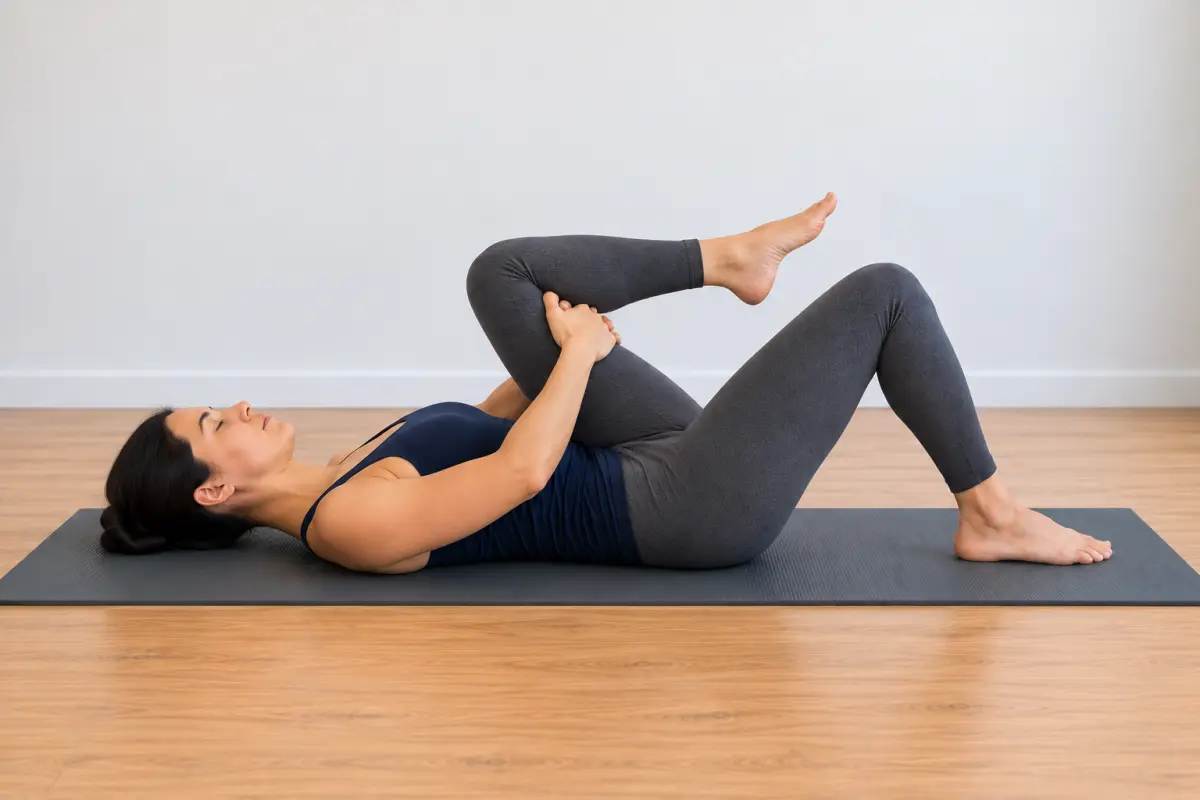
3. Single knee to chest
Link: Knee to Chest, Wind-Relieving Pose
- Lying on your back, knees bent, draw one knee toward your chest.
- Hold behind the thigh (not on top of the knee).
- Keep the other foot on the floor, knee bent.
- Switch sides.
- Breath: Slow, even breaths.
- Hold: 20 to 30 seconds per side, 2 rounds.
- Easier option: Loop a strap or towel behind your thigh if you can't reach comfortably.
- Stop if: Pain increases or spreads into your leg. Hugging both knees at once rounds the lower back more; start with one.
4. Cat-cow (small range)
Link: Cat-Cow
- Come onto hands and knees, wrists under shoulders, knees under hips (Tabletop).
- Inhale: gently lift the chest and tailbone, letting the belly drop a little (cow).
- Exhale: gently round your back, drawing the belly in (cat).
- Move slowly, staying in a comfortable range.
- Breath: Inhale into cow, exhale into cat.
- Reps: 6 to 8 slow rounds.
- Easier option: Do it seated on a chair, hands on knees. Pad your knees with a folded blanket.
- Stop if: Rounding or arching either way sends pain down your leg. Some people do better staying near the middle.
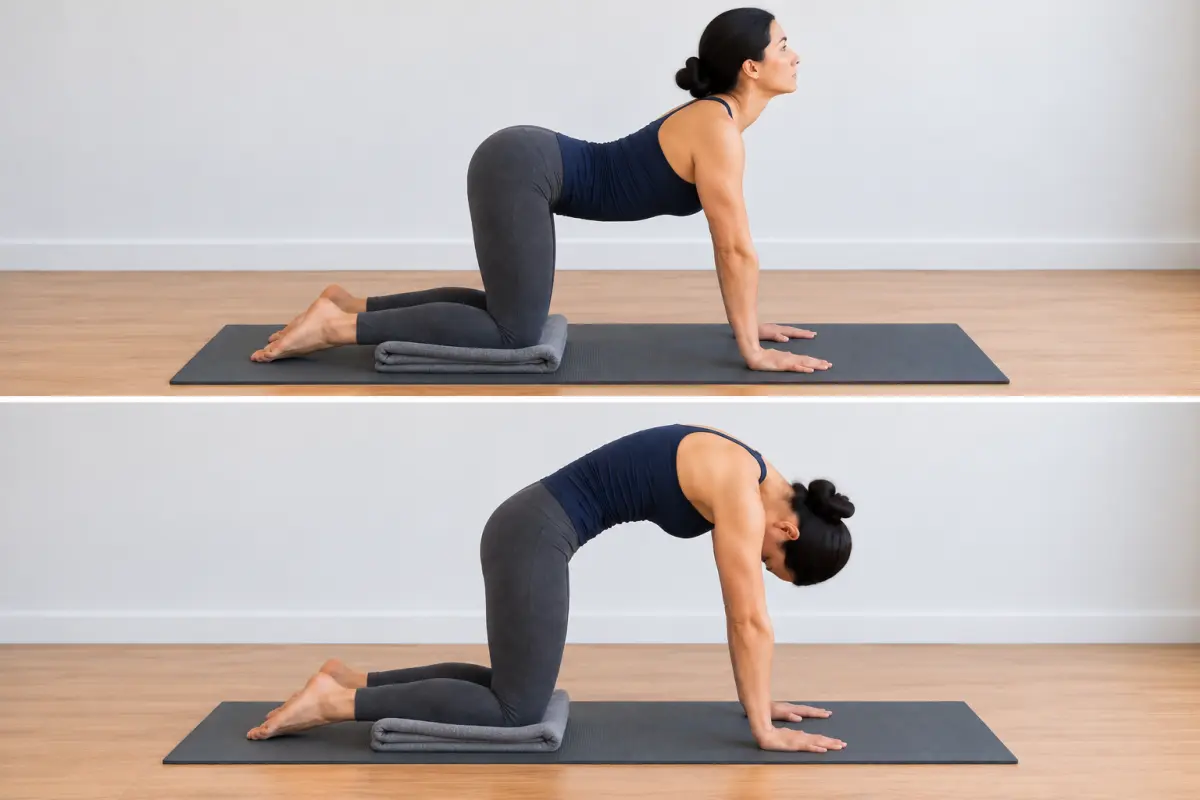
Top: a gentle arch. Bottom: a gentle round. Keep the range small.
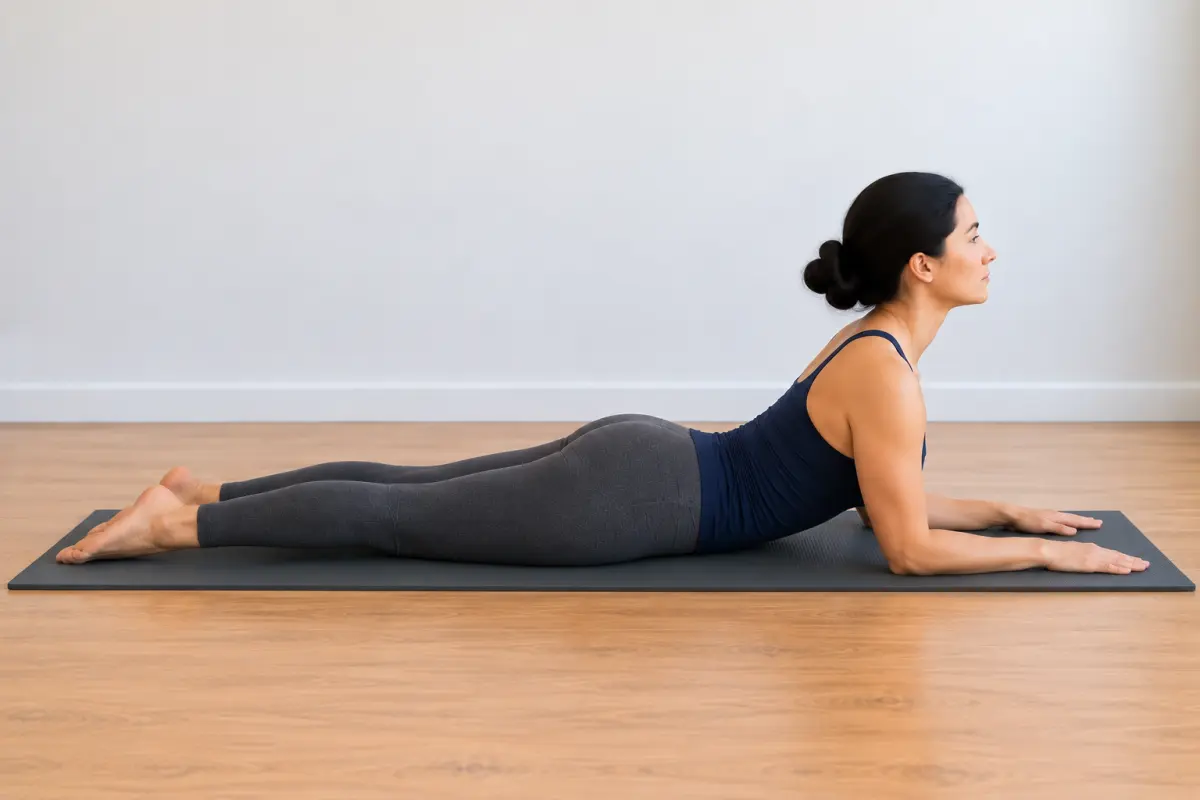
5. Sphinx
Link: Sphinx Pose
- Lie on your belly, legs hip-width apart.
- Place your elbows under your shoulders, forearms on the floor.
- Gently press into your forearms to lift your chest a little. Keep your buttocks relaxed.
- Breath: Slow breaths into the back of your ribs.
- Hold: 20 to 30 seconds; repeat 2 to 3 times.
- Easier option: Place a folded blanket under your chest and keep the lift very low, or just lie on your belly with your head on your hands.
- Stop if: You feel pinching in the lower back or symptoms in your leg. Skip if you've been told you have spinal stenosis or spondylolisthesis, unless your clinician has OK'd back-bending.
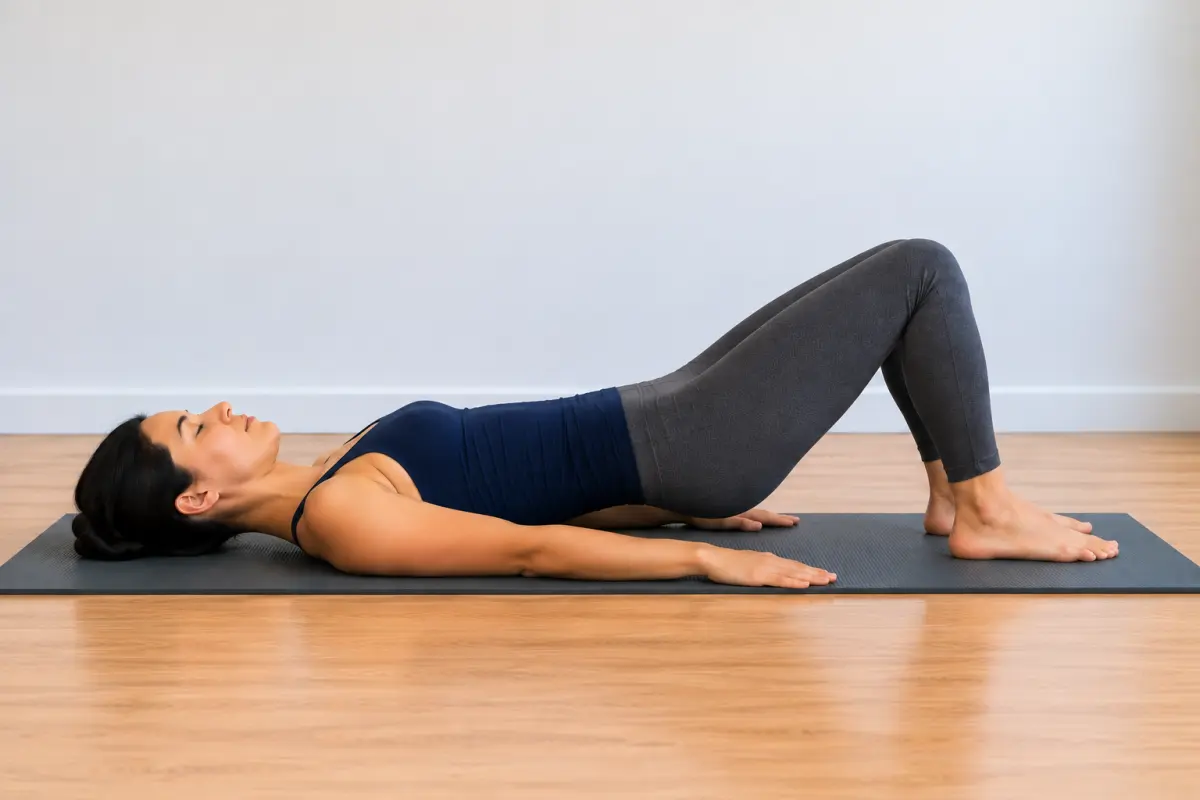
6. Bridge
Link: Bridge Pose, Supported Bridge
- Lie on your back, knees bent, feet flat and hip-width apart, arms by your sides.
- Press your feet into the floor and lift your hips a few inches.
- Lower slowly, one section of the spine at a time.
- Breath: Exhale to lift, inhale to lower.
- Reps: 6 to 8 lifts, or hold 3 to 5 breaths at the top.
- Easier option: Lift only an inch or two, or rest your sacrum on a block for supported bridge.
- Stop if: You feel pain in the lower back or cramping in the hamstrings.
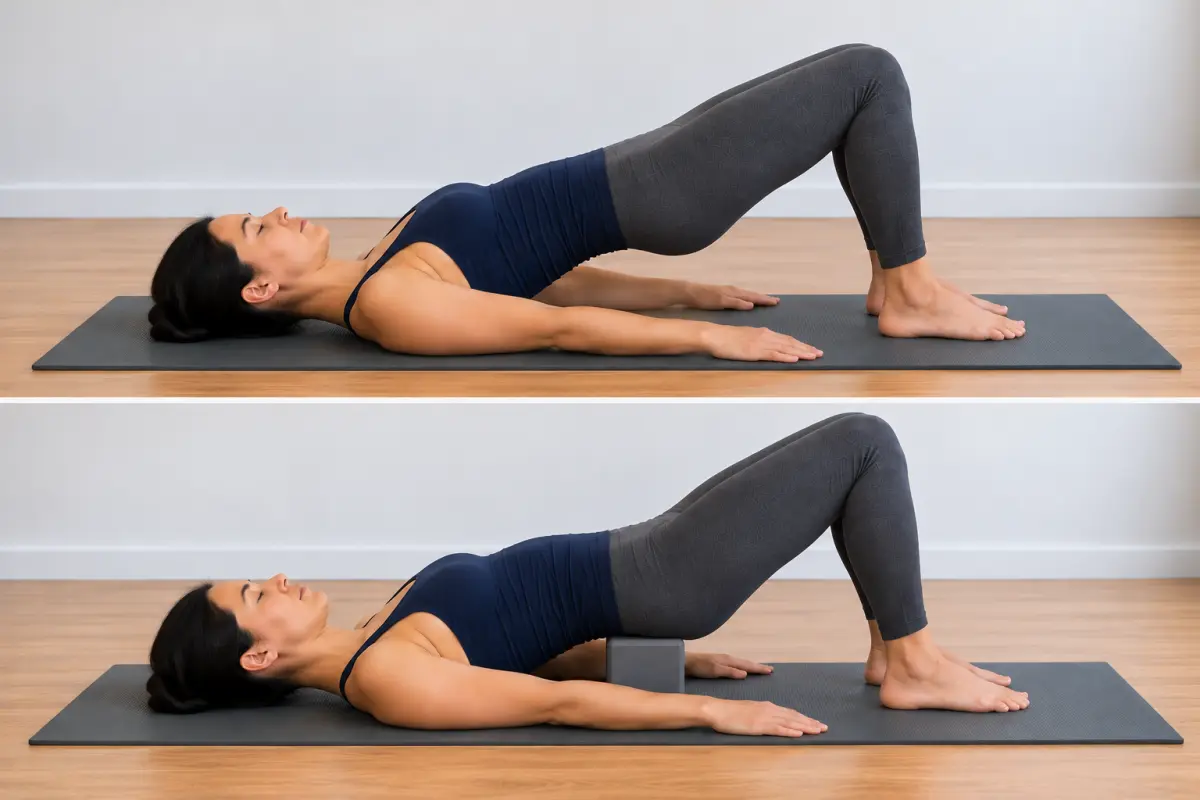
Top: the bridge. Bottom: the same bridge with a block under the hips.
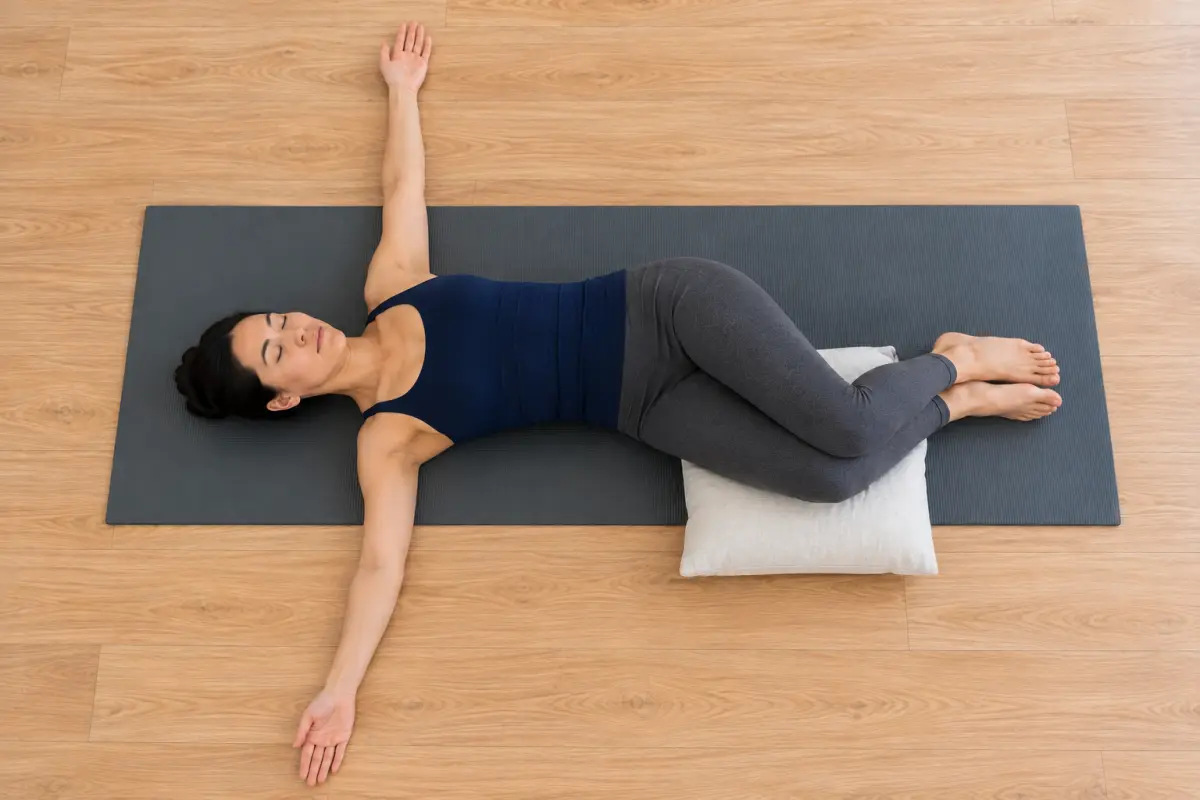
7. Reclined twist (gentle)
Link: Supine Spinal Twist
- Lie on your back with knees bent, feet flat, arms out to the sides.
- Slowly let both knees lower a short way to one side. Keep both shoulders on the floor.
- Bring the knees back to center, then go to the other side.
- Breath: Slow, even breaths.
- Hold: 3 to 5 breaths per side, or move side to side slowly 5 times.
- Easier option: Place a pillow or block under the knees so they don't drop far.
- Stop if: Twisting brings on pain. MedlinePlus advises against heavy lifting or twisting of the back for the first six weeks after sciatica starts, so skip this pose if you have leg symptoms.
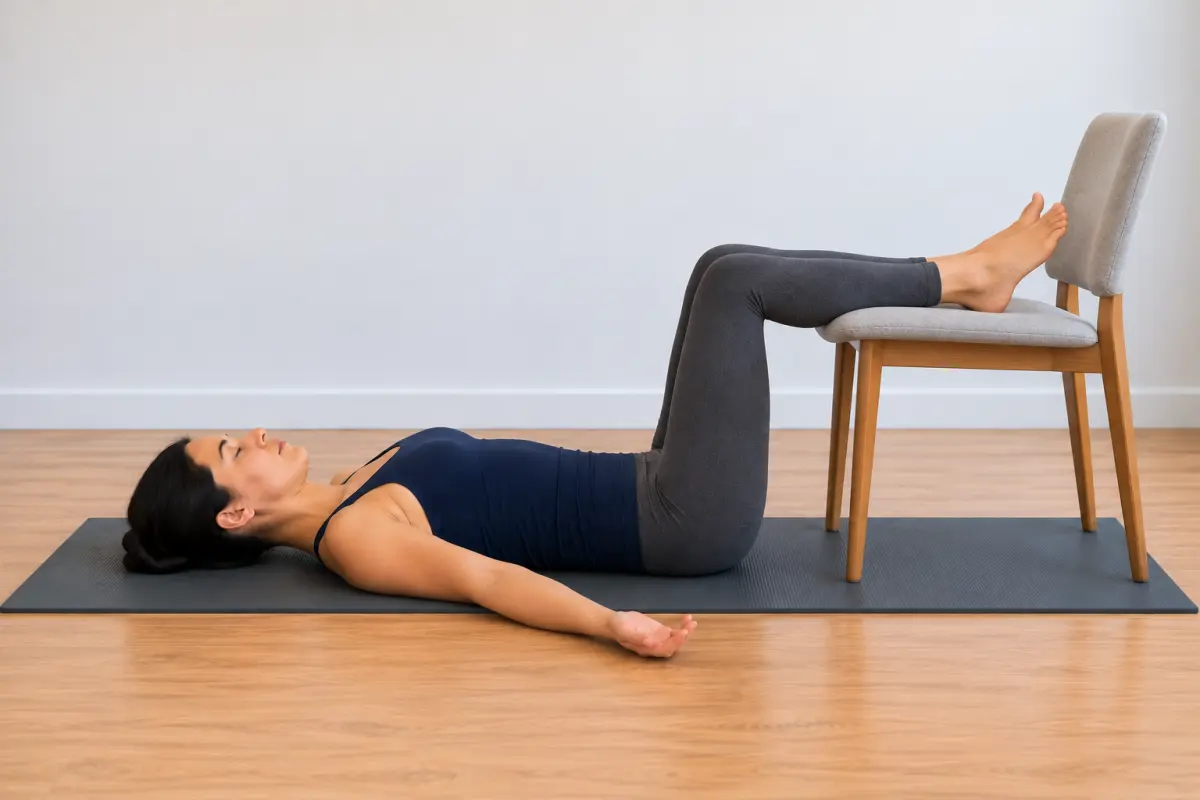
8. Supported rest
Link: Legs on Chair, Child's Pose
- Lie on your back with your calves resting on a chair seat, knees and hips at roughly right angles.
- Let your arms rest by your sides.
- Breath: Easy, natural breathing.
- Hold: 2 to 5 minutes.
- Easier option: Use a stack of pillows or a couch instead of a chair.
- Alternative: If it feels good for you, Child's Pose with a pillow under your chest and knees wide is another resting shape. It is a forward-bending pose, so skip it if forward bending aggravates your symptoms.
Sciatica-friendly options (5 poses)
If you have sciatica, start here instead of the full sequence above. These options keep your spine close to neutral, avoid stretching the nerve hard, and leave out twisting and deep forward folds. Cleveland Clinic recommends gentle movement and stretching, not too much rest, and not pushing through pain. MedlinePlus says bed rest is not recommended for sciatica.
Remember the rule: symptoms spreading further down the leg means stop. If your sciatica is from spinal stenosis, back-bending poses may not suit you; check with your clinician.
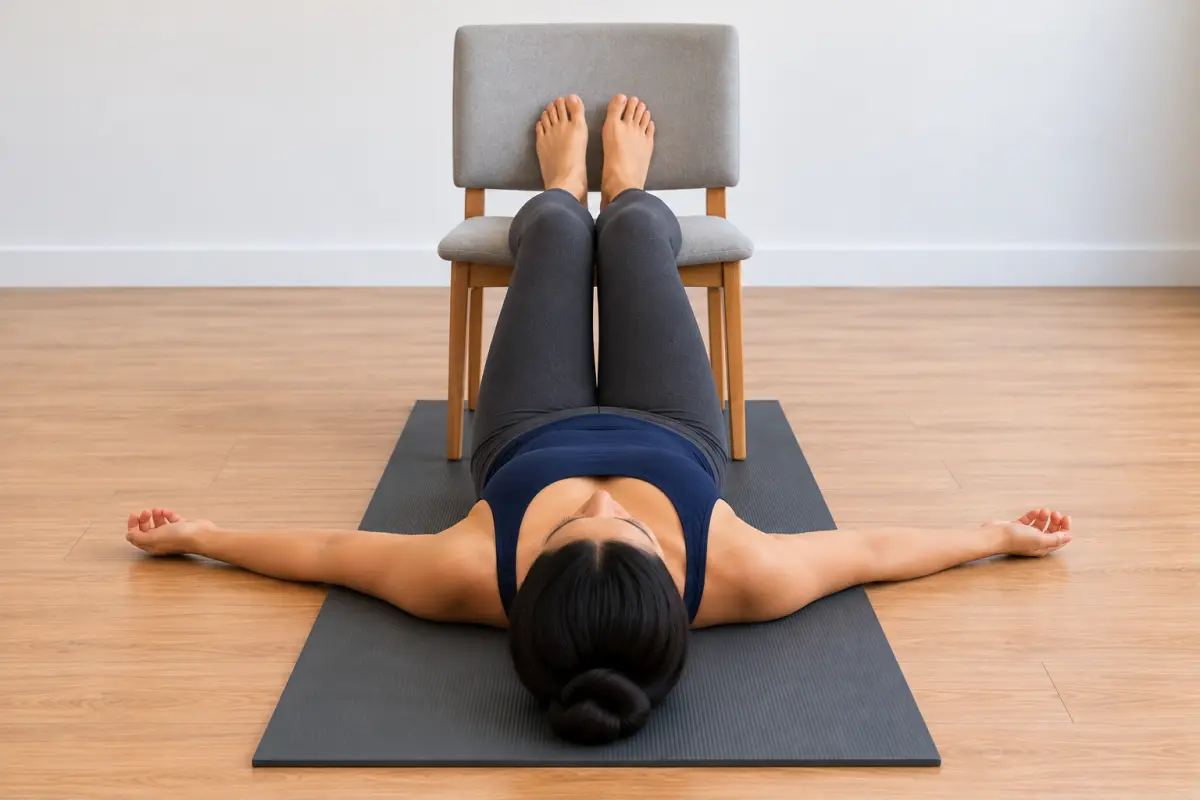
1. Supported rest on a chair (90/90)
Link: Legs on Chair
- Lie on your back and rest your calves on a chair seat so your hips and knees are bent to about 90 degrees.
- Place a thin pillow under your head if needed.
- Breath: Slow belly breathing, longer exhale than inhale.
- Hold: 3 to 5 minutes.
- Easier option: Lie on your less painful side with a pillow between your knees.
- Stop if: Leg symptoms increase.
2. Pelvic tilts (very small)
- Lying on your back, knees bent, gently flatten and release your lower back as described above.
- Keep the range tiny, almost just a change in pressure.
- Breath: Exhale to flatten, inhale to release.
- Reps: 8 to 10.
- Easier option: Do it with calves on a chair.
- Stop if: Leg pain increases.
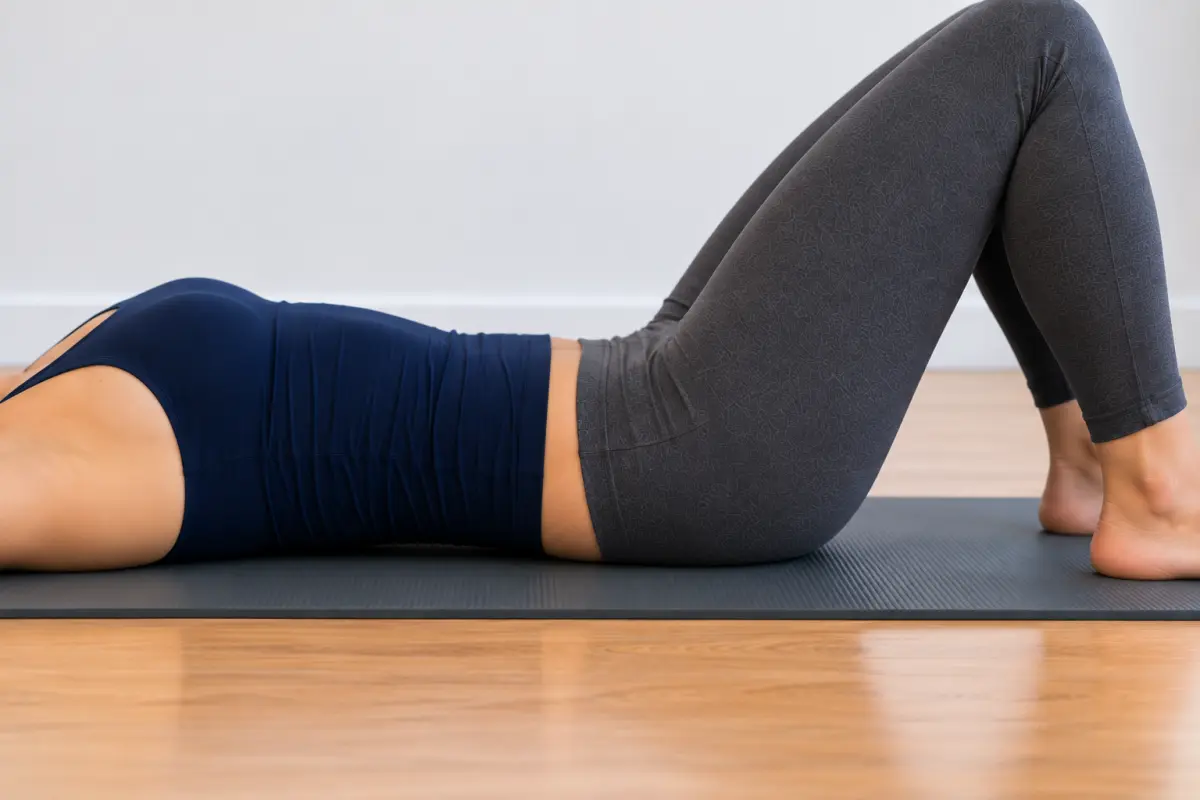
A very small tilt, seen from the side.
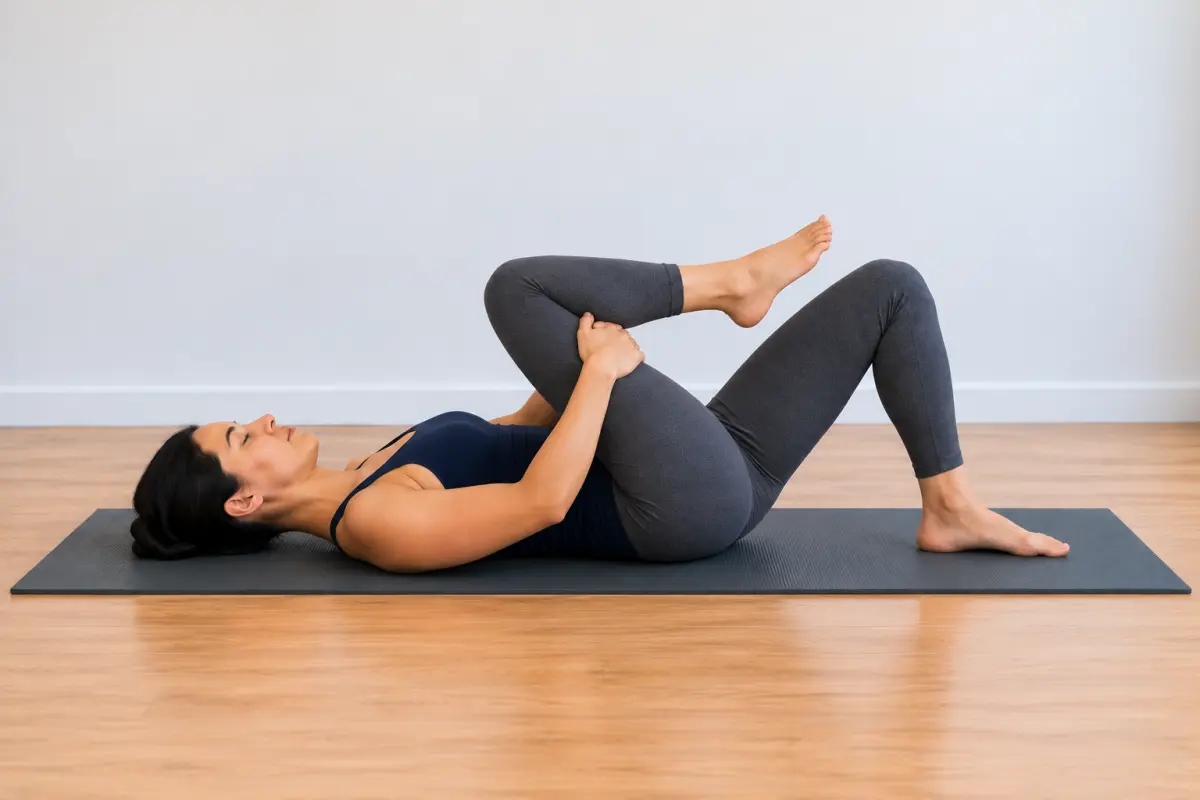
3. Single knee to chest (bent knee only)
Link: Knee to Chest
- On your back, gently draw your less painful leg's knee toward your chest, holding behind the thigh.
- If that feels fine, try the other side.
- Keep the knee bent. Don't straighten the leg into a hamstring stretch.
- Breath: Slow and even.
- Hold: 15 to 30 seconds, 2 rounds each side.
- Easier option: Use a strap behind the thigh and only bring the knee partway.
- Stop if: Symptoms travel down the leg.
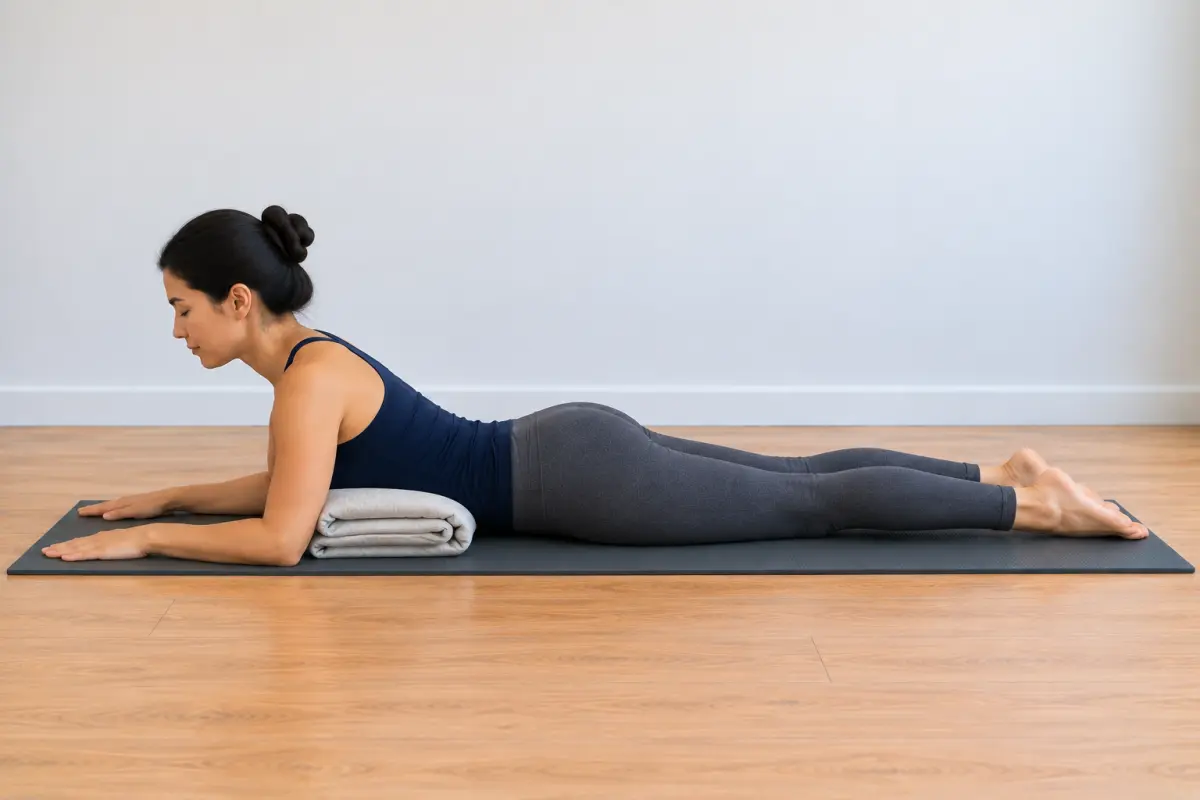
4. Sphinx (if back-bending eases your symptoms)
Link: Sphinx Pose
- Lie on your belly for a minute first. If that is comfortable, come up onto your forearms.
- Keep the lift low and your buttocks relaxed.
- Lower down after a few breaths.
- Breath: Slow and steady.
- Hold: 10 to 30 seconds, repeat 3 to 5 times.
- Easier option: Stay lying on your belly with a pillow under your chest.
- Stop if: Leg symptoms spread or you feel pinching. Skip entirely if you have spinal stenosis unless cleared by your clinician.
Why this one: extension shapes such as Sphinx are often tolerated by people with disk-related sciatica, and Cleveland Clinic lists a lying-down lower back extension among PT examples. But Spine-health notes back extension can worsen stenosis-related symptoms.
5. Small-range bridge
Link: Bridge Pose
- On your back, knees bent, feet hip-width apart.
- Lift your hips just an inch or two, then lower slowly.
- Breath: Exhale up, inhale down.
- Reps: 5 to 8.
- Easier option: Just press your feet into the floor without lifting.
- Stop if: Pain increases. Yoga International's physical therapist source suggests some people with active sciatica do better skipping bridge for a while, because strong buttock contraction can irritate symptoms.
Poses to avoid or modify
Most of these are not "bad" poses. They are just risky while your back or nerve is irritated. Some can return later with a clinician's or teacher's guidance.
| Pose or movement | Why to be careful | Try instead |
|---|---|---|
| Seated Forward Fold, Head to Knee with a rounded back | Forward bending with a rounded spine increases pressure on the disk and can push disk material toward the nerve (Spine-health). | Staff Pose with a tall spine, sitting on a folded blanket (Yoga International). |
| Standing Forward Fold, Ragdoll, toe touches | Same rounded-spine loading, plus the effort of coming back up. Harvard Health suggests doing forward bends seated rather than standing and bracing the belly when coming up. | Hinge forward only partway with hands on thighs or a chair and a flat back. |
| Straight-leg hamstring stretches (e.g. Supine Hand to Foot with a straight leg) | These place direct tension on an irritated sciatic nerve (Spine-health). | Keep the knee bent, or skip until leg symptoms settle (Yoga International). |
| Sit-ups, crunches, Boat Pose | Can push disk material toward the back of the spine where the nerve is (Spine-health). | Pelvic tilts. |
| Deep backbends: Camel, Wheel, Bow, full Cobra | Extension narrows the spinal canal and can worsen stenosis-related symptoms (Spine-health). Yoga International lists bow as one to avoid with severe sciatica. | Low Sphinx, only if it eases symptoms. |
| Deep twists: Revolved Triangle, Revolved Chair, twisting while bending back | Twisting creates uneven pressure across disks (Spine-health). Harvard Health warns against combining twisting and extending. MedlinePlus advises no twisting of the back for six weeks after sciatica starts. | Small reclined twist with knees supported, once leg symptoms are gone. |
| Fast or jumping flows (e.g. vigorous Sun Salutation) | High-impact movement repeatedly loads the spine (Spine-health). Moving quickly into poses is a common cause of yoga back problems (Harvard Health). | Slow, floor-based practice. |
| Plow and Shoulderstand | Inverted poses that put weight on the neck and bend the spine deeply. NCCIH advises beginners to avoid extreme practices such as headstands. | Supported rest with legs on a chair. |
A 10-minute daily routine
Choose this for days when you just want to keep moving. If you have sciatica, swap in the sciatica-friendly versions (bent-knee only, very small ranges, skip the twist).
| Minutes | What to do |
|---|---|
| 0:00–1:30 | Constructive rest with slow belly breathing |
| 1:30–2:30 | Pelvic tilts, 8 to 10 slow reps |
| 2:30–3:30 | Single knee to chest, 2 × 20 seconds each side |
| 3:30–5:00 | Cat-cow, 6 slow rounds, then rest in tabletop |
| 5:00–6:00 | Sphinx, 2 × 20 seconds (skip if extension bothers you) |
| 6:00–7:30 | Bridge, 6 slow lifts |
| 7:30–8:30 | Gentle reclined twist, 3 breaths each side (skip with sciatica) |
| 8:30–10:00 | Rest with legs on a chair |
If you would like a timer to follow, see our gentle timed routines.
How to progress over 4 to 6 weeks
NIAMS advises to "gradually increase physical activity as tolerated," and to avoid bed rest. The plan below is one practical way to do that. It is a starting framework, not a prescription. A physical therapist can adjust it to you.
- Weeks 1–2: Settle in. Do the 10-minute routine most days. Keep every movement small. Notice which poses feel good and which don't, and drop the ones that don't. Pair it with short walks if walking is comfortable.
- Weeks 3–4: Lengthen holds slightly. If the routine feels easy and symptoms are stable or improving, add a few breaths to each hold and do the full 8-pose sequence two or three times a week.
- Weeks 5–6: Build strength gently. Add a few more bridge reps. If you want to join a class, choose a gentle, slow-paced one and tell the teacher about your back. Our directory of US yoga teachers can help you find one.
Signs to slow down: pain that stays worse the next day, symptoms spreading down the leg, or new numbness or weakness. Go back a step, and check with your clinician if it doesn't settle.
Signs you're on track: you move more easily day to day, flare-ups are shorter, and any leg symptoms are staying closer to your back or fading.
When yoga isn't enough: who to see
Yoga is one tool. Get a professional opinion if:
- Pain has lasted longer than four weeks, or this episode feels different and worse than before (MedlinePlus).
- Sciatica isn't improving after a few weeks, or is getting worse (Cleveland Clinic).
- You have any warning sign from the box at the top of this page.
- Pain keeps stopping you from working, sleeping or doing everyday things.
Who can help:
- Primary care physician: the right first stop for a new or changing problem. They can check for causes that need different treatment, and discuss medicines, heat and other options in the ACP guideline.
- Physical therapist: for an exercise plan matched to your diagnosis and how your symptoms respond to movement. OrthoInfo lists physical therapy with exercises to strengthen the lower back and abdominal muscles as part of nonsurgical care for a herniated disk.
- Specialists (such as a physiatrist, orthopedic spine surgeon or neurosurgeon): usually by referral if symptoms persist or there are nerve problems such as weakness.
For short glossary summaries, see Lower Back Pain Relief, Sciatica Relief and our Back Care Sequence. Read how we research and write health content in our editorial policy.
Sources
- Qaseem A, Wilt TJ, McLean RM, Forciea MA; Clinical Guidelines Committee of the American College of Physicians. Noninvasive Treatments for Acute, Subacute, and Chronic Low Back Pain: A Clinical Practice Guideline From the American College of Physicians. Ann Intern Med. 2017;166(7):514-530. https://pubmed.ncbi.nlm.nih.gov/28192789/ (also https://www.acpjournals.org/doi/10.7326/M16-2367)
- Wieland LS, Skoetz N, Pilkington K, Vempati R, D'Adamo CR, Berman BM. Yoga treatment for chronic non-specific low back pain. Cochrane Database Syst Rev. 2017;1:CD010671. https://www.cochranelibrary.com/cdsr/doi/10.1002/14651858.CD010671.pub2/full
- National Center for Complementary and Integrative Health (NCCIH). Yoga: What You Need To Know (updated August 2023). https://www.nccih.nih.gov/health/yoga-what-you-need-to-know
- NCCIH. Low-Back Pain and Complementary Health Approaches: What You Need To Know (updated January 2020). https://www.nccih.nih.gov/health/low-back-pain-and-complementary-health-approaches-what-you-need-to-know
- National Institute of Arthritis and Musculoskeletal and Skin Diseases (NIAMS). Back Pain. https://www.niams.nih.gov/health-topics/back-pain
- NIAMS. Back Pain: Diagnosis, Treatment, and Steps to Take. https://www.niams.nih.gov/health-topics/back-pain/diagnosis-treatment-and-steps-to-take
- MedlinePlus Medical Encyclopedia. Low back pain – acute (reviewed June 27, 2026). https://medlineplus.gov/ency/article/007425.htm
- MedlinePlus Medical Encyclopedia. Sciatica (reviewed August 27, 2024). https://medlineplus.gov/ency/article/000686.htm
- American Academy of Orthopaedic Surgeons, OrthoInfo. Herniated Disk in the Lower Back. https://www.orthoinfo.org/en/diseases--conditions/herniated-disk-in-the-lower-back/
- Cleveland Clinic. Sciatica. https://my.clevelandclinic.org/health/diseases/12792-sciatica
- NHS (UK). Sciatica. https://www.nhs.uk/conditions/sciatica/
- Harvard Health Publishing. The safe way to do yoga for back pain (April 2021). https://www.health.harvard.edu/healthy-aging-and-longevity/the-safe-way-to-do-yoga-for-back-pain
- Cole A (physiatrist). Avoid These 7 Exercises If You Have Sciatica. Spine-health. https://www.spine-health.com/blog/avoid-these-7-exercises-if-you-have-sciatica
- Burke A, with physical therapist Bill Reif. Yoga and Sciatica: Do's and Don'ts to Consider. Yoga International. https://yogainternational.com/article/view/yoga-and-sciatica-dos-and-donts-to-consider/
Want new practices by email?
We email now and then when we publish a new routine, practice or guide. No spam, unsubscribe any time.
Join the YogaMag newsletterFrequently Asked Questions
Popular posts
Related posts




No comments yet. Be the first to comment!