

Hatha vs. Vinyasa Yoga: Pace, Intensity, Calories, and Which to Try
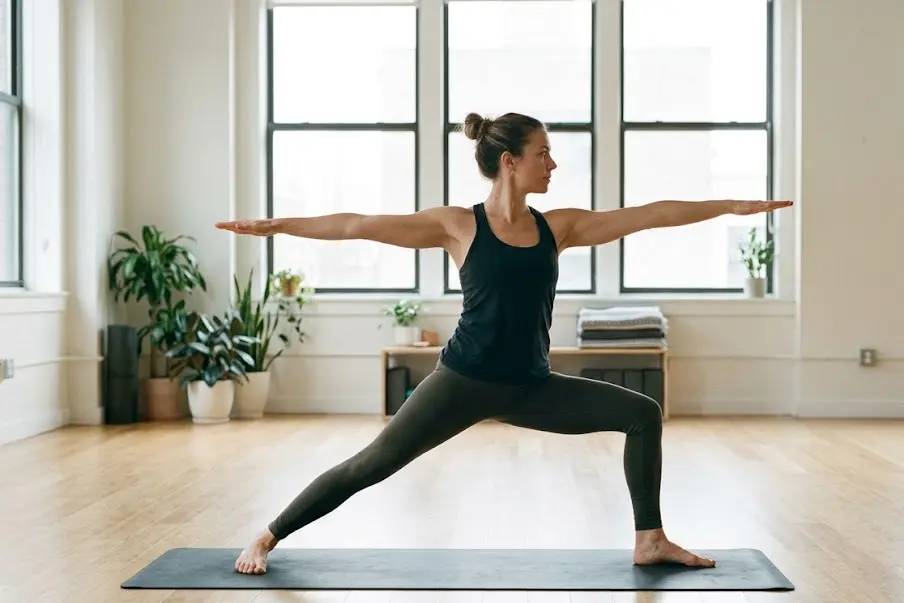
Hatha and vinyasa are two of the most common class labels on US yoga schedules, and they overlap more than the names suggest. Both use postures, breathing, and usually a final rest. Many of the poses are the same. What changes is the pace: a hatha class stops in each pose, and a vinyasa class keeps moving. That one difference affects how hard the class feels, how much time you get to learn each pose, and how many calories you use. This guide compares the two side by side, summarizes what research shows about their intensity, and gives you a short sequence for each.
Quick answer
- Hatha holds each pose "for several breaths," with detailed instruction. Cleveland Clinic calls it "excellent for beginners" (Cleveland Clinic).
- Vinyasa links poses with the breath, repeats sequences, and holds each pose briefly (Cleveland Clinic).
- Vinyasa is a little more intense. The 2024 Compendium rates hatha at 2.3 METs and vinyasa at 2.7, about 160 vs. 190 calories an hour for a 155-pound person (Compendium).
- Choose hatha to learn poses and alignment at a steady pace. Choose vinyasa if you want continuous movement and a higher heart rate.
- You don't have to choose. Many people do both.
A note on the names
"Hatha" has two meanings. Cleveland Clinic explains: "Technically, Hatha is a catchall term for any physical yoga that includes postures and breathwork. In the West, Hatha yoga is its own style" (Cleveland Clinic). So in the broad sense, vinyasa is a type of hatha yoga. In this article, "hatha" means what you'll find on a US class schedule: a slower, general class.
Vinyasa is also an umbrella. Ashtanga yoga is a vinyasa-based practice with a fixed sequence, and power yoga is a more athletic flow with no set postures (Cleveland Clinic). A class called "vinyasa" or "flow" usually means the teacher builds the sequence, and it can range from slow to very fast.
For each style on its own, see our full hatha yoga guide and vinyasa yoga guide.
Hatha and vinyasa side by side
| Hatha | Vinyasa (flow) | |
|---|---|---|
| Intent | Learn and hold poses; "strengthening, relaxation and flexibility" (Cleveland Clinic) | Continuous movement linked to the breath; "a moving meditation" (Cleveland Clinic) |
| Pace | Steady, with pauses between poses | "Quick flow from one pose to the next" (same source) |
| Hold times | "Several breaths" per pose (same source) | "Brief hold of each pose," often one breath per movement (same source) |
| Sequencing | A mix of standing and seated poses with detailed instruction (same source) | "Repeated sequences of poses," often built around sun salutations (same source) |
| Props | Optional blocks or straps can make poses "more comfortable" (Cleveland Clinic) | Used less often, since you move through poses quickly; varies by teacher |
| Intensity | Light. A lab study measured about 2.5 METs (Hagins et al., 2007); the 2024 Compendium lists 2.3 | Light to moderate. The Compendium lists 2.7; one lab study measured about 3.6 METs (Sherman et al., 2017, as reported by Grabara, 2025) |
| Typical class | Breathing exercises, then postures, then a resting period in corpse pose (Harvard Health) | A warm-up, repeated flowing sequences, standing poses, a cool-down on the floor, and a final rest |
| Who it's often recommended for | Beginners (Cleveland Clinic) | "Experienced students who want a more dynamic class"; beginners can try "slow flow" (Cleveland Clinic) |
What they share: both use the same core postures, such as downward dog, warrior II, and triangle pose, and both pay attention to breathing. Cleveland Clinic notes that all styles "share the mind-body-breathe connection" (Cleveland Clinic).
How hard is each one?
This is where the two styles differ most, and where there's useful research. Exercise intensity is often measured in METs (metabolic equivalents). Light activity is under 3.0 METs, and moderate activity is 3.0 to 6.0 (Grabara, 2025).
Hatha is usually light intensity. In a 2007 study, 20 experienced practitioners did 56 minutes of beginner-level hatha yoga from a video inside a room that measured their oxygen use. The session averaged 2.5 METs and about 49% of predicted maximum heart rate, similar to walking on a treadmill at about 2 mph. The authors concluded it didn't meet recommendations for improving cardiovascular fitness, but that sun salutations done for more than 10 minutes "may contribute some portion" of the activity needed (Hagins et al., 2007). A 2025 study of 26 adults around age 70 also found a hatha session was "predominantly below the moderate level," though participants spent some minutes in the moderate range (Grabara, 2025).
Vinyasa can reach moderate intensity. A University of Pittsburgh study measured a 60-minute vinyasa session in adults with prior yoga experience. It averaged 3.6 METs, just into the moderate range (Sherman et al., 2017, as summarized in Grabara, 2025). The same research group later described vinyasa as "a mode of moderate-intensity physical activity" (Thrower et al., 2023).
Real classes vary a lot. In a 2023 study of community-style classes, 21 adults aged 19 to 74 wore heart rate monitors during roughly hour-long hatha and vinyasa classes, at room temperature and heated. In the room-temperature classes, participants spent about 41% of the vinyasa class and about 25% of the hatha class in a moderate or higher heart rate zone. The researchers found no statistically significant differences between class types, and everyone reached moderate intensity for at least part of a class (Dysart and Harden, 2023). It was a small study, but it's a useful reminder that the teacher, the sequence, and your own fitness matter as much as the label.
After class. In a small crossover trial of 18 healthy adults, systolic blood pressure was about 8 points lower five minutes after a 60-minute vinyasa session than after sitting, but the difference was gone an hour later. Heart rate variability, a measure of nervous system regulation, was lower after yoga, which the authors called a less favorable short-term response (Thrower et al., 2023). This was a one-session study and doesn't show long-term effects either way.
What about other benefits? We found no good trials comparing hatha and vinyasa head to head for flexibility, stress, sleep, or back pain. For yoga in general, NCCIH reports beneficial effects on perceived stress in a 2020 review and notes yoga "has been shown to be helpful for sleep in multiple studies" (NCCIH). Those findings come from many styles, so they don't tell you which of these two is better.
Calories: hatha vs. vinyasa
The standard reference is the 2024 Adult Compendium of Physical Activities. To estimate calories:
Calories = MET × body weight in kg × hours
| Activity (Compendium description) | Code | MET | Calories in 60 min (155 lb) | Calories in 30 min (155 lb) |
|---|---|---|---|---|
| Yoga, Hatha | 02150 | 2.3 | about 160 | about 80 |
| Yoga, Vinyasa | 02185 | 2.7 | about 190 | about 95 |
| Yoga, Surya Namaskar (sun salutations) | 02180 | 3.5 | about 245 | about 125 |
Source: conditioning exercise table, 2024 Adult Compendium.
Worked example. A 155-pound person weighs about 70.3 kg. One hour of hatha: 2.3 × 70.3 × 1 = 161.7, or about 160 calories. One hour of vinyasa: 2.7 × 70.3 × 1 = 189.8, or about 190 calories. That's a difference of about 30 calories an hour.
A few caveats:
- These totals include what you'd burn at rest (about 70 calories an hour for the same person).
- The Compendium is an average. The single vinyasa study above measured 3.6 METs, higher than the Compendium's 2.7. A fast class with many sun salutations will cost more than a slow flow.
- There is no Compendium entry for a "slow flow" class, and none for yin or restorative yoga.
To run the numbers for your weight and session length, use our yoga calories calculator. For a comparison with another low-impact practice, see yoga vs. Pilates.
Who each one suits
Hatha may suit you better if:
- You're new to yoga. Cleveland Clinic's expert says a hatha class "teaches the foundations of yoga and an awareness of your breath and body" (Cleveland Clinic).
- You want time to learn how each pose feels. A Cleveland Clinic yoga therapist notes you learn "what muscles are being engaged without rushing into the next movement" (Cleveland Clinic).
- You prefer a calmer pace, or you're working around stiffness or limited balance.
- You want detailed alignment cues. If that's your priority, Iyengar yoga goes even further.
Vinyasa may suit you better if:
- You already know the basic poses and want a more continuous, active class.
- You want yoga that raises your heart rate somewhat.
- You like variety; vinyasa teachers usually change the sequence from class to class.
- You enjoy coordinating movement with breath.
Not sure? Start with hatha or a class labeled "slow flow," "gentle flow," or "vinyasa basics." Cleveland Clinic recommends a slow flow class if you're a beginner who wants to try vinyasa (Cleveland Clinic).
How to try both
- Take a beginner class of each. NCCIH recommends practicing "under the guidance of a qualified instructor" (NCCIH). Learning poses in hatha first makes a flow class easier to follow.
- Try the sequences below at home. Do the hatha sequence first. When the poses feel familiar, try the vinyasa sequence. Our foundational flexibility stretches are another easy starting point.
- Notice how each feels. Did you want more time in each pose, or more movement?
- Build a mixed week if you like both. For example, one hatha and one vinyasa session plus walking. Neither should be your only form of aerobic activity.
- Keep it short and regular. Browse our routines and morning yoga routines for 5- to 20-minute options, and our breathing hub for breath practices.
Sample 20-minute hatha sequence
Hold each pose for about five slow breaths unless noted. Rest between poses as needed.
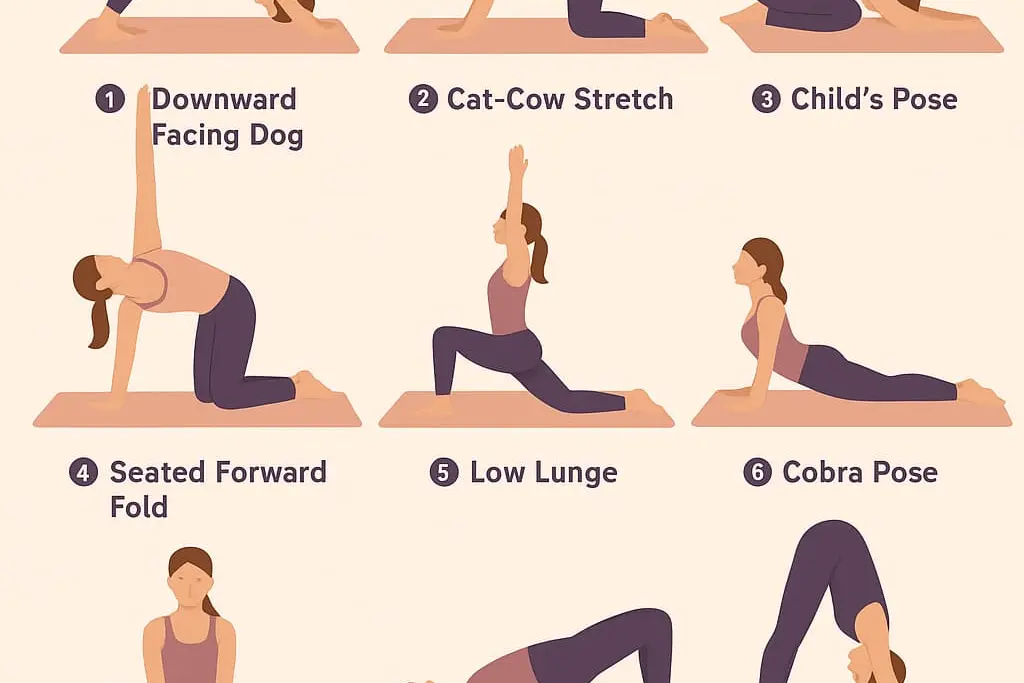
- Mountain pose with breathing (1 minute). Stand in mountain pose and breathe slowly.
- Cat-cow (1 minute). On hands and knees, about eight slow rounds of cat-cow.
- Downward dog (2 minutes). Hold downward dog for five breaths, rest in child's pose, and repeat. Bend your knees as much as you need.
- Warrior II (2 minutes). Five breaths each side in warrior II.
- Triangle pose (2 minutes). Five breaths each side in triangle pose. Rest your lower hand on your shin or a block.
- Chair pose (1½ minutes). Two holds of five breaths in chair pose, with a rest between.
- Cobra (1½ minutes). Three small lifts of five breaths in cobra pose, resting your forehead between.
- Child's pose (1 minute).
- Seated forward fold (2 minutes). Sit with your legs forward and knees bent as needed in a seated forward fold.
- Reclined twist (2 minutes). One minute each side in a reclined twist.
- Corpse pose (4 minutes). Rest in corpse pose.
Total: about 20 minutes.
Sample 19-minute vinyasa sequence
Move with your breath: one movement per inhale or exhale. If you lose your breath, slow down or rest in child's pose. Lower your knees in plank whenever you need to.
- Mountain pose (1 minute). Stand in mountain pose and breathe.
- Cat-cow (1 minute). Warm up your spine with cat-cow.
- Simple sun salutations (5 minutes, about 4 rounds). Inhale arms up. Exhale fold forward. Inhale lift halfway. Exhale step back to plank and lower to the floor (knees down is fine). Inhale cobra. Exhale downward dog and stay three breaths. Step forward, fold, and inhale to stand.
- Standing flow (6 minutes, twice each side). From downward dog, step your right foot forward to a low lunge. Inhale to warrior I. Exhale open to warrior II. Inhale straighten your front leg into triangle pose and stay two breaths. Hands down, step back to plank, lower, cobra, downward dog. Repeat on the left.
- Chair pose (1 minute). Step forward to the top of the mat. Inhale into chair pose for three breaths, then fold. Repeat once.
- Seated forward fold (1 minute). Sit down for a seated forward fold.
- Reclined twist (1 minute). Thirty seconds each side in a reclined twist.
- Corpse pose (3 minutes). Rest in corpse pose.
Total: about 19 minutes.
Safety notes
- Most yoga injuries are minor, but they happen. NCCIH says "the most common injuries are sprains and strains" (NCCIH). In vinyasa, the repeated lowering from plank puts load on your wrists and shoulders; lower your knees or skip the lowering if they complain.
- Don't rush in a flow class. Keep moving only as fast as you can with control. Taking child's pose is always fine.
- Never push through pain. Cleveland Clinic advises: "you should never feel pain. If you do, stop and reassess" (Cleveland Clinic).
- Skip advanced poses at first. NCCIH advises beginners to avoid "extreme practices such as headstands, shoulder stands, the lotus position" (NCCIH).
- Be careful with heated classes. Many vinyasa classes are heated. NCCIH warns that hot yoga "has special risks related to overheating and dehydration" (NCCIH).
- Older adults should take extra care. Yoga-related emergency visits are more common in people 65 and older (NCCIH). A slower hatha class is usually the safer start.
- If you're pregnant, talk with your health care provider. NCCIH advises avoiding hot yoga and poses that involve "long periods of being still or lying on your back" (NCCIH).
- Don't use yoga to put off care. If you have a medical problem, see a health care provider first (NCCIH).
Sources
- Cleveland Clinic. "7 Different Kinds of Yoga and How To Find the Right Practice" (published June 2, 2022). https://health.clevelandclinic.org/how-to-find-the-best-yoga-class-for-you
- Cleveland Clinic. "Yoga for Beginners." https://health.clevelandclinic.org/yoga-for-beginners
- Harvard Health Publishing. "Yoga benefits beyond the mat." https://www.health.harvard.edu/healthy-aging-and-longevity/yoga-benefits-beyond-the-mat
- National Center for Complementary and Integrative Health (NCCIH). "Yoga: What You Need To Know." https://www.nccih.nih.gov/health/yoga-what-you-need-to-know
- Compendium of Physical Activities. "Conditioning Exercise" (2024 Adult Compendium, codes 02150, 02180, 02185). https://pacompendium.com/conditioning-exercise/
- Hagins M, Moore W, Rundle A. "Does practicing hatha yoga satisfy recommendations for intensity of physical activity which improves and maintains health and cardiovascular fitness?" BMC Complementary and Alternative Medicine. 2007;7:40. https://link.springer.com/article/10.1186/1472-6882-7-40
- Sherman SA, Rogers RJ, Davis KK, et al. "Energy Expenditure in Vinyasa Yoga Versus Walking." Journal of Physical Activity and Health. 2017;14(8):597-605. https://doi.org/10.1123/jpah.2016-0548
- Grabara M. "Intensity of Hatha yoga training for older adults." Scientific Reports. 2025;15:12936. https://pmc.ncbi.nlm.nih.gov/articles/PMC12000320/
- Thrower A, et al. "Blood pressure and heart rate variability responses following an acute bout of vinyasa yoga and a prolonged seated control: A randomized crossover trial." PLOS ONE. 2023;18(11):e0294945. https://pmc.ncbi.nlm.nih.gov/articles/PMC10684087/
- Dysart A, Harden SM. "Effects of Temperature and Tempo: Evaluating How Much Time in a Typical Community-Based Yoga Class Is Moderate-Intensity Aerobic Activity." International Journal of Environmental Research and Public Health. 2023;20(3):2349. https://pmc.ncbi.nlm.nih.gov/articles/PMC9915918/
Want new practices by email?
We email now and then when we publish a new routine, practice or guide. No spam, unsubscribe any time.
Join the YogaMag newsletterFrequently Asked Questions
Popular posts
Related posts




No comments yet. Be the first to comment!