

Yoga vs. Pilates: How They Differ, What the Research Shows, and Which to Try
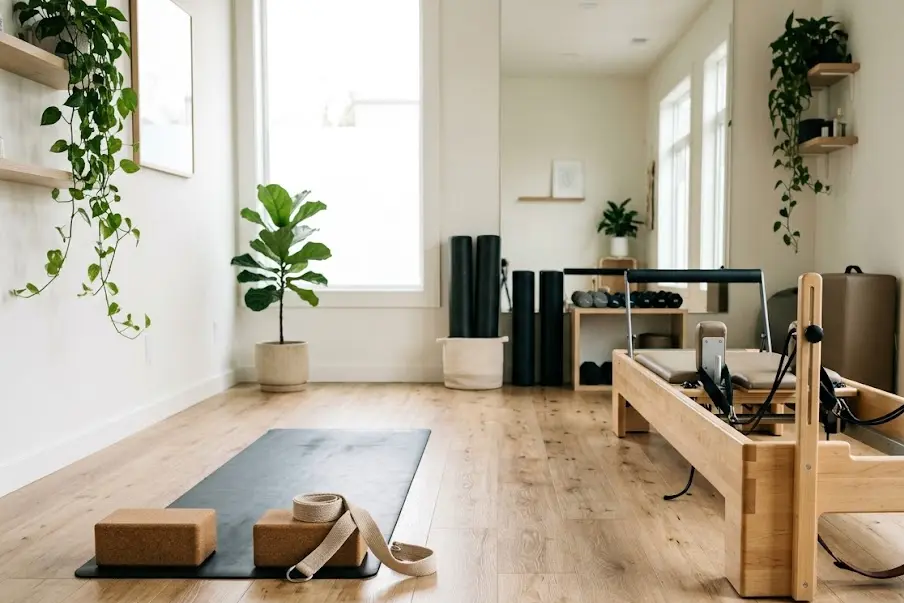
Yoga and Pilates often get listed together as "low-impact mind-body workouts," and they share a lot: a mat, slow controlled movement, attention to breath, and a focus on posture. But they come from different places and are built for different goals. This guide compares them side by side, looks at what research actually shows, and estimates calories using the most recent official MET values. We've tried to say clearly where the evidence is strong, where it's thin, and where there's simply no head-to-head comparison. You can read how we source health claims in our editorial policy.
Quick answer
- Choose yoga if you want a practice that combines movement with breathing and relaxation, and works on flexibility and balance. It has more research on stress and on balance in older adults.
- Choose Pilates if you want focused, controlled core work and a structured, rehab-style approach. It ranks well in studies of chronic low back pain.
- Calories are similar. Most styles of both are light intensity, roughly 125 to 280 calories an hour for a 155-pound person, depending on style (Compendium of Physical Activities).
- For back pain, both can help modestly. The best exercise is the one you'll keep doing (Hayden et al., 2021).
- You don't have to pick one. Many people do both.
Yoga and Pilates side by side
| Yoga | Pilates | |
|---|---|---|
| Origins | An ancient practice "rooted in Indian philosophy" (NCCIH) | Developed by Joseph Pilates in the early 20th century, first used mostly to help dancers recover from injuries (Cleveland Clinic) |
| Main focus | Postures (asanas), breathing (pranayama), and meditation (NCCIH) | Core strength and control through small, precise movements of the abdomen, low back, hips, and buttocks (Cleveland Clinic) |
| Breath | Usually linked to each movement throughout the class (Cleveland Clinic) | "Controlled breathing" used to support each exercise (Cleveland Clinic) |
| Equipment | A mat, plus optional props like a block, strap, or bolster, used mainly to modify or deepen poses | A mat, or apparatus such as the bed-like reformer. Many studio classes use both (Cleveland Clinic) |
| Pace | Varies widely by style, from quick vinyasa flows to very slow restorative classes (Cleveland Clinic) | Steady, controlled sets of small movements |
| Typical class | Standing, seated, and lying poses, breathing practice, and often a final rest or meditation | A sequence of exercises; one study's basic mat routine had about 25 exercises in an hour (Kloubec, 2010) |
| Spiritual or meditative side | Yes, to varying degrees. As one physician puts it, "Yoga has much more of a spiritual aspect to it" (Cleveland Clinic) | Generally no; "more about an approach to rehab" (same source) |
| Cost | Varies by studio and format; free videos and home practice are common | Cleveland Clinic notes it "can be expensive," and class bundles can lower the price (Cleveland Clinic) |
What they share: both are low-impact, both mostly use your own body weight, and both emphasize breath awareness, concentration, and alignment (Cleveland Clinic).
Yoga is also an umbrella term. A hatha class, a fast vinyasa flow, and a still yin class can feel more different from each other than a mat Pilates class feels from a gentle hatha class. Keep that in mind with any "yoga vs. Pilates" claim, including the ones in this article.
What the research says
A note before the details: we found almost no well-designed trials that compare yoga and Pilates directly in the same study. Most of what follows compares each practice with no exercise, or ranks many exercise types using a statistical method called network meta-analysis. Those rankings are useful but less certain than head-to-head trials.
Flexibility
Pilates. In a small randomized trial, active middle-aged adults who did a basic mat Pilates routine for an hour twice a week for 12 weeks improved hamstring flexibility, abdominal endurance, and upper-body endurance compared with a control group (Kloubec, 2010). In adults 60 and older, a 2021 meta-analysis of 39 studies found a moderate effect of Pilates on flexibility, though certainty was rated low (Fernández-Rodríguez et al., 2021).
Yoga. A 2021 meta-analysis of 12 studies in older adults found moderate improvements in lower-body flexibility but no significant change in upper-body flexibility (Shin, 2021).
Bottom line: both appear to improve flexibility, especially in the hips and hamstrings. We didn't find good evidence that one is clearly better. If flexibility is your main goal, our daily flexibility stretches guide is a practical place to start.
Core strength
Core work is Pilates's defining feature. Cleveland Clinic describes the core it targets as extending beyond the abdomen to the sides, mid-to-lower back, buttocks, and hips (Cleveland Clinic). The Kloubec trial above found a significant gain in abdominal endurance after 12 weeks of mat Pilates. In older adults, the 2021 Pilates meta-analysis found a moderate effect on strength, with moderate certainty (Fernández-Rodríguez et al., 2021).
Yoga also builds strength. Holding poses like plank, boat pose, and the warrior poses takes muscular effort, and the 2021 meta-analysis in older adults found moderate improvements in muscle strength (Shin, 2021). But most yoga classes don't target the core as systematically as Pilates does. If you want yoga with a stronger core emphasis, look for a sequence built for it, like our core strength sequence.
Balance
Yoga. A meta-analysis of six trials in people 60 and older found yoga had a small effect on balance and a medium effect on physical mobility (Youkhana et al., 2016). The authors noted that more research is needed to see whether this translates into fewer falls. NCCIH also notes that several studies have found improvement in at least one balance measure (NCCIH).
Pilates. For older adults, one meta-analysis of six trials found Pilates improved postural balance (Casonatto and Yamacita, 2020). The larger 2021 review found a moderate effect on balance (low certainty) and a large effect on fall risk (moderate certainty) compared with control groups (Fernández-Rodríguez et al., 2021). In the middle-aged adults in the Kloubec trial, however, balance did not improve (Kloubec, 2010).
Bottom line: both show benefits for balance in older adults. Pilates has a review linking it to lower fall risk. Yoga's balance evidence is older and smaller. Simple balance poses like tree pose are easy to practice at home, near a wall or chair for support. Our balance and focus sequence puts several together.
Back pain
This is where the research is largest, and where it's easiest to overstate.
Pilates ranks well in comparisons of many exercise types. A 2022 network meta-analysis of 118 trials (9,710 adults with chronic low back pain) found that almost every type of exercise helped compared with control. Pilates ranked highest for reducing both pain and disability (Fernández-Rodríguez et al., 2022). A 2021 network meta-analysis of 217 trials reached a similar conclusion, but its authors added that people with chronic low back pain "should be encouraged to perform the exercise that they enjoy to promote adherence" (Hayden et al., 2021). A 2022 analysis limited to mind-body exercise ranked Pilates first, then tai chi, yoga, and qigong for pain. Its authors cautioned that the number of studies was small (Shi et al., 2022).
But direct evidence is more modest. The Cochrane review of Pilates for low back pain found low- to moderate-quality evidence that Pilates beats minimal intervention for pain and disability, but "no conclusive evidence that it is superior to other forms of exercises." It concluded that the choice can come down to preference and cost (Yamato et al., 2015).
Yoga helps a little. The 2022 Cochrane review of yoga for chronic low back pain (21 trials) found small improvements in function and pain compared with no exercise, smaller than what patients typically notice. Yoga performed about the same as other back-focused exercise. Yoga was linked to more adverse events than no exercise, mostly increased back pain, but about the same as other exercise (Wieland et al., 2022). NCCIH notes that the American College of Physicians lists yoga as an option for initial treatment of chronic low back pain (NCCIH).
Bottom line: for chronic, non-specific low back pain, Pilates has a slight edge in ranking studies, but the difference isn't certain, and both are reasonable choices. These studies are about chronic pain in adults, not new injuries, nerve symptoms, or pain after surgery. Get those checked first. If you want a starting point, try our back pain self-check and gentle low back care sequence, or the guided back pain reset.
Stress and mood
Yoga. NCCIH reports that a 2020 review of studies in healthy adults found beneficial effects of yoga on perceived stress. It also notes some benefit for anxiety symptoms, but "little evidence of a benefit for people with anxiety disorders" (NCCIH). A separate 2020 systematic review of 12 studies found that most types of yoga had positive effects on stress in healthy people (Wang and Szabo, 2020).
Pilates. A 2018 meta-analysis of eight small controlled trials found Pilates was linked to reductions in depressive and anxiety symptoms and fatigue. The authors noted small samples, variable quality, and inactive comparison groups (Fleming and Herring, 2018). Cleveland Clinic says Pilates should complement, not replace, existing mental health care (Cleveland Clinic).
A direct comparison. One 2023 survey compared 118 yoga practitioners with 128 Pilates practitioners. Yoga practice was linked to higher religious and spiritual well-being, but there was no difference in general psychological well-being or distress (Bös et al., 2023). It was a one-time survey, so it can't show cause and effect.
Bottom line: yoga has more research on stress, and its built-in breathing and relaxation make it a natural fit if stress is your main reason to exercise. Our stress relief sequence and breathing hub are good starting points. Pilates may help mood too, but the evidence is thinner.
Calories: yoga vs. Pilates
The standard reference for the energy cost of activities is the 2024 Adult Compendium of Physical Activities (Herrmann et al., 2024). It rates each activity in METs (metabolic equivalents). One MET is the energy you use at rest, defined as 3.5 milliliters of oxygen per kilogram of body weight per minute, or about 1 calorie per kilogram per hour (Herrmann et al., 2024).
To estimate calories:
Calories = MET × body weight in kg × hours
Here are the 2024 values for yoga and Pilates, with walking for comparison. Calorie figures are for a 155-pound (70.3 kg) person doing the activity for 60 minutes.
| Activity (compendium description) | Code | MET | Calories in 60 min (155 lb) |
|---|---|---|---|
| Pilates, traditional, mat | 02103 | 1.8 | about 127 |
| Yoga, Nadisodhana (alternate-nostril breathing) | 02170 | 2.0 | about 141 |
| Yoga, Hatha | 02150 | 2.3 | about 162 |
| Yoga, General | 02175 | 2.3 | about 162 |
| Stretching, mild | 02101 | 2.3 | about 162 |
| Yoga, Vinyasa | 02185 | 2.7 | about 190 |
| Pilates, general | 02105 | 2.8 | about 197 |
| Yoga, Hot | 02155 | 3.0 | about 211 |
| Yoga, Surya Namaskar (sun salutations) | 02180 | 3.5 | about 246 |
| Walking, 2.8 to 3.4 mph, level, moderate pace | 17190 | 3.8 | about 267 |
| Yoga, Power* | 02160 | 4.0 | about 281 |
Sources: conditioning exercise and walking tables, 2024 Adult Compendium. *The compendium marks power yoga's value as estimated rather than measured.
Worked example. A 155-pound person weighs about 70.3 kg. For a one-hour hatha class: 2.3 METs × 70.3 kg × 1 hour = 161.7, or about 160 calories. For a one-hour general Pilates class: 2.8 × 70.3 × 1 = 196.8, or about 200 calories. That's a difference of roughly 35 calories an hour, and mat Pilates (1.8 METs) actually comes out lower than hatha.
Some practical points:
- These totals include what you'd burn at rest. Resting quietly for that hour, the same person would burn about 70 calories (1 MET). The extra energy from the class is roughly the total minus 70.
- They're averages, not your number. The compendium's authors say its values do "not reflect precise individual" energy use and are a starting point (Herrmann et al., 2024). Resting metabolism varies with age, sex, height, weight, and lean mass, and the standard values don't adjust for those factors (Compendium: corrected METs).
- Style and effort matter more than the label. A fast flow with many sun salutations will cost more than a slow class with long holds. The compendium has no separate entries for reformer Pilates, Iyengar, Bikram, yin, or restorative yoga, so we haven't given numbers for them.
- Older numbers are still everywhere. Many calculators still use 2011 values (2.5 for hatha, 3.0 for Pilates). The 2024 update changed both (Compendium tracking guide).
- Adults 60 and over have a separate Older Adult Compendium that uses a lower resting baseline. It lists general yoga at 2.5 and chair yoga at 2.8 on its own scale, so those numbers aren't directly comparable to the table above (Older Adult Compendium). See our chair yoga guide.
To run the numbers for your own weight and session length, use our yoga calories calculator.
For context, the US physical activity guidelines classify activities under 3.0 METs as light, 3.0 to 5.9 as moderate, and 6.0 or more as vigorous (Compendium: corrected METs). By that measure, most yoga and Pilates classes are light activity. Cleveland Clinic notes that Pilates "is not as heavy a cardiovascular workout" and should be part of a balanced program (Cleveland Clinic). The CDC recommends that adults get 150 minutes of moderate activity a week plus at least two days of muscle-strengthening activity (CDC). Yoga or Pilates can be part of that, alongside walking or other aerobic exercise, not a replacement for it.
Who each one suits
Yoga may suit you better if:
- Stress relief is a main goal. Cleveland Clinic's expert notes that learning to relax is what makes yoga "especially important for people who are stressed" (Cleveland Clinic).
- You want breathing and meditation as part of your practice. See our guide to pranayama.
- You like variety. Styles range from slow and supported to fast and sweaty.
- You want flexibility and balance work in one session.
- You'd like a short daily practice. Our morning yoga routines take 5 to 20 minutes.
Pilates may suit you better if:
- You want focused core strength and body control.
- You prefer a structured, exercise-class format without a spiritual component.
- You've had chronic low back pain and want an approach that ranks well in research. Ideally, start with guidance from a physical therapist or a certified instructor, as Cleveland Clinic suggests (Cleveland Clinic).
- You're returning to exercise after an injury and your provider has cleared you. Pilates began as a rehab method.
Either is a reasonable choice if you're an older adult looking to work on balance and strength. Both have supportive evidence in people 60 and older.
How to try both
- Start with one beginner class of each. Cleveland Clinic suggests trying both before deciding (Cleveland Clinic). Look for "beginner," "basics," or "gentle" in the class name. For yoga, a hatha class is a good first choice. For Pilates, a beginner mat class needs no equipment beyond a mat.
- Find a qualified teacher. NCCIH recommends learning yoga under qualified instruction rather than on your own (NCCIH). Our US teacher directory can help you find one near you. Ask Pilates studios about instructor certification.
- Give each a few weeks. Many studies used programs of two sessions a week for several weeks. In the back pain network meta-analysis, the best programs included one to two Pilates sessions a week for three to nine weeks (Fernández-Rodríguez et al., 2022).
- Build a mixed week if you like both. For example, one yoga and one Pilates session plus walking on other days. Cleveland Clinic's expert suggests "up to two to three times each week" alongside strength and cardio training (Cleveland Clinic).
- Practice at home between classes. Short sessions help you stick with it. Browse our routines or start with a beginner's guide to yoga.
Safety notes
- Both are generally safe for healthy people when practiced properly. NCCIH says serious yoga injuries are rare; the most common are sprains and strains, mostly of the knee or lower leg (NCCIH).
- Older adults should take extra care. Yoga-related emergency visits are higher among people 65 and older (NCCIH).
- Skip advanced poses at first. NCCIH advises beginners to avoid extreme practices such as headstands and shoulder stands (NCCIH).
- Be careful with hot yoga. It carries risks of overheating and dehydration (NCCIH).
- If you're pregnant, talk with your health care provider first. NCCIH advises avoiding hot yoga and long periods lying on your back (NCCIH).
- If you're injured or recovering from surgery, check with your doctor before starting Pilates. Cleveland Clinic warns that "starting too early could make things worse" (Cleveland Clinic).
- If you have a health condition such as high blood pressure, ask your provider which moves to avoid or modify (Cleveland Clinic).
- Don't use either to put off care. NCCIH advises against using yoga to postpone seeing a health care provider about a medical problem (NCCIH).
- Stop any movement that causes sharp pain, numbness, tingling, or dizziness.
Sources
- Herrmann SD, Willis EA, Ainsworth BE, et al. "2024 Adult Compendium of Physical Activities: A third update of the energy costs of human activities." Journal of Sport and Health Science. 2024;13(1):6-12. doi:10.1016/j.jshs.2023.10.010. https://pmc.ncbi.nlm.nih.gov/articles/PMC10818145/
- Compendium of Physical Activities. "Conditioning Exercise" (2024 Adult Compendium, codes 02101-02185). https://pacompendium.com/conditioning-exercise/
- Compendium of Physical Activities. "Walking" (2024 Adult Compendium, code 17190). https://pacompendium.com/walking/
- Compendium of Physical Activities. "Corrected METs - Adults." https://pacompendium.com/corrected-mets/
- Compendium of Physical Activities. "Adult Compendium Tracking Guide (1993, 2000, 2011, 2024)." https://pacompendium.com/wp-content/uploads/2025/02/4_2024_adult-compendium-tracking-guide-1-2024.pdf
- Compendium of Physical Activities. "Older Adult Compendium." https://pacompendium.com/older-adult-compendium/
- Herrmann SD, Conger SA, Willis EA, Ainsworth BE. "Promoting public health through the 2024 Compendium of Physical Activities: Strategies for adults, older adults, and wheelchair users." Journal of Sport and Health Science. 2024;13(6):739-742. https://pmc.ncbi.nlm.nih.gov/articles/PMC11336313/
- National Center for Complementary and Integrative Health (NCCIH). "Yoga: What You Need To Know." https://www.nccih.nih.gov/health/yoga-what-you-need-to-know
- NCCIH. "Low-Back Pain and Complementary Health Approaches: What You Need To Know." https://www.nccih.nih.gov/health/low-back-pain-and-complementary-health-approaches-what-you-need-to-know
- Cleveland Clinic. "Yoga vs. Pilates: The Differences Between Two Great Exercises." https://health.clevelandclinic.org/yoga-vs-pilates
- Cleveland Clinic. "Pilates 101: What It Is and Its Health Benefits." https://health.clevelandclinic.org/everything-you-want-to-know-about-pilates
- Centers for Disease Control and Prevention. Physical activity guidelines for adults (Physical Activity Basics). https://www.cdc.gov/physical-activity-basics/guidelines/adults.html
- Fernández-Rodríguez R, et al. "Best Exercise Options for Reducing Pain and Disability in Adults With Chronic Low Back Pain: Pilates, Strength, Core-Based, and Mind-Body. A Network Meta-analysis." JOSPT. 2022;52(8):505-521. https://pubmed.ncbi.nlm.nih.gov/35722759/
- Hayden JA, et al. "Some types of exercise are more effective than others in people with chronic low back pain: a network meta-analysis." Journal of Physiotherapy. 2021;67(4):252-262. https://pubmed.ncbi.nlm.nih.gov/34538747/
- Shi J, et al. "Optimal modes of mind-body exercise for treating chronic non-specific low back pain: Systematic review and network meta-analysis." Frontiers in Neuroscience. 2022;16:1046518. https://pmc.ncbi.nlm.nih.gov/articles/PMC9713308/
- Yamato TP, et al. "Pilates for low back pain." Cochrane Database of Systematic Reviews. 2015;(7):CD010265. https://pubmed.ncbi.nlm.nih.gov/26133923/
- Wieland LS, et al. "Yoga for chronic non-specific low back pain." Cochrane Database of Systematic Reviews. 2022;11:CD010671. https://pubmed.ncbi.nlm.nih.gov/36398843/
- Kloubec JA. "Pilates for improvement of muscle endurance, flexibility, balance, and posture." Journal of Strength and Conditioning Research. 2010;24(3):661-7. https://pubmed.ncbi.nlm.nih.gov/20145572/
- Fernández-Rodríguez R, et al. "Pilates improves physical performance and decreases risk of falls in older adults: a systematic review and meta-analysis." Physiotherapy. 2021;112:163-177. https://pubmed.ncbi.nlm.nih.gov/34332493/
- Casonatto J, Yamacita CM. "Pilates exercise and postural balance in older adults: A systematic review and meta-analysis of randomized controlled trials." Complementary Therapies in Medicine. 2020;48:102232. https://pubmed.ncbi.nlm.nih.gov/31987246/
- Shin S. "Meta-Analysis of the Effect of Yoga Practice on Physical Fitness in the Elderly." International Journal of Environmental Research and Public Health. 2021;18(21):11663. https://pubmed.ncbi.nlm.nih.gov/34770176/
- Youkhana S, et al. "Yoga-based exercise improves balance and mobility in people aged 60 and over: a systematic review and meta-analysis." Age and Ageing. 2016;45(1):21-9. https://pubmed.ncbi.nlm.nih.gov/26707903/
- Wang F, Szabo A. "Effects of Yoga on Stress Among Healthy Adults: A Systematic Review." Alternative Therapies in Health and Medicine. 2020;26(4):AT6214. https://pubmed.ncbi.nlm.nih.gov/32088671/
- Fleming KM, Herring MP. "The effects of pilates on mental health outcomes: A meta-analysis of controlled trials." Complementary Therapies in Medicine. 2018;37:80-95. https://pubmed.ncbi.nlm.nih.gov/29609943/
- Bös C, et al. "Effect of Yoga involvement on mental health in times of crisis: A cross-sectional study." Frontiers in Psychology. 2023;14:1096848. https://pmc.ncbi.nlm.nih.gov/articles/PMC10074601/
Want new practices by email?
We email now and then when we publish a new routine, practice or guide. No spam, unsubscribe any time.
Join the YogaMag newsletterFrequently Asked Questions
Popular posts
Related posts




No comments yet. Be the first to comment!