

Somatic Yoga: What It Is, What the Research Says, and a 15-Minute Beginner Sequence
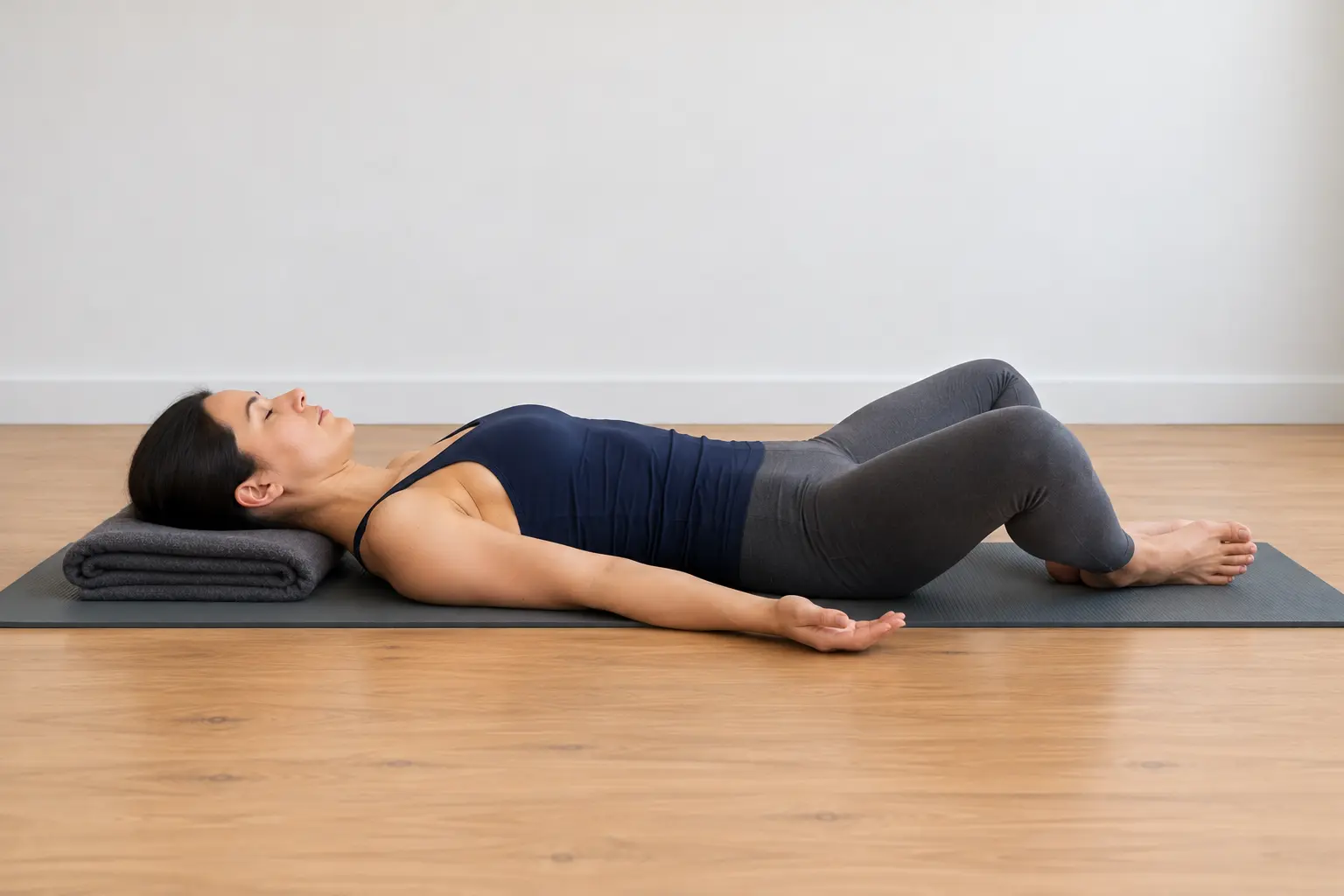
"Somatic yoga" has gone from a niche term to a feed full of ads in about two years. Some of those ads promise weight loss. Others say a few hip stretches will release trauma your body has been storing. This guide is the calmer version. It covers what the word means, where the practice comes from, how it compares with other gentle styles, what the research does and doesn't support, and a 15-minute beginner sequence you can try on a mat or a bed.
A quick note before the details: there is very little research on "somatic yoga" as its own practice. Most of the evidence below comes from related methods, mainly the Feldenkrais Method, yoga in general, and a trauma therapy called Somatic Experiencing. We say which is which as we go. You can read how we source and review health claims in our editorial policy.
Reviewed by the YogaMag editorial team against the sources listed below, in line with our editorial policy. This page has not been reviewed by a doctor or physical therapist.
Quick answers
- What is somatic yoga? Yoga done slowly, with small movements and your attention on how each movement feels from the inside, rather than on how a pose looks. It blends yoga with 20th-century body-awareness methods, mainly Hanna Somatics and the Feldenkrais Method.
- Is there evidence for it? Very little on somatic yoga itself. We found no controlled trial of it as a defined practice. The closest research, on the Feldenkrais Method, suggests it may help balance and mobility in older adults, but those trials are small and at high risk of bias.
- Is it the same as somatic therapy? No. Somatic Experiencing is a trauma therapy delivered by licensed clinicians with added training. A somatic yoga class is gentle movement, not treatment.
- Will it help with weight loss or "release trauma"? We found no research showing either.
- Check with your health care provider first if you're pregnant, an older adult, managing a health condition, or recovering from surgery or a new injury. If body-focused attention makes you feel worse, talk to a licensed therapist.
- Where to start: the 15-minute beginner sequence below.
What "somatic" means
"Somatic" comes from the Greek soma, body. In the movement world it means paying attention to the body as you feel it from the inside, rather than how it looks from the outside. Harvard Health describes somatic exercises as ones that "involve paying attention to internal sensations and responses during physical movements" (Harvard Health).
In practice, that usually means three things:
- Slow movement. Slow enough that you can feel each part of it, rather than moving on autopilot.
- Small range. You don't push to your end range. A smaller movement you can feel clearly beats a bigger one you can't.
- Attention over achievement. A Cleveland Clinic exercise physiologist puts it this way: "The process is what matters, not athletic proficiency" (Cleveland Clinic).
Where somatic yoga comes from
There's no single founder of somatic yoga. It's a blend of yoga with a few 20th-century body-awareness methods. The two that come up most often are these.
Hanna Somatics. Thomas Hanna was a US philosophy professor who coined the term "somatics" in 1976. He was introduced to Moshé Feldenkrais's work in San Francisco and took part in the first Feldenkrais training in the US in 1975, then developed his own approach, Hanna Somatic Education (Wikipedia: Thomas Louis Hanna). Hanna proposed that many aches people blame on age come from what he called "sensory motor amnesia": muscles held tight out of habit, so routinely that the brain stops noticing them. That's a theory from his practice, not an established medical diagnosis.
His signature technique is pandiculation: you deliberately tighten a muscle group a little more, then lengthen it slowly and consciously until it relaxes. One Hanna-trained practitioner describes it as "a conscious slow and deliberate lengthening of the muscle(s) to where they are relaxed" (Somatic Reawakenings). Several moves in our sequence use this tighten-then-slowly-release pattern. Hanna Somatic Education itself is delivered by practitioners through hands-on sessions and home movement routines (Association for Hanna Somatic Education).
The Feldenkrais Method. Developed by Moshé Feldenkrais, it teaches movement awareness through slow, often floor-based lessons. Of all the somatic methods, it has the most published research, covered below.
Yoga itself. Cleveland Clinic points out that traditional yoga was already inward-focused, and that modern Western classes "don't always hold on to those spiritual and somatic elements" (Cleveland Clinic). In that sense, somatic yoga is partly a return to paying attention, with techniques borrowed from Hanna and Feldenkrais.
How it compares with other gentle practices
Somatic yoga often gets lumped in with yin, restorative yoga, and somatic therapy. They are different things.
| Somatic yoga | Yin yoga | Restorative yoga | Typical hatha/vinyasa class | Somatic therapy (e.g., Somatic Experiencing) | |
|---|---|---|---|---|---|
| Main aim | Feel and refine how you move | Long passive stretch of tissues | Deep rest with full support | Strength, flexibility, flow | Treat trauma and stress symptoms |
| Movement | Slow, small, repeated | Poses held still | Poses held still | Poses held or linked with breath | Mostly talk plus guided attention to body sensation |
| Typical hold | Seconds; movements repeated | 3–5 minutes | 5–20 minutes | A few breaths | Not applicable |
| Props | Optional blanket or pillow | Bolsters, blocks | Many bolsters, blankets | Mat, sometimes blocks | None needed |
| Who leads it | Yoga or movement teacher | Yoga teacher | Yoga teacher | Yoga teacher | Licensed clinician with added SE training |
| Is it treatment? | No | No | No | No | Yes, a therapy modality |
The last column matters most. Somatic Experiencing (SE) is a body-oriented trauma therapy. Practitioners are trained through Somatic Experiencing International, which trains "healing and helping professionals" such as therapists, social workers and medical providers (Somatic Experiencing International). A somatic yoga class, even a good one, is not that.
What the evidence actually says
On somatic yoga specifically: we could not find a controlled trial of "somatic yoga" as a defined practice. Claims you see online are mostly borrowed from related research. Cleveland Clinic's overview lists possible benefits (body awareness, balance, stress, sleep, chronic pain) but frames them as things it "may" help with (Cleveland Clinic).
On the Feldenkrais Method (the best-studied relative):
- A 2015 systematic review of 20 randomized trials found results in favor of Feldenkrais for balance in older adults, but the risk of bias was high and the authors concluded that "further research is required." Results for low back pain were mixed (Hillier & Worley, 2015).
- A 2022 systematic review and meta-analysis of 16 randomized trials found improvements in gait, balance and mobility in older adults, and effects on spine pain comparable to other physiotherapy techniques. The authors noted that "the risk of bias remains high" and that larger trials are needed (Berland et al., 2022).
On somatic exercise in general: Harvard Health describes a small 2025 study in which older adults in a twice-weekly online somatic program moved their spines more easily after 10 weeks (Harvard Health). Small and early, but it points the same way as the Feldenkrais research: these methods may help with ease of movement.
On trauma:
- A 2021 scoping review of Somatic Experiencing (the therapy) included 16 studies, only two of them randomized controlled trials. It found "preliminary evidence" for benefits on PTSD-related symptoms, rated overall study quality as mixed, and stated that "the current evidence base is weak" (Kuhfuß et al., 2021).
- A 2024 meta-analysis of 20 randomized trials of yoga (not somatic yoga specifically) for PTSD found improvement in self-reported symptoms right after treatment, but not on clinician-rated measures, and found a high risk of bias in all included studies (Nejadghaderi et al., 2024). The NCCIH summarizes the PTSD evidence for yoga as "only low-quality evidence of a possible benefit" (NCCIH).
What the evidence does not show:
- Weight loss. We found no study testing somatic yoga or somatic exercise for weight loss. A Medical News Today article on the topic offers only that somatic exercises "may" help by improving the mind-body connection, and none of the studies it cites measure weight (Medical News Today). Reviews of general yoga programs show modest weight loss (NCCIH), but those are longer, more active programs. For weight, the CDC recommends 150 minutes a week of moderate activity plus at least two days of muscle strengthening (CDC).
- "Trauma stored in your hips." We found no research showing that specific emotions are stored in specific muscles, or that a stretch releases them. Some people do feel emotional during slow, quiet practice. That's worth noticing, and worth bringing to a therapist if it's strong, but it's not evidence that the stretch "released" something.
- Curing chronic pain or any condition. The Feldenkrais pain results are promising but come from small, mixed-quality trials. Treat somatic practice as gentle movement that may help you feel more at ease, not as treatment.
A 15-minute beginner somatic sequence
This routine uses ten slow movements, mostly lying down. You need a mat or carpet, and a folded blanket or thin pillow for your head. You can also do most of it on a firm bed (see bed or couch yoga).
The photos in this sequence are AI-generated illustrations. We checked each one against the written steps.
General rules for every movement:
- Move at about half the speed you think is slow.
- Stay well inside your comfortable range. If you can't feel the movement clearly, make it smaller.
- Breathe normally. Don't hold your breath.
- Rest for a breath or two between repetitions. The pauses are part of the practice.
- Stop anything that causes sharp, shooting or increasing pain.
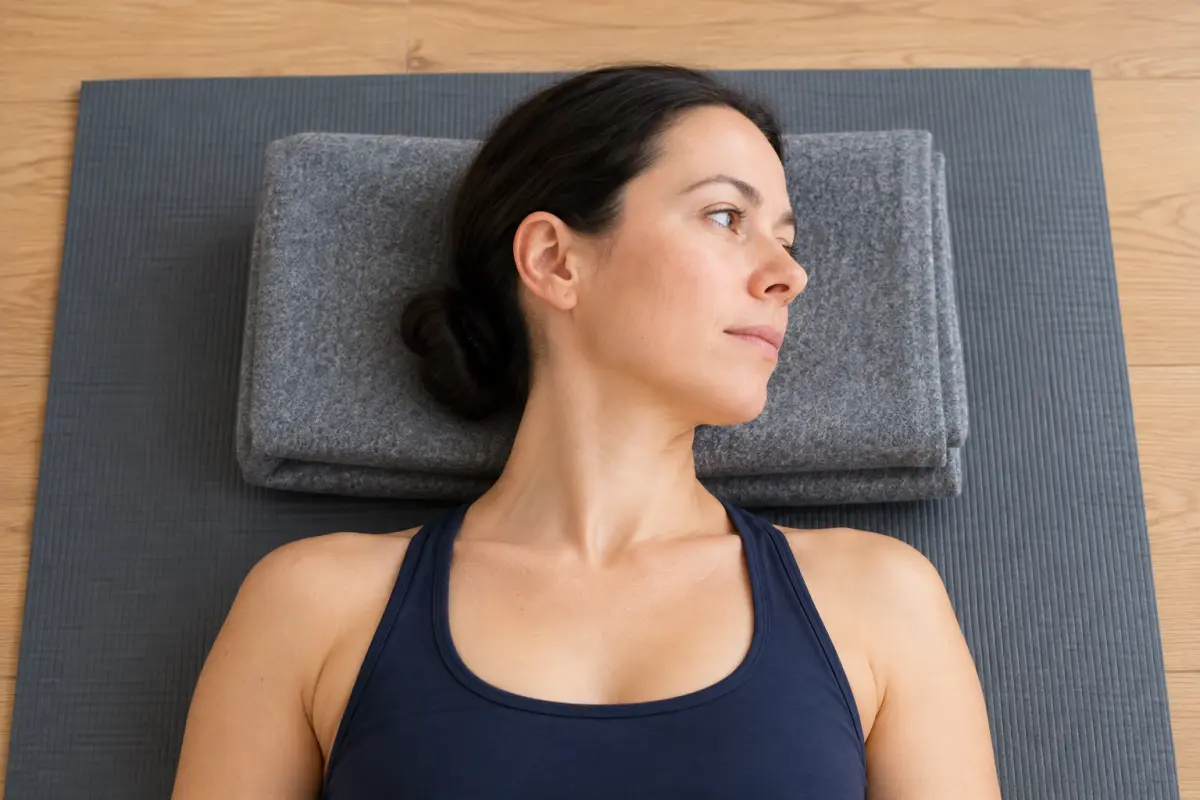
1. Arrive in constructive rest (1.5 minutes)
- Lie on your back with knees bent, feet flat and hip-width apart. Rest your arms by your sides.
- Let your knees lean gently toward each other if that's easier to hold.
- Notice where your body touches the floor: head, shoulder blades, pelvis, feet.
- Watch about ten breaths without changing them.
Pace: Still. Notice: Which side of your back feels heavier or lighter on the floor. Skip if: Lying flat on your back is uncomfortable (late pregnancy, some reflux or breathing problems). Sit in a chair or lie on your side instead. See constructive rest.
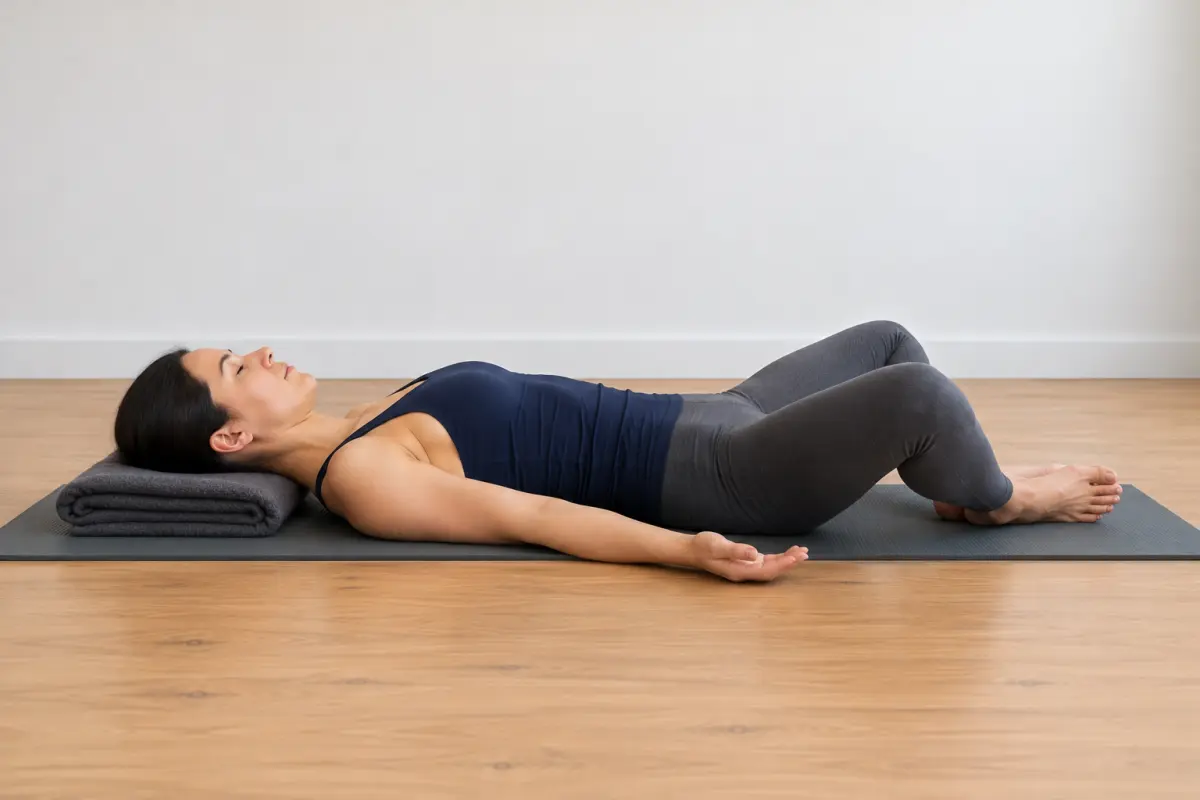
2. Arch and flatten (pandiculation-style pelvic tilt) (2 minutes)
- From constructive rest, slowly tip your pelvis so your lower back arches a little away from the floor. Feel the back muscles gently tighten.
- Pause for a breath at the top of the arch.
- Over a slow count of 5, let the arch release back down. Then keep going, pressing your lower back gently toward the floor.
- Release fully and rest for a breath. Repeat 5 times.
Pace: About 3 seconds up, 5 seconds down. Notice: Whether the release is smooth or jumpy. Can you slow down the jumpy part? Skip if: You've had recent back surgery or a disc injury flare, unless a clinician has cleared it.
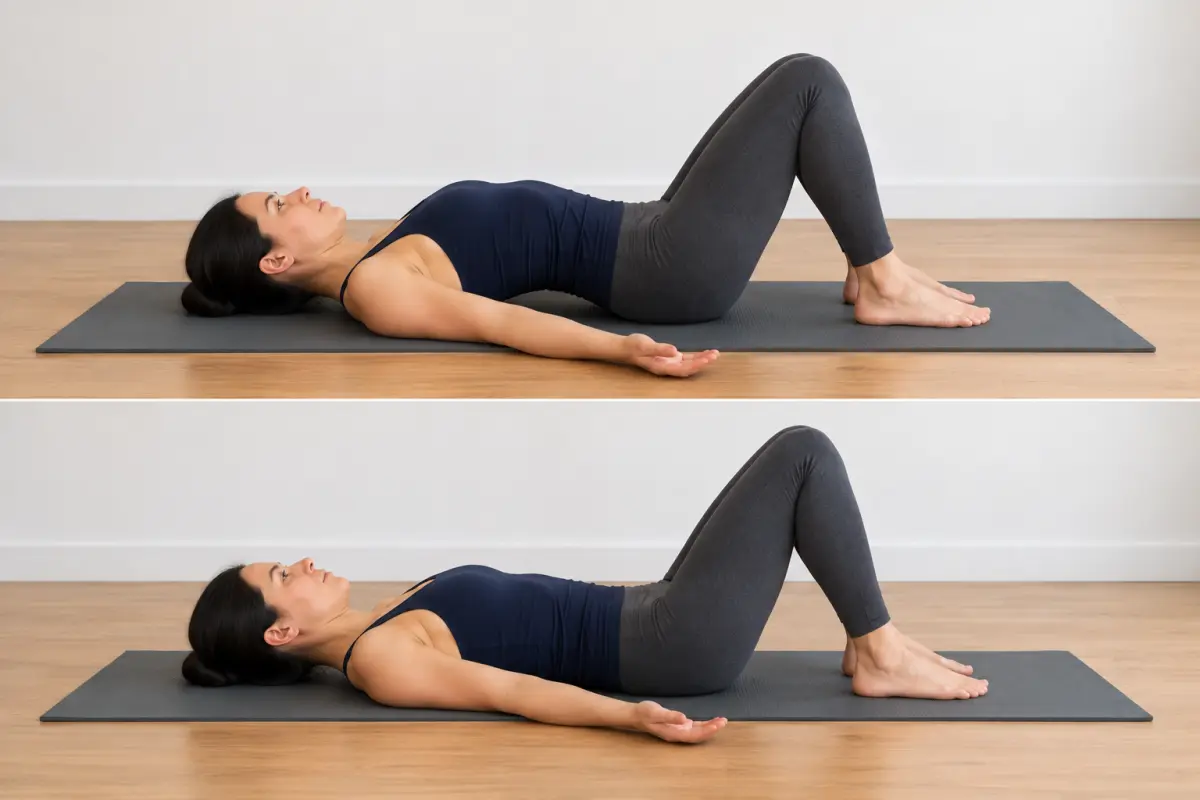
Top: a small arch under the lower back. Bottom: the lower back flat on the mat.
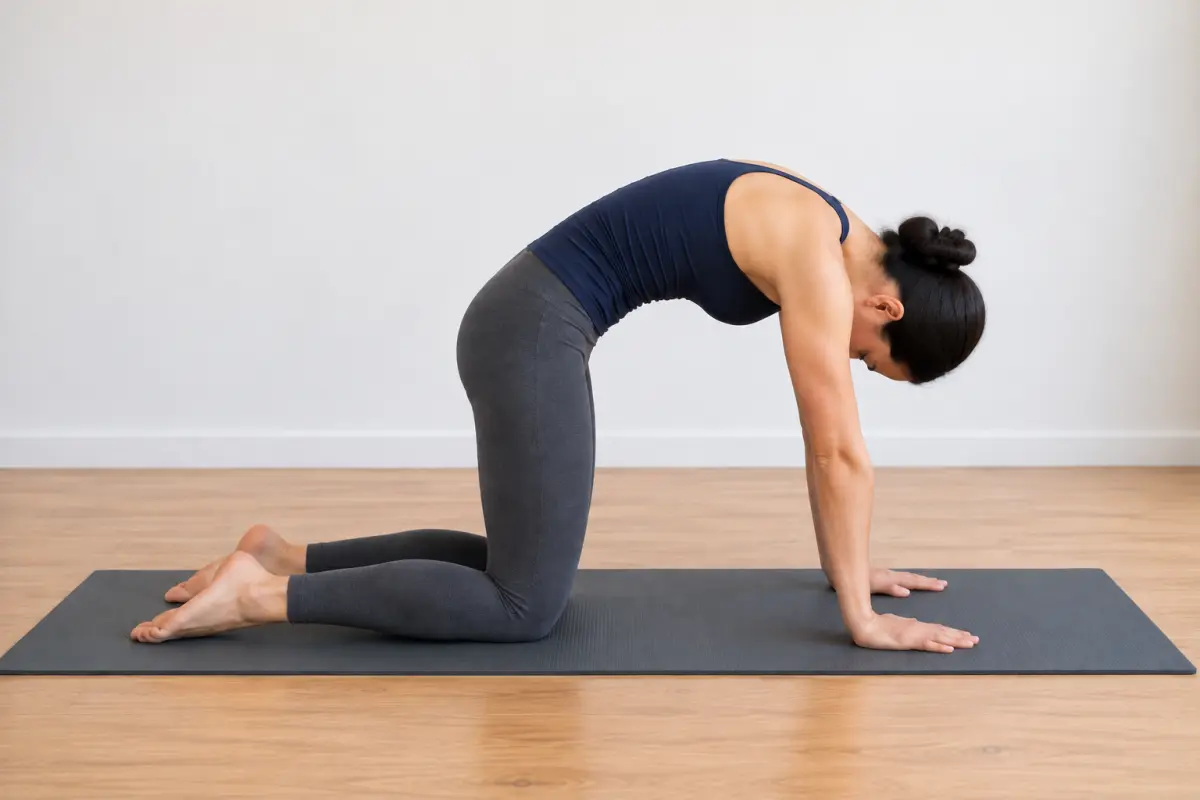
3. Slow Cat-Cow (2 minutes)
- Come onto hands and knees, hands under shoulders and knees under hips.
- Starting from your tailbone, slowly round your back one section at a time until your head drops last.
- Then reverse it, tailbone first, letting your belly lower and your chest move forward. Lift your head last.
- Take 6 rounds, each slower than the last.
Pace: About 5 seconds each way. Notice: Which part of your spine is hardest to move on its own. Skip if: Your wrists or knees hurt on all fours. Do it seated in a chair with hands on your thighs, as Cleveland Clinic suggests. See Cat-Cow and wrist-free modifications.
4. Side-lying shoulder circles (1.5 minutes per side)
- Lie on your right side with knees bent and a pillow under your head. Rest your left hand on your left hip.
- Slowly slide your left shoulder up toward your ear, then forward, then down, then back, drawing a small circle.
- Make 5 slow circles, then 5 in the other direction.
- Roll to the other side and repeat.
Pace: About 8 seconds per circle. Notice: Any part of the circle that feels "sticky" or that you want to rush through. Skip if: You have a recent shoulder injury or dislocation. Do only the parts of the circle that feel fine.
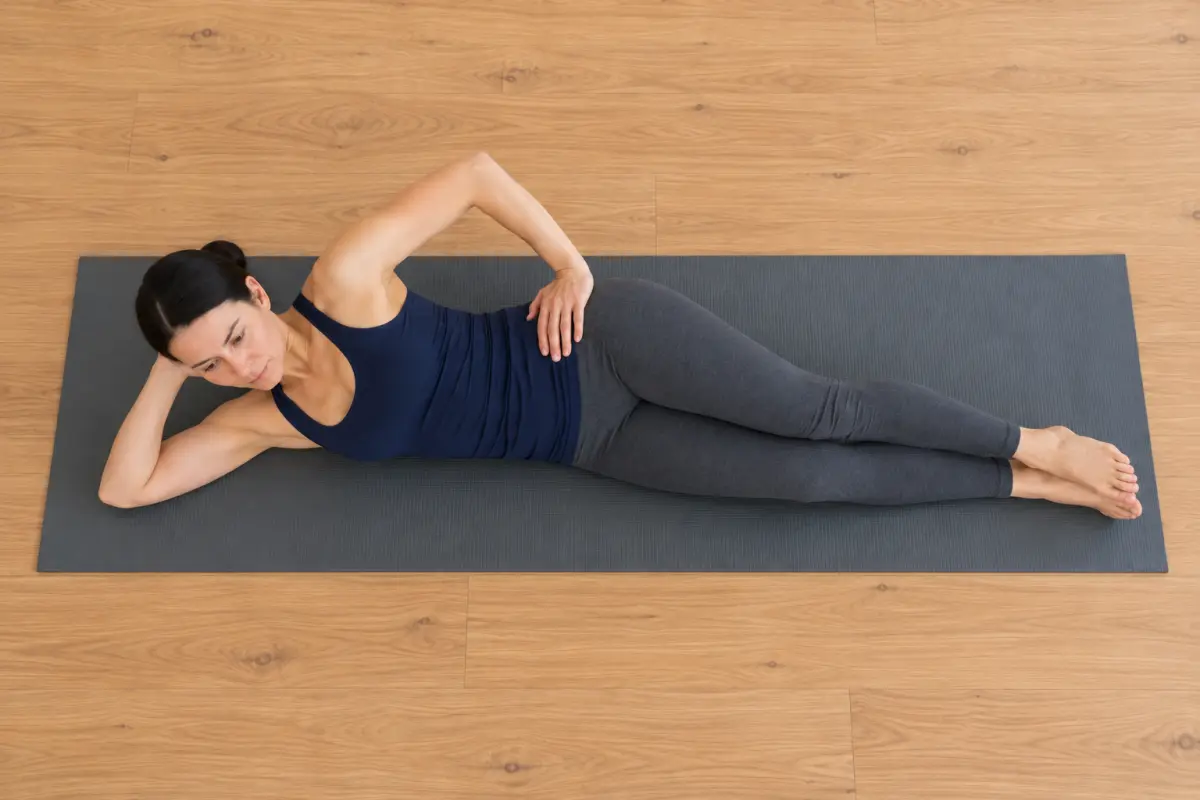
5. Side-lying arm slide (1 minute per side)
- Still on your side, extend your top arm along the floor in front of you at shoulder height.
- Slowly slide that hand forward along the floor, letting your shoulder blade follow, then slide it back.
- Repeat 5 times on each side.
Pace: About 4 seconds out, 4 back. Notice: Whether your ribs and head want to join in. Let them, a little. Skip if: Same as above. Keep the slide small.
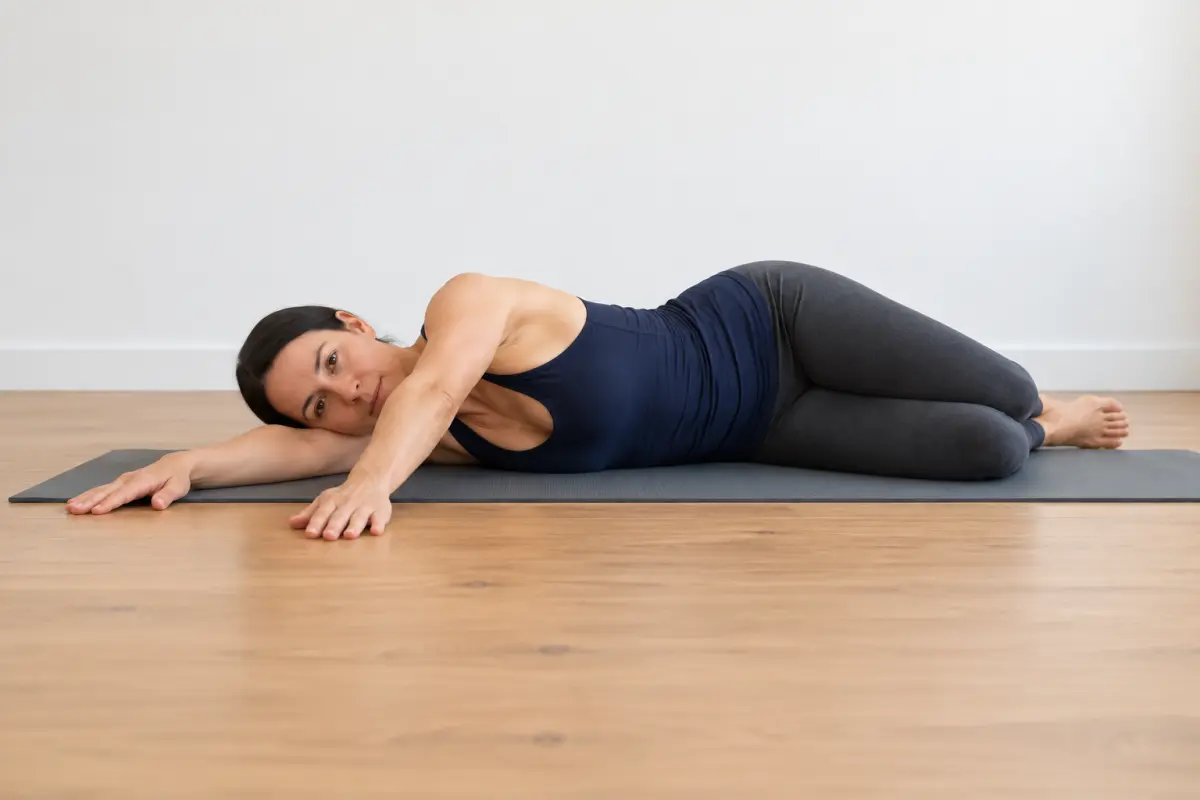
6. Knee sways (1.5 minutes)
- Lie on your back, knees bent, feet a bit wider than your hips.
- Slowly let both knees drift to the right, only as far as feels easy.
- Pause, then bring them back to center using your belly rather than your legs.
- Repeat to the left. Do 5 slow sways each way.
Pace: About 5 seconds each direction. Notice: Which side moves more easily, and where you feel the movement in your back. Skip if: You've had a recent hip replacement or hip surgery. Ask your surgeon which movements are allowed. See supine spinal twist for a held version.
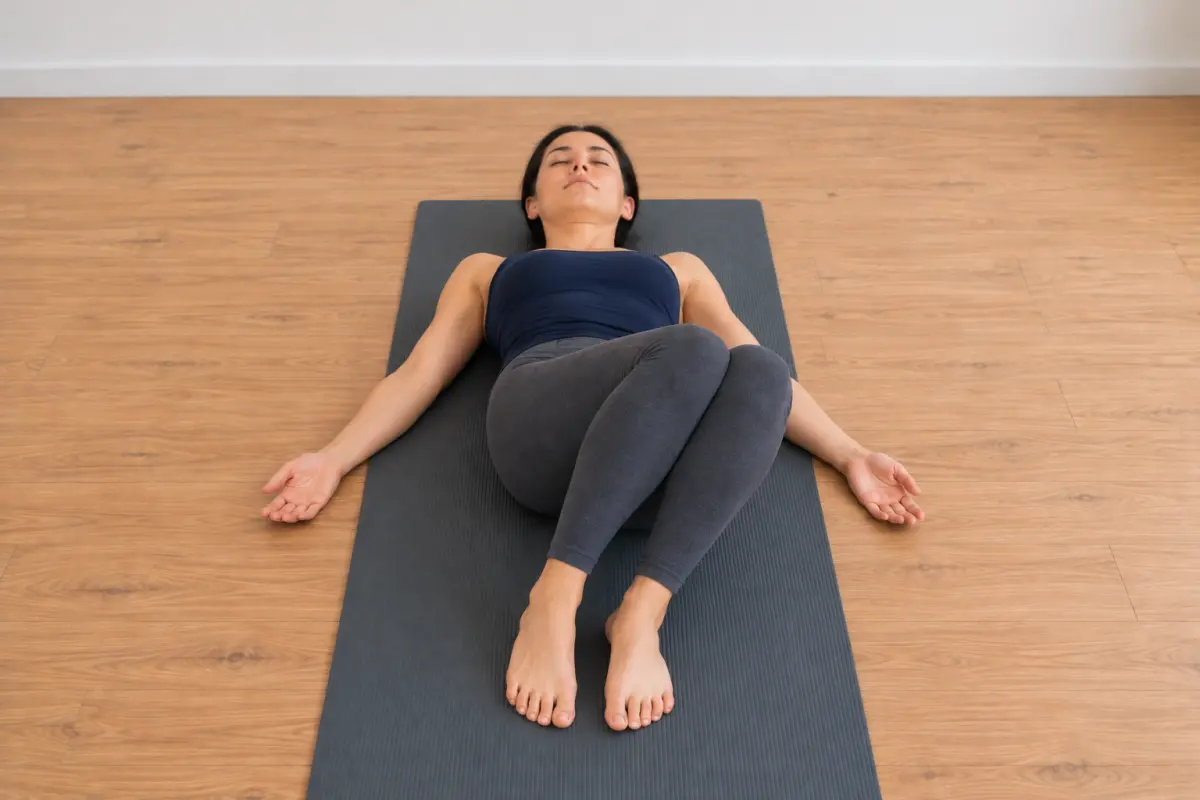
A small tilt is enough. The knees only move a short way from the centre.
7. Belly-down knee slide (1.5 minutes)
This one is adapted from an example in Harvard Health's guide.
- Lie on your belly. Turn your head to whichever side is comfortable and rest it on your stacked hands.
- Slowly slide your right knee out to the side and up toward your ribs, keeping it on the floor.
- Slide it back down slowly. Repeat 4 times, then switch legs.
Pace: About 5 seconds each way. Notice: How your pelvis and lower back respond as the knee moves. Skip if: Lying on your belly is uncomfortable (pregnancy, recent abdominal surgery). Do it lying on your side instead.
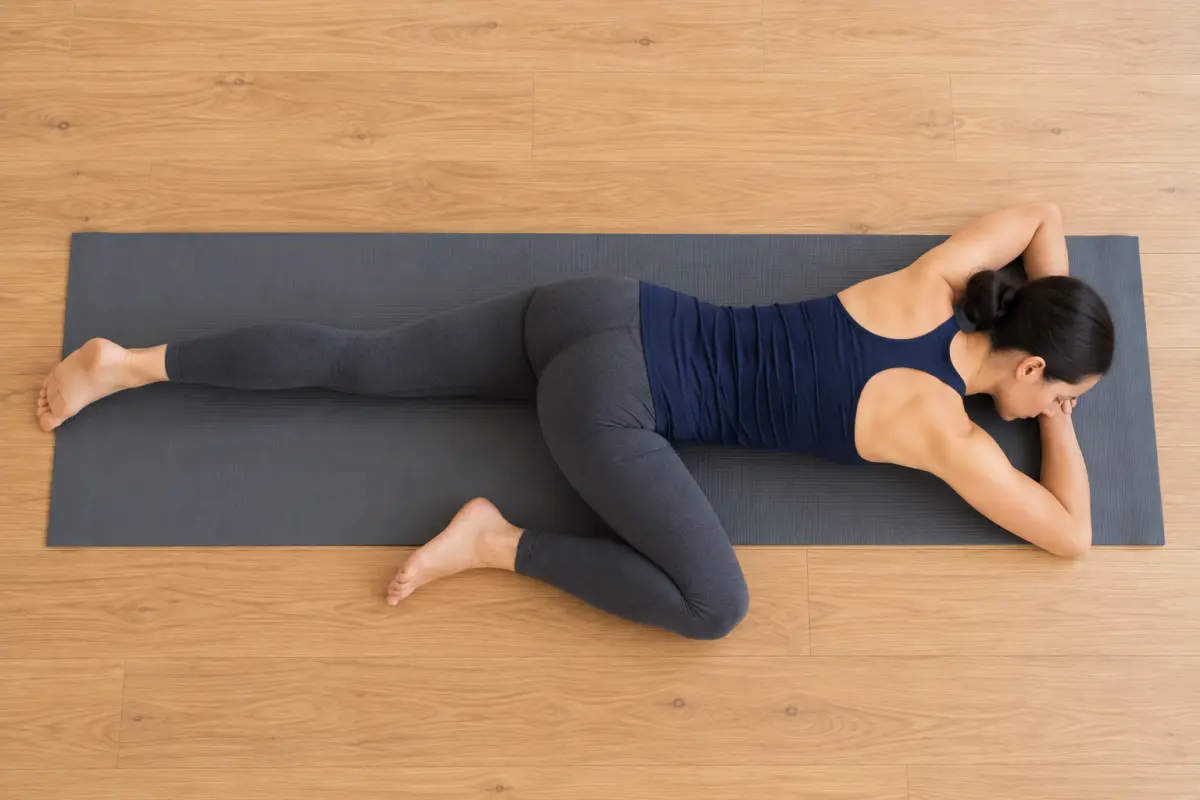
8. Slow head turns (1 minute)
- Lie on your back again, knees bent.
- Slowly roll your head to the right, as if your nose is drawing a line across the ceiling. Go only partway.
- Roll it back through center to the left.
- Repeat 5 times each way, making each turn a little smaller and slower.
Pace: About 4 seconds each way. Notice: Whether your eyes lead the movement or your jaw tightens. Skip if: You have dizziness with head movement, or a neck injury. Keep the turn tiny or skip it. See neck and shoulder release.
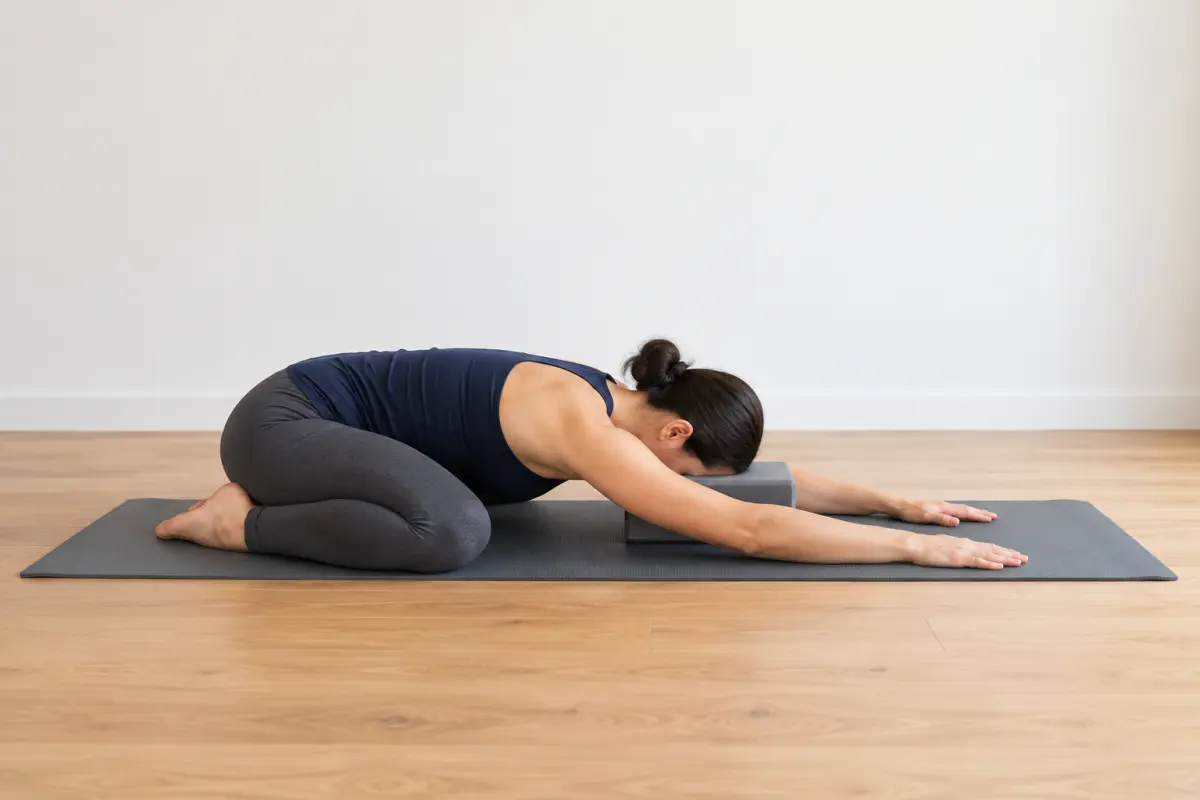
9. Child's Pose with slow breathing (1 minute)
- Come to hands and knees, then sit your hips back toward your heels. Widen your knees if that's more comfortable.
- Rest your forehead on the floor, a block, or your stacked fists.
- Take 6 slow breaths and feel your back widen as you breathe in.
Pace: Still. Notice: Where the breath moves: belly, ribs, or back. Skip if: You have knee problems. Cleveland Clinic also suggests checking with your provider if you have heart or lung issues. Rest on your back instead. See Child's Pose.
10. Rest and body scan (2 minutes)
- Lie on your back with your legs long, or knees bent if your lower back prefers that.
- Starting at your feet, move your attention slowly up through your body, noticing what you feel without trying to change it.
- Compare how you feel now with how you felt in step 1.
Pace: Still. Notice: Any change in how your back meets the floor. Or no change, which is fine too. Skip if: Body-focused attention brings up distress. Keep your eyes open, look around the room, and shorten or skip this step. See body scan and Savasana.

Who somatic yoga suits, and who should be cautious
It may suit you if you:
- Find regular classes too fast, or want to learn to move with less strain.
- Are new to exercise, or are coming back to movement and want a low-load starting point.
- Like a slower practice to pair with breath work or meditation.
Be cautious, and talk to your health care provider first, if you:
- Are pregnant, an older adult, or managing a health condition. The NCCIH gives that advice for all yoga (NCCIH).
- Have had recent surgery, a new or worsening injury, or pain with numbness, weakness, or loss of bladder or bowel control. Those need medical attention, not a movement class.
- Have a trauma history and find that body-focused attention makes you feel worse, panicky or numb. A licensed therapist can help you decide whether and how to include body-based practice. Look for trauma-informed approaches.
It isn't for you if you want a workout. It won't build much strength or cardiovascular fitness. Pair it with other activity if that's your goal.
How to find a qualified teacher
"Somatic yoga" isn't a regulated or certified title in the US, so anyone can use it. Some practical checks:
- Ask about training. The NCCIH advises asking about any yoga teacher's training and experience (NCCIH). A good answer names a specific training, such as Hanna Somatic Education, a Feldenkrais training, or a trauma-informed yoga course, and what it involved.
- Listen to how they talk. Be wary of teachers who promise weight loss, cures, or "trauma release." A good teacher offers options and tells you that you can stop.
- For the parent methods, look for practitioners trained in that method. The Association for Hanna Somatic Education lists practitioners on its site (AHSE).
- For trauma work, see a therapist, not a yoga teacher. Somatic Experiencing International keeps a directory of trained practitioners (SEI). Check that whoever you choose also holds a state license in a mental health profession.
- Browse local teachers in our US teacher directory, and ask the questions above before booking.
If you'd rather start with other gentle styles, try a yin sequence, our restorative sequence, or the stress relief sequence.
Sources
- Cleveland Clinic. "What Is Somatic Yoga and Its Benefits?" May 23, 2025. https://health.clevelandclinic.org/somatic-yoga
- Harvard Health Publishing (Salamon M.). "What are somatic workouts?" January 23, 2026. https://www.health.harvard.edu/exercise-and-fitness-1/what-are-somatic-workouts
- Wikipedia. "Thomas Louis Hanna." https://en.wikipedia.org/wiki/Thomas_Louis_Hanna
- Somatic Reawakenings. "What is Clinical Somatic Education." https://somaticreawakenings.ca/what-is-clinical-somatic-education/
- Association for Hanna Somatic Education. FAQ. https://www.associationforhannasomaticeducation.com/faq
- Hillier S, Worley A. "The Effectiveness of the Feldenkrais Method: A Systematic Review of the Evidence." Evidence-Based Complementary and Alternative Medicine, 2015. https://pmc.ncbi.nlm.nih.gov/articles/PMC4408630/
- Berland R, et al. "Effects of the Feldenkrais Method as a Physiotherapy Tool: A Systematic Review and Meta-Analysis of Randomized Controlled Trials." Int J Environ Res Public Health, 2022. https://pmc.ncbi.nlm.nih.gov/articles/PMC9657136/
- Kuhfuß M, Maldei T, Hetmanek A, Baumann N. "Somatic experiencing – effectiveness and key factors of a body-oriented trauma therapy: a scoping literature review." European Journal of Psychotraumatology, 2021. https://pmc.ncbi.nlm.nih.gov/articles/PMC8276649/
- Nejadghaderi SA, et al. "Efficacy of yoga for post-traumatic stress disorder: A systematic review and meta-analysis of randomized controlled trials." Psychiatry Research, 2024. https://pmc.ncbi.nlm.nih.gov/articles/PMC12100614
- National Center for Complementary and Integrative Health. "Yoga: Effectiveness and Safety." https://www.nccih.nih.gov/health/yoga-effectiveness-and-safety
- Centers for Disease Control and Prevention. "Adult Activity: An Overview." https://www.cdc.gov/physical-activity-basics/guidelines/adults.html
- Somatic Experiencing International. "About Us." https://traumahealing.org/about-us/
- Medical News Today. "Somatic exercises for weight loss." https://www.medicalnewstoday.com/articles/somatic-exercises-for-weight-loss
Want new practices by email?
We email now and then when we publish a new routine, practice or guide. No spam, unsubscribe any time.
Join the YogaMag newsletterFrequently Asked Questions
Popular posts
Related posts




No comments yet. Be the first to comment!