

Yin vs. Restorative Yoga: How They Differ and Which One to Try
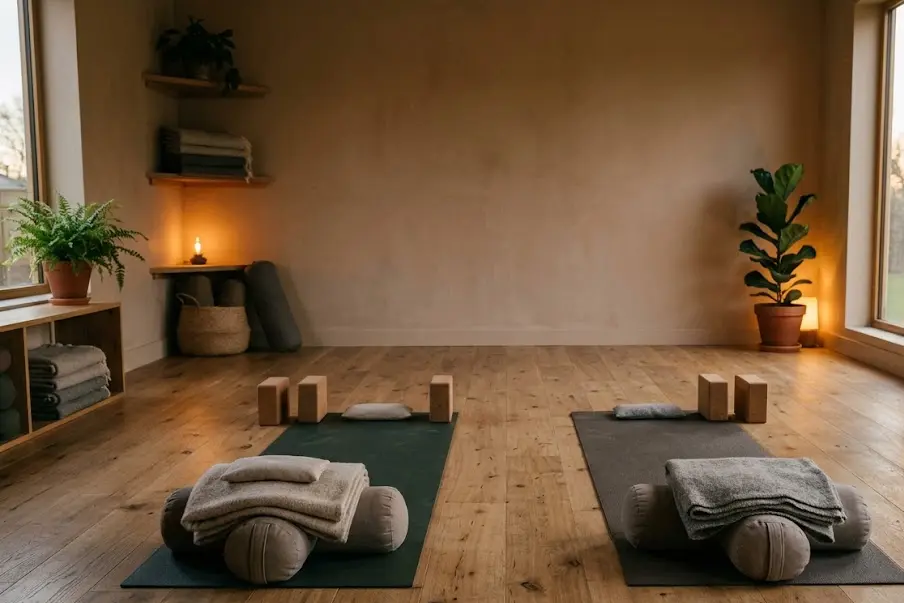
Yin and restorative yoga are often scheduled side by side as the "slow" classes, and from the outside they look almost the same: people lying or sitting on the floor, not moving much, for a long time. Cleveland Clinic describes both as "slow, meditative, floor-based yoga" but notes that "each has a unique goal" (Cleveland Clinic). Here's how they differ, what the limited research shows, and a short sequence for each so you can feel the difference yourself.
Quick answer
- Yin yoga holds floor stretches for several minutes. You're meant to feel a mild, steady stretch. Cleveland Clinic calls it "long, deep, active stretching" aimed at muscles and connective tissue (Cleveland Clinic).
- Restorative yoga uses props to support your body so you can rest. It's "designed to give you a period of complete mental and physical relaxation" (Cleveland Clinic).
- Choose yin if you want slow flexibility work and don't mind some sensation.
- Choose restorative if you want to rest and recover, or if stretching for several minutes doesn't appeal to you.
- The research is thin for both. No study we found compares the two directly.
Yin and restorative yoga side by side
| Yin yoga | Restorative yoga | |
|---|---|---|
| Intent | Stay in a mild stretch for a long time. Aims "to improve flexibility of muscles and connective tissues" (Cleveland Clinic) | Rest in fully supported positions. Props are used "to remove all muscular effort" (Kanaya et al., 2014) |
| What you should feel | A noticeable but tolerable stretch | Little or nothing. "There should be no discomfort in your poses" (Cleveland Clinic) |
| Pace | Very slow; a handful of poses per class | Even slower; fewer poses, longer rests |
| Hold times | About 3 to 5 minutes in one trial (Daukantaitė et al., 2018); "three minutes to nearly 10 minutes" per Cleveland Clinic (Cleveland Clinic) | "Five to 10 minutes at a time or longer" (Cleveland Clinic) |
| Props | Optional. Used to help you get into position (Cleveland Clinic); another Cleveland Clinic article says yin uses "fewer props" (Cleveland Clinic) | Central. Bolsters, blankets, and pillows support the knees, neck, and lower back (Cleveland Clinic) |
| Intensity | Low effort, but long holds can feel intense | Very low effort |
| Typical class | Mostly seated and lying poses, often with a short breathing practice at the start and a final rest at the end (Somere et al., 2024) | A few supported poses such as legs up the wall, supported child's pose, a supine twist, a reclined butterfly, and corpse pose, sometimes with low light and an eye covering (Cleveland Clinic) |
Cleveland Clinic says both "can help relieve the pressures of daily life and are suitable for students of all levels" (Cleveland Clinic).
Many poses appear in both styles, set up differently. Bound angle is a seated forward fold in yin (often called "butterfly") and a reclined, supported rest in restorative. Yin also uses its own names for familiar poses. For example, yin's "swan" is a version of pigeon pose.
What yin yoga is
Yin is a slow style built around long, passive holds. A 2024 study describes it as a series of passive poses "typically held between three to ten minutes," mostly seated or lying down, with no standing, balancing, or inverted poses and minimal muscle use (Somere et al., 2024). Yin teachers often say the long holds target connective tissue such as fascia and ligaments rather than muscle. That's how the style is usually described, but we didn't find direct evidence that yin changes connective tissue differently from other stretching, so treat it as a teaching idea rather than an established finding.
For poses, a typical class and safety notes, see our full yin yoga guide.
Cleveland Clinic's expert notes that "Yin yoga requires more practice and patience to achieve a deep stretch but can be physically and mentally rewarding" (Cleveland Clinic).
What restorative yoga is
Restorative yoga uses props to hold you in comfortable positions so you can rest. Researchers in one trial described it as "prolonged periods of rest in supported poses using props to remove all muscular effort" (Kanaya et al., 2014). A Cleveland Clinic yoga therapist explains that restorative poses "help activate the parasympathetic nervous system," the part of the nervous system that relaxes your body after stress (Cleveland Clinic).
For props, a sample class and who it suits, see our full restorative yoga guide.
The rule of thumb: if you feel strain, add support.
What the research says
Both styles have little research, mostly small studies with caveats. We found no trial comparing them directly.
Yin yoga
- Stress, anxiety, and sleep. In a Swedish trial, 105 adults with moderate to high stress were randomly assigned to five weeks of yin yoga (60 minutes, twice a week), yin yoga plus mindfulness and psychoeducation, or no intervention. Both yoga groups had greater drops in anxiety and sleep problems than the control group. Perceived stress and depression improved significantly only in the group that added mindfulness (Daukantaitė et al., 2018). The authors noted high dropout, mostly well-educated women, self-reported measures, and no placebo-type comparison.
- Anxiety during the COVID-19 pandemic. A study of 48 women in Latvia found that 10 weeks of weekly online yin classes reduced state anxiety (how anxious you feel right now) compared with a control group, and anxiety dropped after each class. Trait anxiety (a more stable tendency) didn't differ between groups (Somere et al., 2024).
Bottom line: small trials suggest yin classes may help people feel less anxious and sleep somewhat better than doing nothing. They don't show that yin works better than other yoga, other stretching, or other relaxation methods.
Restorative yoga
- Metabolic health. In the PRYSMS trial, 180 underactive adults with metabolic syndrome were randomly assigned to restorative yoga or a stretching class for a year. At 12 months, fasting glucose dropped more in the yoga group, but there were no other significant differences. The authors concluded restorative yoga "was marginally better than stretching for improving fasting glucose but not other metabolic factors" (Kanaya et al., 2014).
- Stress and cortisol. A second analysis of the same trial found the opposite of what you might expect. At six months, the stretching group had lower waking and bedtime cortisol, and at one year it had a larger drop in perceived stress, than the restorative yoga group. The authors suggested the group support in the more interactive stretching classes may have played a role (Corey et al., 2014).
- Other studies. Cleveland Clinic cites small studies in breast and ovarian cancer survivors and in medical students that reported benefits such as better adherence, thinking skills, and relaxation (Cleveland Clinic). We didn't review those studies directly.
Bottom line: restorative yoga is a reasonable way to rest, but the best trial we found doesn't show it beats ordinary stretching for stress. For yoga in general, NCCIH notes that a 2020 review found beneficial effects on perceived stress, and that yoga "has been shown to be helpful for sleep in multiple studies" (NCCIH). Those findings come from many styles, not specifically from yin or restorative.
Calories: there isn't a reliable number
The standard reference for estimating calories from activity is the 2024 Adult Compendium of Physical Activities. It lists hatha yoga at 2.3 METs, vinyasa at 2.7, and general yoga at 2.3, but it has no entry for yin or restorative yoga (Compendium, conditioning exercise). We haven't substituted a different activity's value, because that would be a guess dressed up as a number.
What we can say: both styles involve far less movement than a hatha class, and hatha is already light intensity. Activities under 3.0 METs are classed as light, and 3.0 to 6.0 as moderate (Grabara, 2025). Neither yin nor restorative should be counted as aerobic exercise. If you want an estimate for a more active style, use our yoga calories calculator.
Who each one suits
Yin may suit you better if:
- You want to work on flexibility slowly, especially in the hips and hamstrings.
- You do running, cycling, or faster yoga and want a slower counterpart. Cleveland Clinic suggests both slow styles fit well alongside "other types of yoga or athletic activities" (Cleveland Clinic).
- You're comfortable staying with mild sensation for a few minutes at a time.
Restorative may suit you better if:
- Your main goal is rest. Cleveland Clinic's expert says "Restorative yoga is best if you want a restful, healing experience" (Cleveland Clinic).
- Long stretches feel uncomfortable or you find yin frustrating.
- You want something gentle on a tired day, after hard exercise, or before bed.
Either is a reasonable choice if you're new to yoga and find faster classes intimidating. A Cleveland Clinic yoga therapist notes that slower styles let you "ease into it, and then work yourself up to more active classes like vinyasa or Ashtanga" (Cleveland Clinic). If you'd rather start with a general class, see hatha yoga or the prop-heavy, alignment-focused Iyengar yoga.
How to try both
- Take one class of each. A Cleveland Clinic restorative teacher recommends "taking a couple of restorative yoga classes" to learn prop setups before practicing at home (Cleveland Clinic). NCCIH recommends learning under "a qualified instructor" (NCCIH).
- Start short. Cleveland Clinic suggests 20 to 30 minutes of restorative yoga at first (Cleveland Clinic). The sequences below are about 20 minutes each.
- Try them on different days and compare how you feel that evening and the next morning.
- Pair them with more active movement. Neither style raises your heart rate much. Balance them with walking, strength work, or a more active practice such as vinyasa. Our routines and morning yoga routines include shorter options.
- Add breathing if you like. Slow breathing fits well at the start of either practice. See our breathing hub.
Sample 20-minute yin sequence
You'll need a mat and, optionally, a cushion or folded blanket. Set a gentle timer. Holds here are on the short end of the usual range; lengthen them as you get used to the style. In each pose, settle into a mild stretch, not your maximum, and stay still. Come out slowly.
- Seated breathing (1 minute). Sit on a cushion and breathe slowly through your nose.
- Butterfly (3 minutes). From bound angle, slide your feet away from you and fold forward with a rounded back. Rest your head on your hands or a cushion if it helps.
- Caterpillar (3 minutes). A relaxed seated forward fold with your knees bent as much as you need. Let your back round.
- Sphinx (3 minutes). Lie on your belly, propped on your forearms, as in sphinx pose. Lower to the floor if your lower back complains.
- Child's pose (1 minute). A short rest in child's pose to reset.
- Swan (2 minutes each side). A version of pigeon pose with your chest folded forward. Put a cushion under your front hip if it doesn't reach the floor. Skip this one if it bothers your knee, and try a reclined figure-four instead.
- Reclined twist (1½ minutes each side). Lie on your back and let your knees fall to one side in a reclined twist.
- Final rest (2 minutes). Happy baby for a few breaths if you like, then corpse pose.
Total: about 20 minutes.
Sample 20-minute restorative sequence
You'll need a mat or rug, two or three firm pillows or a bolster, two folded blankets or bath towels, and a wall. A yoga block or a thick book works under the hips. Setup takes a few minutes, so allow some extra time. In each pose, adjust the props until nothing feels like effort.
- Supported child's pose (4 minutes). Kneel with your knees apart and a stack of pillows lengthwise between them. Lie your chest and one cheek on the stack. Turn your head the other way halfway through. Cleveland Clinic lists supported child's pose among common restorative poses (Cleveland Clinic).
- Supported bridge (4 minutes). Lie on your back with your knees bent, lift your hips, and slide a block or firm cushion under your sacrum (the flat bone at the base of your spine). Rest your weight on it. See supported bridge.
- Reclined bound angle (5 minutes). Lie back on a pillow or bolster with the soles of your feet together and pillows or folded blankets under each knee so your hips don't strain. This is a supported version of bound angle.
- Legs up the wall (4 minutes). Lie with your hips a few inches from the wall and your legs resting up it, with a folded blanket under your lower back if you like. Come out slowly (Cleveland Clinic). See the safety notes below before trying this one. A gentler swap is resting your calves on a chair seat. See legs up the wall.
- Supported corpse pose (3 minutes or longer). Lie on your back with a rolled blanket under your knees and a thin pillow under your head. Cover your eyes if you like. See corpse pose.
Total: about 20 minutes of holding, plus setup.
Safety notes
- Yin should never hurt. Mild sensation is expected, but sharp pain, numbness, or tingling means come out of the pose. Cleveland Clinic advises: "you should never feel pain. If you do, stop and reassess" (Cleveland Clinic).
- Restorative shouldn't be uncomfortable at all. If it is, add props or skip the pose (Cleveland Clinic).
- Move slowly out of long holds. Joints can feel stiff after several minutes still. Cleveland Clinic advises against coming out of an inversion like legs up the wall quickly and suggests sitting quietly for at least 30 seconds (Cleveland Clinic).
- Legs up the wall isn't for everyone. Cleveland Clinic says to avoid it if you have glaucoma or uncontrolled high blood pressure, and to avoid it or do it only with a doctor's guidance if you have congestive heart failure, kidney failure, or liver failure or cirrhosis (Cleveland Clinic).
- If you're pregnant, talk with your health care provider first. NCCIH advises avoiding yoga poses that involve "long periods of being still or lying on your back" (NCCIH). That rules out several poses in both sequences above unless your provider or a prenatal teacher adapts them.
- Older adults should take extra care. NCCIH notes that yoga-related injuries treated in emergency departments are more common in people 65 and older (NCCIH). If getting up and down from the floor is hard, use a sturdy chair nearby or ask a teacher about chair-based options.
- Don't use either to put off care. NCCIH advises against using yoga to postpone seeing a health care provider about a medical problem (NCCIH).
Sources
- Cleveland Clinic. "7 Different Kinds of Yoga and How To Find the Right Practice" (published June 2, 2022). https://health.clevelandclinic.org/how-to-find-the-best-yoga-class-for-you
- Cleveland Clinic. "How Restorative Yoga Can Nurture Your Mind, Body and Spirit." https://health.clevelandclinic.org/restorative-yoga
- Cleveland Clinic. "Yoga for Beginners." https://health.clevelandclinic.org/yoga-for-beginners
- Cleveland Clinic. "The Yoga Pose You Need: The Health Benefits of Legs Up the Wall." https://health.clevelandclinic.org/benefits-of-legs-up-the-wall
- National Center for Complementary and Integrative Health (NCCIH). "Yoga: What You Need To Know." https://www.nccih.nih.gov/health/yoga-what-you-need-to-know
- Daukantaitė D, Tellhed U, Maddux RE, Svensson T, Melander O. "Five-week yin yoga-based interventions decreased plasma adrenomedullin and increased psychological health in stressed adults: A randomized controlled trial." PLOS ONE. 2018;13(7):e0200518. https://journals.plos.org/plosone/article?id=10.1371/journal.pone.0200518
- Somere K, Munkevics M, et al. "The effect of yin yoga intervention on state and trait anxiety during the COVID-19 pandemic." Frontiers in Psychiatry. 2024;15:1345455. https://pmc.ncbi.nlm.nih.gov/articles/PMC10973109/
- Kanaya AM, Araneta MR, Pawlowsky SB, et al. "Restorative yoga and metabolic risk factors: the Practicing Restorative Yoga vs. Stretching for the Metabolic Syndrome (PRYSMS) randomized trial." Journal of Diabetes and Its Complications. 2014;28(3):406-412. https://pmc.ncbi.nlm.nih.gov/articles/PMC4004660/
- Corey SM, Epel E, Schembri M, et al. "Effect of restorative yoga vs. stretching on diurnal cortisol dynamics and psychosocial outcomes in individuals with the metabolic syndrome: the PRYSMS randomized controlled trial." Psychoneuroendocrinology. 2014;49:260-271. https://pmc.ncbi.nlm.nih.gov/articles/PMC4174464/
- Compendium of Physical Activities. "Conditioning Exercise" (2024 Adult Compendium, codes 02150, 02175, 02185). https://pacompendium.com/conditioning-exercise/
- Grabara M. "Intensity of Hatha yoga training for older adults." Scientific Reports. 2025;15:12936. https://pmc.ncbi.nlm.nih.gov/articles/PMC12000320/
Want new practices by email?
We email now and then when we publish a new routine, practice or guide. No spam, unsubscribe any time.
Join the YogaMag newsletterFrequently Asked Questions
Popular posts
Related posts




No comments yet. Be the first to comment!