Yoga Styles

Restorative Yoga - Complete Guide, Benefits, and Poses

A slow, quiet style of yoga in which a few poses are fully supported by bolsters, blankets and blocks and held for several minutes each.

Part of our guide: Yoga for Sleep and Winding Down

Published: October 14, 2026 Updated: October 14, 2026

What Restorative Yoga Is

Restorative yoga is a practice of resting in a small number of fully supported poses. Bolsters, blankets and blocks hold your body in place so your muscles can let go, and each pose is held for several minutes. There is very little movement and no effort to stretch further.

The style grew out of B.K.S. Iyengar's use of props to support students who were ill, injured or tired. One of his early American students, Judith Hanson Lasater, a physical therapist who began teaching yoga in 1971, is widely credited with shaping it into a class format of its own. Her 1995 book Relax and Renew: Restful Yoga for Stressful Times laid out the supported poses and sequences that most restorative classes in the United States still use.

The Core Idea

If a pose needs effort to hold, add support until it doesn't. Restorative yoga is not a workout or a deep stretch. It is a structured way to lie still, breathe and rest.

Key Characteristics

  • Poses held about 5-10 minutes or longer
  • A handful of poses per class
  • Body fully supported by props
  • Mostly lying down or reclined
  • No pose should feel uncomfortable

What a Class Looks Like

Set Up

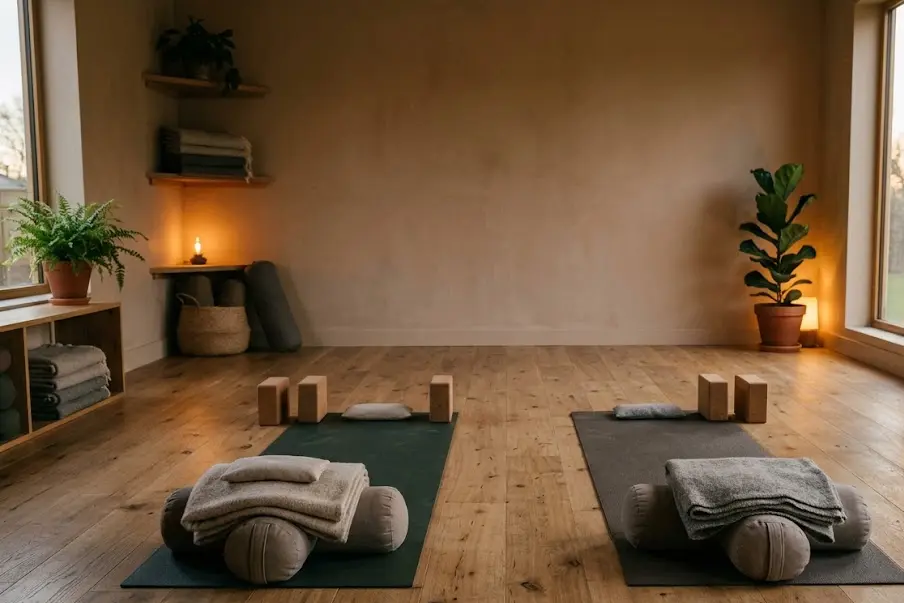
The teacher shows how to arrange bolsters, blankets and blocks for each pose. Setting up well takes a minute or two and matters more than the pose itself.

Settle and Stay

You stay in each pose for several minutes, often 5 to 10 or more, breathing normally. Many teachers dim the lights and offer an eye pillow or an extra blanket for warmth.

Close in Savasana

Most classes end with a long, supported Corpse Pose. A full class may include only a handful of poses.

What You Can Reasonably Expect

Physical

  • Low-effort poses that take pressure off joints
  • Gentle, supported opening of hips and chest
  • An easy session for rest or recovery days

Mental

  • Set-aside time to be still and quiet
  • Practice noticing your breath
  • A calmer way to end the day

What the Research Says

The National Center for Complementary and Integrative Health (NCCIH) summarizes reviews in which yoga in general improved perceived stress in healthy adults and helped sleep in several groups. Many of those studies were small, and few looked at restorative yoga specifically, so treat it as a way to rest, not a treatment.

Common Restorative Poses

Supported Child's Pose

Props: Bolster lengthwise under the torso, blanket under the knees

Setup: Knees wide, chest and one cheek resting on the bolster. Turn your head halfway through.

Legs Up the Wall

Props: Folded blanket under the hips (optional)

Setup: Lie on your back with your legs resting up a wall. Move your hips back from the wall if your hamstrings pull.

Supported Reclined Bound Angle

Props: Bolster along the spine, a block or blanket under each thigh

Setup: Soles of the feet together, knees falling open onto the supports so the inner thighs do not strain.

Supported Reclined Twist

Props: Bolster or blanket between and under the knees

Setup: Knees drop to one side onto the support so the twist stays mild. Stay a few minutes, then switch sides.

Supported Bridge

Props: Block on its lowest height, or a bolster, under the sacrum

Setup: Rest your weight on the support with arms by your sides. Lift your hips to remove the block before you come down.

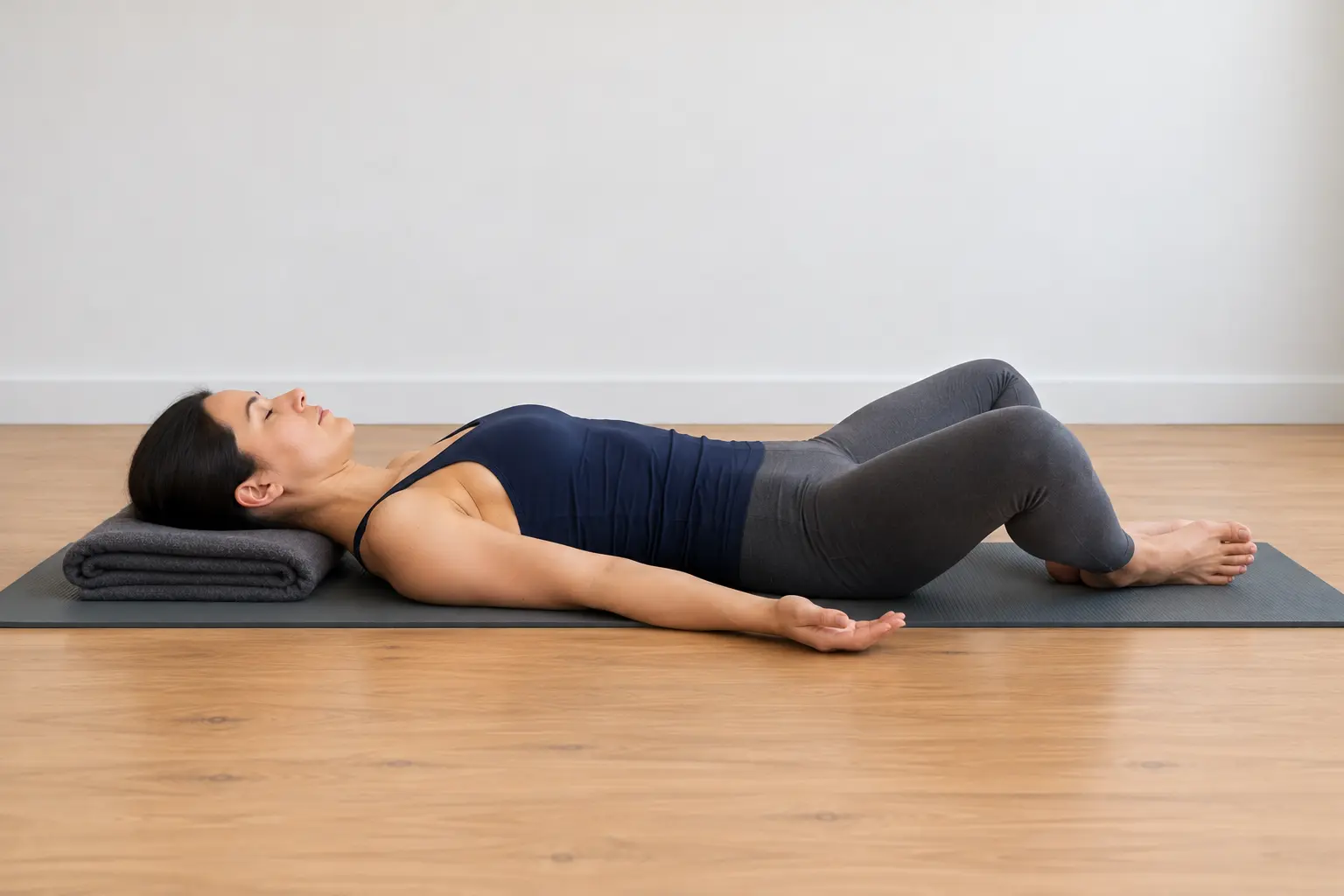
Supported Savasana

Props: Bolster under the knees, folded blanket under the head, eye pillow

Setup: Lie on your back with everything supported. Cover yourself with a blanket, since you cool down when still.

Restorative vs. Yin Yoga

Both styles are slow, floor-based and use long holds, so they are often confused. The difference is the goal. In Yin Yoga you move into a pose until you feel a clear stretch, then stay there for 3 to 5 minutes or more. In restorative yoga you add props until there is no stretch to speak of, and you simply rest.

Restorative

  • Aim: rest with no discomfort
  • Many props in every pose
  • Fewer poses, often longer holds

Yin

  • Aim: a steady stretch you can stay with
  • Props used to adjust, not to remove sensation
  • More poses, mostly hips and lower back

If you want a slow class with some active work, try Hatha Yoga. Restorative poses also borrow heavily from Iyengar Yoga, where many of these prop setups started.

Who It Suits and Who Should Modify

Good Fit For

Beginners, people who find active classes too demanding, anyone wanting an easy session on a rest day, and people who simply want a quiet hour. No flexibility or fitness is required.

Duration

At home, start with 20-30 minutes and two or three poses. Studio classes usually run 60-75 minutes. In the evening, pair it with slow breathing exercises.

Precautions

  • Pregnant: NCCIH advises avoiding long periods lying on your back; ask for side-lying setups
  • Glaucoma or severe high blood pressure: ask before legs-up or head-low poses
  • Knee, hip or back injuries: tell the teacher so props can be adjusted
  • Come out of any pose that causes pain, numbness or tingling
  • Talk to your health care provider if you have a medical condition

Getting Started at Home

You don't need studio gear. Household items work as long as they are firm enough to hold you.

Props

Bolster or Firm Pillows

2-3 Blankets

Two Blocks or Books

Eye Pillow (optional)

Beginner's Tip

Set a gentle timer so you aren't checking the clock. If you fall asleep, that's fine. For a ready-made sequence, browse our routines and pick a short, gentle one.

Restorative Yoga FAQ

Is restorative yoga good for beginners?

Yes. It needs no flexibility or fitness, and the teacher sets up each pose with you. It is one of the easiest classes to start with.

How long are poses held in restorative yoga?

Usually about 5 to 10 minutes, sometimes longer for the final Savasana. At home, 3 to 5 minutes per pose is a reasonable start.

Will restorative yoga build strength or burn many calories?

No. It is designed to be low effort. Pair it with an active style such as Vinyasa or Power Yoga, or another form of exercise, if strength and fitness are goals.

What is the difference between restorative and yin yoga?

Yin holds a pose at a point of noticeable stretch. Restorative uses props to remove the stretch so you can rest. Both are slow and quiet.

Sources: NCCIH, Yoga: Effectiveness and Safety (opens in a new tab); Cleveland Clinic, Restorative Yoga (opens in a new tab); Harvard Health, Yoga for Better Sleep (opens in a new tab). This page is general information, not medical advice.

Related Articles

Want to try yoga at home first?

Our free timed routines run from 2 to 20 minutes, with a timer that tells you when to switch poses.

Find a routine

Want to loosen up? Yoga for flexibility: 15 poses by body area and two routines.