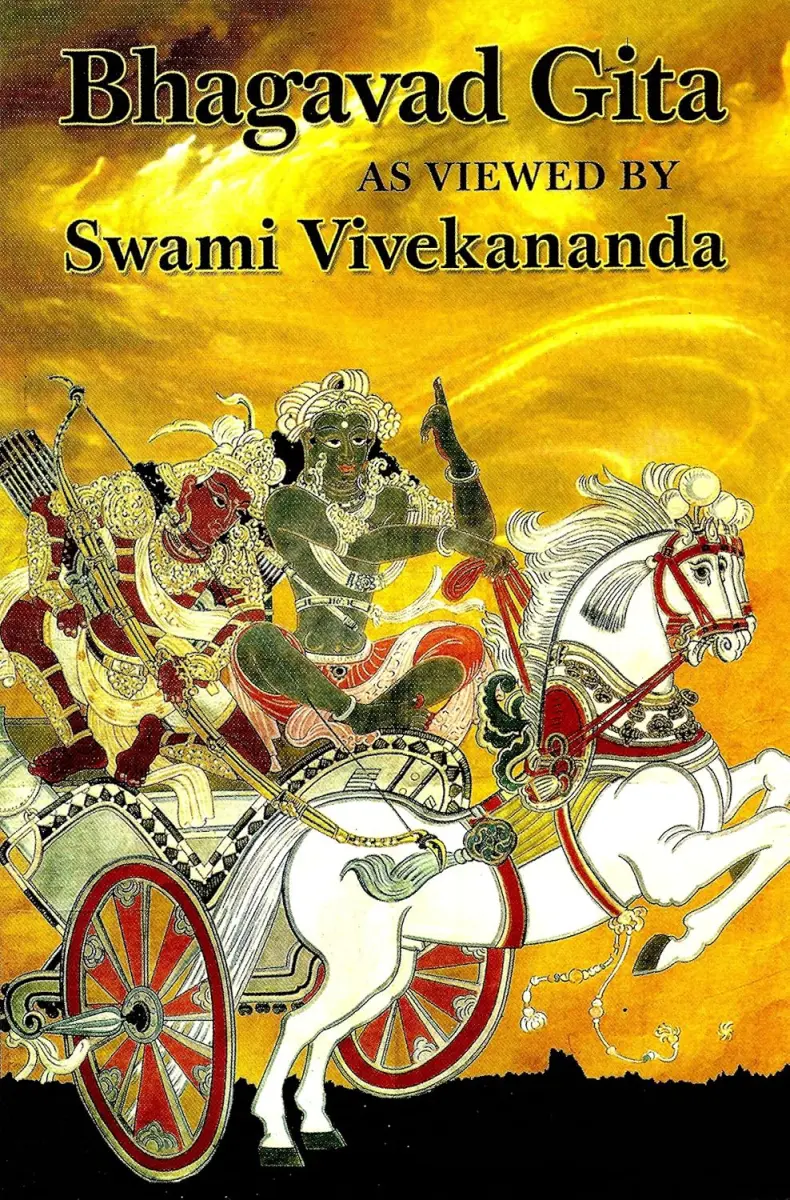
Bhagavad Gita As Viewed by Swami Vivekananda is a powerful compilation of Swami Vivekananda’s interpretations and insights on the Bhagavad Gita, a foundational spiritual scripture of Hindu philosophy. Swami Madhurananda assembled these teachings from Vivekananda’s Complete Works to present a unified view of how this modern sage understood and applied the Gita’s wisdom.
Vivekananda emphasizes that the Gita is more than a religious text — it is a manual for life, especially for those engaged in the world. Unlike escapist philosophies, the Gita calls upon the reader to rise above fear, laziness, and delusion, and to embrace courageous action (karma yoga) rooted in detachment and devotion. Krishna’s call to Arjuna — Yield not to unmanliness, O Partha! — is a recurring theme, representing the voice of the Higher Self urging each person to awaken to their divine nature and duty.
According to Vivekananda, the Gita is not about non-violence or pacifism in the superficial sense. It teaches righteousness (dharma) and non-attachment, even in the midst of warfare, symbolizing the inner battle between the higher and lower selves. Arjuna’s weakness on the battlefield represents the confusion faced by all individuals when emotions cloud duty and clarity. Krishna, representing divine wisdom, clears the fog by teaching Arjuna about the immortal soul (Atman), which is neither born nor dies, and about the illusion of the body and ego.
Swami Vivekananda also highlights the Gita's unifying message — it harmonizes all paths: jnana (knowledge), bhakti (devotion), karma (action), and raja (meditation). The Gita does not reject any school of thought but integrates them into a complete spiritual vision. He contrasts this with narrow interpretations of scriptures that exclude one approach in favor of another. Krishna accepts all sincere efforts, and the Gita’s spiritual breadth accommodates everyone, regardless of caste, gender, or background.
One of the most powerful aspects of Vivekananda’s interpretation is his focus on strength. He believed that India’s decline was due in part to misinterpreting the Gita’s message and embracing weakness in the name of renunciation. Instead, he calls for a revival of manliness, fearlessness, and intense karma yoga, where people work not for results but for the purification of the heart. He links the Gita’s teachings directly with national and personal regeneration.
Vivekananda also clarifies that true nishkama karma (selfless action) is not heartless or indifferent but is rooted in deep compassion and spiritual awareness. Acting without attachment doesn’t mean acting without love — it means acting from a place of freedom and unity with the Divine.
In conclusion, Swami Vivekananda saw the Gita as a spiritual dynamo that could transform individuals and nations. For him, it was not a book of religion but a handbook for inner revolution. Its true message was self-realization, fearlessness, and harmony — qualities he believed were urgently needed in modern life.
100 important points from “Bhagavad Gita As Viewed by Swami Vivekananda”, capturing key insights and interpretations:
Spiritual Philosophy and Core Ideas
- The Gita teaches the divinity of the soul (Atman).
- The body is perishable; the soul is eternal.
- Krishna represents the Higher Self or Supreme Consciousness.
- Arjuna symbolizes the struggling human soul.
- The battlefield is symbolic of life’s inner and outer struggles.
- True strength lies in detachment, not inaction.
- Non-attachment (nishkama karma) is key to liberation.
- Fear is the only real sin, according to Vivekananda.
- Strength is the essence of spirituality.
- The Gita is a commentary on the Upanishads.
On Dharma and Duty
- Doing one’s duty without attachment is dharma.
- Cowardice must not be confused with compassion.
- The Gita insists on action, not escapism.
- Arjuna’s doubt arises from tamas (inertia), not sattva (purity).
- Dharma is contextual and must be performed boldly.
- Even violence may be justified in defense of dharma.
Interpretation of the Gita
- The Gita harmonizes jnana, bhakti, karma, and raja yoga.
- It is an inclusive scripture, not sectarian.
- Its wisdom transcends caste, creed, and gender.
- Krishna’s "I" refers to the Atman, not the individual ego.
- The Gita teaches personal transformation, not dogma.
- It was possibly added to the Mahabharata but matches its philosophy.
- The historical personality of Krishna is secondary to the spiritual message.
On Karma Yoga
- Work must be done selflessly.
- The ego should not claim the fruits of actions.
- Concentrated action (with full attention) is true karma yoga.
- The best work is done without selfish motives.
- Work done without attachment leads to purification.
- Even small acts can be spiritual if done with purity.
- Karma yoga leads to spiritual growth.
On Jnana Yoga (Knowledge)
- The Gita conveys deep non-dualistic knowledge.
- Wisdom must rise above emotions and senses.
- Real knowledge is realization of the Self.
- “I am That” – the realization of unity with Brahman.
- Death is not the end, just transformation.
- Existence is eternal; fear arises from ignorance.
- Emotion must not blind reason.
On Bhakti Yoga (Devotion)
- Bhakti is glorified in the Gita.
- Krishna’s love is universal and constant.
- Love of God means loving all beings.
- Bhakti does not require historical belief, only devotion.
- God is formless and personal at once.
- Bhakti must be free of ego and selfishness.
- God responds to sincere devotion, not ritual.
On Strength and Manliness
- “Do not yield to weakness” is the Gita’s core message.
- Even forgiveness must be backed by strength.
- Effeminate weakness is tamas, not sattva.
- A true spiritual person is fearless and bold.
- The Gita inspires heroism, not escapism.
- Cowardice in the name of spirituality is sin.
Application to Modern Life
- Vivekananda urges karma yoga for national regeneration.
- Meditation must be backed by active service.
- Social reform must be rooted in spiritual power.
- The Gita supports inner strength in daily life.
- It teaches spiritual action in the midst of chaos.
- Life should be spiritualized, not escaped from.
- The Gita is useful in every profession and stage of life.
Universalism
- All religions are accepted in the Gita.
- There’s no condemnation of other faiths.
- Krishna harmonizes diverse paths of worship.
- Truth is one; paths are many.
- Gita is a universal scripture, not just Hindu.
- Buddhism is not mentioned because it came later.
- Gita respects all levels of spiritual evolution.
Gita’s Influence and Legacy
- The Gita is the Bible of Hinduism.
- It influenced Western thinkers like Emerson.
- Swami Vivekananda praised Shankaracharya’s commentary on it.
- All Vedantic sects use the Gita as an authority.
- The Gita remains relevant across centuries.
- It is a scripture of action, strength, and harmony.
Vivekananda’s Interpretations
- Vivekananda linked the Gita with national pride.
- He taught that spiritual awakening leads to social upliftment.
- He warned against misinterpreting renunciation.
- Renunciation without strength is hypocrisy.
- He emphasized yoga as the path to realization.
Practical Teachings
- Repeat great mantras like “Tat Tvam Asi”, “Soham”.
- Read the Gita daily, even if only one verse.
- Teach others about the Atman.
- Meditate with courage, not fear.
- Don’t be a passive observer in life.
Symbolism and Allegory
- Arjuna’s doubt is our everyday confusion.
- The Kurukshetra war is the inner battle of life.
- Krishna’s chariot is symbolic of the body.
- The senses are the horses, the mind the reins.
- The soul must control them all to attain liberation.
Warnings Against Misuse
- Tamas can disguise itself as sattva.
- Lazy and weak people often pretend to be renunciates.
- True sattva shows in calm strength and clear thinking.
- Emotionalism is not the same as bhakti.
- Sentimentality without control is weakness.
Messages for Youth
- Strength comes before religion.
- Football may be better than Gita if it builds strength.
- Young people must embrace karma yoga.
- No room for excuses in spiritual life.
- The Gita is a guide for warriors — inner and outer.
Final Takeaways
- The Gita teaches bold living and fearless dying.
- It is a synthesis of Vedantic wisdom.
- Spiritual life means conquering weakness and illusion.
- The goal is realization of the immortal Self.
- The Gita’s core teaching: Arise, awake, and fight with inner strength!
. . .