

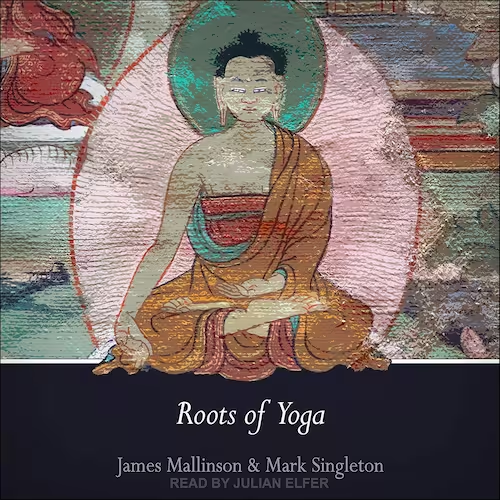
Roots of Yoga by James Mallinson and Mark Singleton
Roots of Yoga, translated and edited by James Mallinson and Mark Singleton, is a scholarly compilation of yoga’s historical, philosophical, and practical dimensions. Drawing from over 100 ancient texts in Sanskrit, Tibetan, Persian, and more, it explores the origins of asanas, pranayama, meditation, mantras, and liberation. The book provides rare insights into the evolution of yoga traditions, from the Upanishads to Hatha Yoga...
Summary of Roots of Yoga
Roots of Yoga, translated and edited by James Mallinson and Mark Singleton, provides a deep exploration of yoga's historical, philosophical, and practical aspects. The book compiles excerpts from over 100 ancient texts, spanning Sanskrit, Tibetan, Arabic, Persian, and other languages, revealing the evolution of yoga practices from 1000 BCE to the 19th century. It examines asanas, pranayama, meditation, mantras, and philosophical discussions, bridging ancient traditions with their modern interpretations. This work offers invaluable insights for practitioners, scholars, and anyone seeking a comprehensive understanding of yoga's origins and significance.

Why One Should Read Roots of Yoga
- To understand the historical evolution of yoga over millennia.
- To gain access to rare and untranslated yoga texts from diverse traditions.
- To explore the origins of asanas and their purpose beyond physical fitness.
- To comprehend the spiritual and metaphysical roots of yoga.
- To appreciate yoga's development through cross-cultural exchanges (e.g., with Buddhism and Tantra).
- To study practical techniques like pranayama, mudras, and samadhi in their original context.
- To learn how yoga connects with philosophical systems like Samkhya and Vedanta.
- To understand how yoga evolved into global modern practices.
- To appreciate the diverse interpretations of liberation (moksha) across traditions.
- To deepen knowledge of yoga’s connection with physical and subtle bodies.
50 Important Points from Roots of Yoga
Historical Context and Development
- Yoga originated around 1000 BCE and evolved over centuries into various traditions.
- The book spans texts in Sanskrit, Tibetan, Arabic, Persian, and more.
- Early mentions of yoga appear in Vedic texts and the Upanishads.
- The Mahabharata and Bhagavad Gita explore yoga's ethical and spiritual dimensions.
- Tantra significantly influenced the development of yogic practices.
Philosophy and Spirituality
- Yoga is rooted in Samkhya philosophy, emphasizing purusha (soul) and prakriti (matter).
- Patanjali’s Yoga Sutras systematized yoga into an eightfold path (ashtanga yoga).
- Liberation (moksha) is a core aim of yoga, varying from oneness with divinity to freedom from rebirth.
- Yogic teachings focus on overcoming the ego and attachments.
- The concept of kundalini energy is central to many yoga traditions.
Practical Techniques
- The early focus of yoga was on meditation and mental control, not physical asanas.
- Breath control (pranayama) was a primary practice in classical yoga.
- Yoga's six cleansing techniques (shatkarma) were introduced for physical and mental purification.
- Meditation (dhyana) evolved from Buddhist and Jain influences.
- Mantra chanting, such as "Om," is integral to yogic disciplines.
Asanas and Physical Practice
- Early texts describe asanas as stable sitting postures for meditation.
- The expansion of physical asanas began with Hatha Yoga texts.
- The 17th-century Haṭhapradīpikā codified many of the physical poses practiced today.
- Yoga asanas are linked to energetic and spiritual benefits, not just physical fitness.
- Asanas became a prominent feature in modern yoga's global spread.
Subtle Body and Energetics
- Yoga texts describe the body as a microcosm of the universe.
- Chakras and nadis (energy channels) play central roles in advanced practices.
- The kundalini energy resides at the base of the spine and is awakened through yoga.
- Practices like mudras and bandhas manipulate energy flow within the body.
- Breathwork is linked to balancing prana (life force) in the subtle body.
Diversity Across Traditions
- Buddhist, Jain, and Hindu traditions influenced yoga’s evolution.
- Tantric practices introduced visualizations, rituals, and deity worship to yoga.
- The Jain concept of tapas (austerity) overlaps with yogic discipline.
- Sufi mysticism and Persian texts incorporate yoga-like practices.
- Tibetan yoga integrates breathing techniques with spiritual visualization.
Modern Interpretations
- Yoga adapted to global cultures through psychology, sports science, and biomedicine.
- 19th-century texts reflect the rise of Hatha Yoga's accessibility to lay practitioners.
- The integration of yoga into fitness culture began in the 20th century.
- Yoga's globalization has led to diverse interpretations, including power yoga and yin yoga.
- The International Day of Yoga reflects its universal appeal today.
Criticism and Misconceptions
- Some Vedic orthodoxy criticized yoga as non-Brahmanical.
- Misinterpretations often conflate physical yoga with its spiritual aims.
- Not all yoga practices aim for liberation; some focus on practical benefits.
- The book highlights the myths of "ancient yoga poses" in modern fitness trends.
- Tantra and ascetic practices are often misunderstood in mainstream yoga.
Scholarly Insights
- The book draws from over 100 primary sources, many of which are rare.
- It challenges the notion that Patanjali's Yoga Sutras are the definitive yoga text.
- Historical analysis reveals yoga’s cross-cultural exchanges over time.
- Scholarly contributions help distinguish yoga's philosophical and practical aspects.
- The authors bridge academic rigor with accessible translations.
Relevance for Practitioners
- Understand the authentic roots of asanas and pranayama.
- Learn how to incorporate yoga as a holistic lifestyle practice.
- Gain deeper insight into yoga’s spiritual goals beyond fitness.
- Explore ancient teachings to enrich modern yoga practices.
- Use the text as a reference for scholarly and personal growth.