

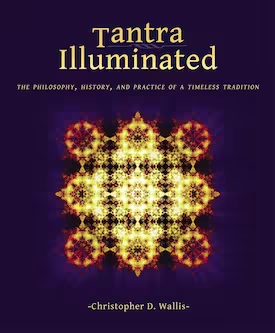
Tantra Illuminated: The Philosophy, History, and Practice of a Timeless Tradition by Christopher D. Wallis
Tantra Illuminated by Christopher D. Wallis explores the history, philosophy, and practices of classical Śaiva Tantra, distinguishing it from modern neo-Tantra. The book delves into nondual Śaivism, Śakti (divine energy), Kundalini, mantra chanting, deity worship, meditation, and rituals. It emphasizes direct experience, spiritual awakening, and the integration of Tantra into modern yoga. Rooted in Sanskrit texts, it provides...
Tantra Illuminated is a comprehensive exploration of the history, philosophy, and practice of classical Śaiva Tantra. Wallis dispels common misconceptions, distinguishing traditional Tantra from modern, Westernized interpretations. The book covers key philosophical concepts such as nondual Śaivism, the role of Śakti (divine energy), and the transformational power of Tantric practice. It delves into essential practices like mantra chanting, deity worship, meditation, and ritual. The historical evolution of Tantra is also discussed, highlighting its influence on yoga and spirituality. The book aims to provide both an academic and experiential understanding of Tantra, making it accessible to scholars and spiritual seekers alike.

Why You Should Read Tantra Illuminated
- Clarifies Misconceptions – It corrects the widespread misunderstanding of Tantra as merely a sexual or hedonistic practice.
- Authentic Teachings – Draws from primary Sanskrit texts and scholarly research, presenting classical Tantra in its original form.
- Practical Application – Offers insights into how Tantric teachings can be integrated into modern yoga and spiritual practices.
- Comprehensive Coverage – Discusses history, philosophy, and rituals, providing a well-rounded understanding of Tantra.
- Spiritual Growth – Introduces transformative practices that can lead to self-realization and expanded awareness
100 Important Points from Tantra Illuminated
- Tantra is a spiritual tradition rooted in the worship of Śiva and Śakti.
- Classical Tantra differs from modern neo-Tantra.
- Tantra emphasizes nonduality (Advaita) in Śaiva philosophy.
- It integrates both ascetic and householder paths.
- The practice involves mantra chanting, meditation, and ritual worship.
- Śakti represents divine energy and the creative force of the universe.
- Śiva symbolizes pure consciousness.
- Kundalini energy is central to Tantric awakening.
- Tantra includes esoteric rituals aimed at spiritual liberation.
- It influenced modern yoga, including postural and meditative practices.
- The guru-disciple relationship is vital for proper initiation.
- Sanskrit scriptures (Tantras) are the primary sources of knowledge.
- Mantras are considered sacred vibrations that embody divine consciousness.
- Yantras (geometric diagrams) aid in meditative focus.
- Mudras (hand gestures) channel spiritual energy.
- Pranayama (breath control) is used to regulate life force.
- The chakras (energy centers) play a key role in spiritual transformation.
- Tantric rituals often involve fire sacrifices (homa).
- Offerings of flowers, food, and incense are common in worship.
- Visualization techniques help align with divine consciousness.
- The body is seen as a temple of divine energy.
- Some lineages practice sexual rituals, but they are rare and highly esoteric.
- Meditation on deities facilitates self-realization.
- Śakti is worshipped in different forms, including Kali and Durga.
- Initiation (Diksha) is necessary to activate the power of mantras.
- Tantra teaches the union of opposites (Śiva-Śakti).
- Sound (nāda) is a fundamental force in Tantric cosmology.
- The five elements (earth, water, fire, air, ether) are crucial in rituals.
- Tantra recognizes the divine in all aspects of life.
- It challenges conventional morality to break free from societal conditioning.
- Spontaneity (sahaja) is emphasized in advanced practice.
- The philosophy of nondualism states that all existence is divine.
- Tantra flourished between the 8th and 12th centuries.
- Kashmir Shaivism is a major branch of nondual Śaiva Tantra.
- The lineage of Abhinavagupta is a cornerstone of Tantra’s philosophy.
- Ritual transgressions (e.g., eating forbidden foods) are used to transcend limitations.
- Some Tantric traditions practice asceticism, while others embrace sensuality.
- Tantra influenced Tibetan Buddhism, especially Dzogchen teachings.
- The purpose of Tantra is to achieve liberation (moksha) in this life.
- The sacred texts include the Tantrāloka and Spanda Kārikās.
- The practice of Nyasa involves placing mantras on the body.
- Tantric meditation involves internalizing the divine through visualization.
- Offerings (puja) invoke divine grace.
- Tantra acknowledges both the light and dark aspects of existence.
- Devi (the Goddess) is revered as the source of all creation.
- Sacred sounds (bijas) hold immense spiritual power.
- The concept of Maya (illusion) is crucial to understanding Tantra.
- Some rituals involve consuming consecrated substances like wine.
- The inner fire (Agni) represents transformation.
- Spiritual awakening is gradual and requires discipline.
- The guru imparts secret teachings only to worthy disciples.
- The Śiva-Sūtras provide key philosophical insights.
- Tantra is a path of direct experience rather than dogma.
- The ultimate goal is to recognize oneself as divine.
- Energy centers (padmas) are activated through deep meditation.
- Time and space are seen as illusions in advanced practice.
- Ritual bathing (abhisheka) purifies the practitioner.
- Sacred syllables (seed mantras) activate cosmic energy.
- Awakening Kundalini requires precise techniques.
- The third eye represents higher perception.
- Tantra integrates left-hand (Vamachara) and right-hand (Dakshinachara) practices.
- Some practices involve fasting and celibacy.
- The Tantrik path embraces all aspects of existence as divine.
- Tantra provides methods for overcoming karmic cycles.
- Ritual dance (Tandava) symbolizes cosmic creation.
- Tantric texts emphasize experiential wisdom over blind belief.
- The body’s energy channels (nadis) must be purified.
- Different schools emphasize distinct deities (e.g., Bhairava, Lalita).
- Devotion (bhakti) is central to many practices.
- Certain Tantric sects use skulls and ashes in rituals.
- Visualization of light expands awareness.
- Deity yoga is a core element of practice.
- Silence (mauna) is a powerful meditative practice.
- Non-attachment is a key principle.
- The five great elements are worshipped as divine.
- The five M’s (meat, fish, wine, mudra, and ritual sex) are symbolic.
- Tantra offers a balance between discipline and spontaneity.
- The breath is a gateway to higher consciousness.
- Mandalas represent cosmic order.
- Some rituals require special Tantric initiations.
- The guru-disciple relationship is considered sacred.
- The sense organs are tools for spiritual awareness.
- Awakening requires surrendering to divine will.
- Consciousness is seen as the supreme reality.
- The left-hand path involves breaking social taboos for spiritual growth.
- Certain mudras channel divine energy.
- The right-hand path focuses on internal meditation.
- The Kaula tradition emphasizes group rituals.
- Tantra is accessible to both renunciates and householders.
- The play (Lila) of the divine is a key concept.
- Ritual purity is considered essential in many practices.
- Visualization techniques create inner transformation.
- Certain sacred texts remain secret and require transmission.
- The energy of the Goddess is central to many Tantric schools.
- Awakening is achieved through both grace and effort.
- Some traditions incorporate astrology and numerology.
- Tantric knowledge has been preserved by oral transmission.
- True Tantra transcends mere intellectual understanding.
- Meditation on the breath leads to stillness.
- . The ultimate realization is that everything is divine