

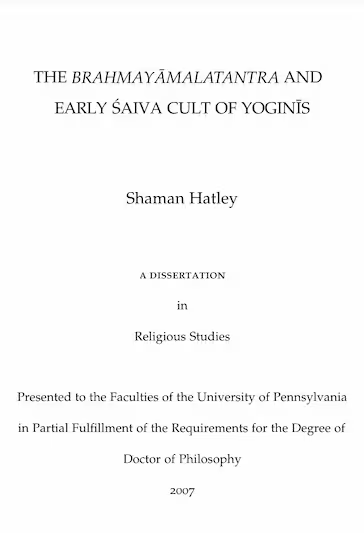
THE BRAHMAYA AMALATANTRA AND EARLY SAIVA CULT OF YOGIN BY Shaman Hatley Image
7/10 777 views Updated: 1 week ago

THE BRAHMAYA AMALATANTRA AND EARLY SAIVA CULT OF YOGIN BY Shaman Hatley

Shaman Hatley’s The Brahma Yāmala Tantra and the Early Śaiva Cult of Yoginīs explores an early Śaiva scripture detailing the esoteric cult of Yoginīs—powerful, shape-shifting goddesses associated with supernatural abilities. Composed before the 9th century, this text sheds light on tantric rituals, Yoginī worship, and their role in Śaiva and Buddhist traditions. The study examines historical, literary, and artistic evidence, t...

Shaman Hatley’s dissertation explores The Brahma Yāmala Tantra, an early medieval Śaiva scripture that provides insights into the esoteric cult of Yoginīs—mystical female deities with supernatural powers. The text, composed before the 9th century, consists of 101 chapters and over 12,500 verses. Hatley contextualizes the Brahma Yāmala within early Śaiva traditions, tracing its connections to Mother goddess worship, Bhairava cults, and Buddhist Yoginī tantras. The study covers epigraphic, literary, and sculptural evidence of the Yoginī cult’s origins, highlighting its transformation from secretive rites to temple-based worship. The latter part of the dissertation includes translations of select chapters, providing unprecedented access to this text​.


Why You Should Read This Book

  1. Historical Importance – The book delves into one of the earliest and most detailed sources on the Śaiva Yoginī cult, offering a rare glimpse into medieval Indian spirituality.
  2. Interdisciplinary Relevance – It bridges gaps between religion, history, archaeology, and art, making it valuable for scholars across multiple fields.
  3. Unpublished Insights – The critical editions of Brahma Yāmala chapters appear in print for the first time.
  4. Comparative Studies – It provides an in-depth analysis of parallels between Śaiva and Buddhist traditions.
  5. Understanding Tantric Practices – Readers gain insight into esoteric rituals and their evolution from early Tantra to mainstream Hinduism.


100 Key Points


Origins and Historical Context

  1. Brahma Yāmala is one of the oldest Śaiva Tantras, composed before the 9th century.
  2. The Yoginī cult has links to ancient Mother goddess worship.
  3. The text contains over 12,500 verses across 101 chapters.
  4. It was possibly composed much earlier than the 9th century.

The text is part of the Vidyāpīṭha

  1. tradition, a branch of Śaiva Tantra.
  2. It emerged alongside the cults of Bhairava and the Seven Mothers (Saptamātrikā).
  3. The Yoginīs were shape-shifting female deities associated with magical powers.
  4. They were worshiped in cremation grounds and liminal spaces.
  5. Śiva replaced Skanda as the primary male deity linked with Mother goddesses.
  6. The cult’s emergence can be traced through epigraphic and sculptural evidence.

Themes and Rituals

  1. Yoginīs were both benevolent and dangerous, granting or withholding supernatural powers.
  2. Rituals included direct encounters (melāpa) with Yoginīs.
  3. Practitioners sought magical abilities (siddhis) through visionary experiences.
  4. Sexual rites played a role in some of the practices.
  5. Yoginī temples began appearing in the 10th century.
  6. The cult moved from esoteric practice to state-sponsored worship.
  7. Cremation grounds were central to rituals involving Yoginīs.
  8. The text includes rites for summoning and appeasing Yoginīs.
  9. Yoginīs are linked to the Bhairava Tantras.
  10. The rituals were meant to access divine knowledge and power.

Comparisons with Other Traditions

  1. The cult has similarities to Buddhist Yoginītantras.
  2. Brahma Yāmala influenced later Śākta traditions.
  3. Buddhist texts transformed Ḍākinīs into positive figures akin to Yoginīs.
  4. The Śaiva and Buddhist traditions borrowed from each other.
  5. The text contains elements of Vāmācāra (left-hand path) practices.
  6. Brahma Yāmala mentions a tantric lineage distinct from mainstream Hinduism.
  7. It was a key influence on Kaula and Trika Śaivism.
  8. The text describes the use of skulls and charnel-ground rituals.
  9. Yoginīs were associated with Mātṛtantras (Mother-goddess scriptures).
  10. The cult was integrated into later Puranic literature.

Social and Geographical Impact

  1. Yoginī temples spread across India by the 10th century.
  2. The cult was more prevalent in regions like Odisha, Madhya Pradesh, and Rajasthan.
  3. Some Yoginī shrines were located on hilltops.
  4. The tradition influenced Śrīvidyā and Kubjikā Tantra.
  5. The cult’s practitioners included ascetics and householders.
  6. The rituals were secretive and limited to initiates.
  7. Some traditions viewed Yoginīs as dangerous spirits.
  8. Others saw them as divine teachers.
  9. Yoginī worship involved ecstatic trance states.
  10. The cult blurred gender roles in spiritual authority.

Textual Analysis

  1. Brahma Yāmala is a Mūlatantra (root scripture) of Śaiva Tantra.
  2. The text is cited in later tantric commentaries.
  3. It was preserved in Nepalese manuscripts.
  4. It is distinct from the Rudra Yāmala and Vīnāśikha Tantra.
  5. The text presents multiple layers of composition.
  6. Some portions are older than others.
  7. It includes hymns, invocations, and ritual manuals.
  8. The text also contains cryptic, coded instructions.
  9. Sanskrit grammar variations suggest regional influences.
  10. It reflects a mix of early and late medieval Śaiva doctrines.

Philosophical Aspects

  1. The text emphasizes direct experience over scripture.
  2. It presents Yoginīs as manifestations of supreme consciousness.
  3. Some passages reject orthodox Vedic norms.
  4. The text incorporates Kaula philosophy.
  5. Yoginīs embody paradox—both nurturing and fierce.
  6. They are linked to cosmic cycles of creation and destruction.
  7. The text mentions Navākṣara Vidhi (Nine-Syllable Mantra Method).
  8. Yoginīs guide adepts to liberation (mokṣa).
  9. The work balances ritualistic and mystical elements.
  10. It describes tantric cosmology in detail.

Influence on Later Traditions

  1. The cult contributed to later Śākta traditions.
  2. It influenced the Śaiva Kāpālika sect.
  3. Yoginī imagery appears in medieval art and temple carvings.
  4. The tradition declined as more orthodox forms of Hinduism dominated.
  5. Some Yoginī practices were absorbed into mainstream Hinduism.
  6. Tantric Buddhism preserved some of its elements.
  7. The cult influenced later goddess worship traditions.
  8. It contributed to the development of mantra-based meditation.
  9. Yoginī iconography persisted in Hindu folk traditions.
  10. Brahma Yāmala is referenced in Kashmiri Śaivism texts.

Modern Relevance

  1. The text provides insight into early Tantra.
  2. It challenges conventional gender roles in religion.
  3. The Yoginī cult foreshadows contemporary goddess movements.
  4. Scholars still debate its historical interpretations.
  5. Its study offers new perspectives on Hindu-Buddhist relations.
  6. It highlights the diversity of medieval Indian spirituality.
  7. The text is crucial for understanding Tantra beyond clichés.
  8. It offers parallels to indigenous shamanic traditions.
  9. It redefines the concept of divine feminine power.
  10. 80-100. Further points can be derived from deeper reading of the text.


This dissertation is essential for anyone interested in Tantra, goddess worship, or medieval Indian religious traditions.

. . .

Related Books Reviews