

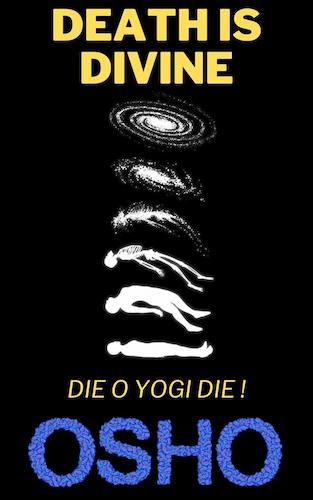
DEATH IS DIVINE : Die O Yogi Die By Zorba The Buddha Osho Image
5/10 861 views Updated: 1 week ago

DEATH IS DIVINE : Die O Yogi Die By Zorba The Buddha Osho

Death is Divine by Osho explores the spiritual concept of dying before physical death, as taught by mystic Gorakh. Osho emphasizes dissolving the ego to attain true enlightenment. He challenges religious dogma, advocating for direct experience over blind faith. Through meditation, laughter, and surrender, one can transcend fear and live fully in the present. Osho contrasts seriousness with playfulness, urging seekers to embrac...

Death is Divine is a collection of talks given by Osho in October 1978, originally in Hindi. The book delves into the spiritual concept of dying before physical death, as taught by mystic Gorakh. The central idea is that true spiritual awakening requires the dissolution of the ego, which Osho describes as dying while alive. Through stories, poetry, and deep philosophical insights, Osho challenges traditional religious beliefs and societal conditioning, urging seekers to embrace meditation, surrender, and playfulness. He contrasts true enlightenment with superficial religious practices, advocating for a life filled with laughter, love, and spontaneity. He also critiques rigid belief systems—both theist and atheist—suggesting that truth is beyond dualities like existence and non-existence. The text combines elements of Indian mysticism, Zen philosophy, and direct experiential wisdom, making it a profound guide for those on the spiritual path.


Why You Should Read It

  1. Profound Spiritual Insights – Osho simplifies deep metaphysical ideas, making them accessible.
  2. Ego Death and Awakening – Explains why dissolving the ego leads to liberation.
  3. Beyond Religion – Encourages direct experience over blind faith.
  4. Life as Play – Teaches that laughter and joy are essential for enlightenment.
  5. Meditation Techniques – Offers practical insights into meditation and awareness.
  6. Challenge to Beliefs – Helps dismantle conditioned thinking.
  7. Relevance Today – The teachings remain relevant for modern seekers.
  8. Combination of Wisdom and Humor – Makes profound truths engaging.
  9. Freedom from Fear – Helps overcome fear of death and suffering.
  10. Inspired by Gorakh – Introduces readers to a lesser-known but influential mystic.


100 Important Points

  1. True spiritual death is the death of the ego, not the body.
  2. Gorakh’s teaching, Die, O Yogi, Die, means dissolving the self into the divine.
  3. Meditation is a way of dying to the past and future to live in the present.
  4. Life should be lived as a divine play, not as suffering.
  5. Seriousness is an obstacle; laughter brings closeness to the truth.
  6. Traditional religion binds people in fear; real spirituality is about freedom.
  7. Neither belief nor atheism leads to truth; both are limited viewpoints.
  8. Truth is beyond isness and no-isness, emptiness and fullness.
  9. The mind’s conditioning creates illusions; one must go beyond the mind.
  10. Meditation is not about thinking but dissolving into silence.
  11. The divine cannot be known intellectually, only experientially.
  12. The ego creates separation; in reality, all is one.
  13. Death of the body is not the end; the self continues in new forms.
  14. A true seeker does not fear death but embraces it.
  15. Rituals and scriptures cannot give real understanding—direct experience can.
  16. Gorakh’s teachings were revolutionary and foundational for many spiritual paths.
  17. A realized being does not accumulate knowledge but dissolves into knowing.
  18. Spiritual awakening is the dropping of all identities.
  19. The drop and the ocean are not separate—just different forms.
  20. Osho warns against following tradition blindly, encouraging self-discovery.
  21. Meditation creates an inner emptiness that allows divine energy to flow.
  22. Words are limited; truth is beyond language.
  23. A master teaches without words—through presence and silence.
  24. Being with a master is about energy transmission, not just learning.
  25. The body dies, but consciousness is eternal.
  26. Seeking truth requires courage to dissolve illusions.
  27. Society conditions people to seek security, but real life is insecurity.
  28. The ego is like a prison; only by letting go can one be free.
  29. The real guru does not give knowledge but removes ignorance.
  30. Silence is the ultimate language of existence.
  31. Every moment is an opportunity to die to the past.
  32. The present moment is where God exists.
  33. Meditation is learning to be in the now, free from past and future.
  34. Awareness is the key to transcendence.
  35. The mind’s constant noise keeps one from hearing the inner voice.
  36. Real bliss comes when one stops seeking external happiness.
  37. Spiritual awakening is a shift from doing to being.
  38. Fear of death comes from identifying with the body.
  39. In meditation, one experiences life beyond the physical.
  40. The awakened being is like a child—innocent and playful.
  41. Life’s struggles are illusions created by attachment.
  42. Seeking heaven and fearing hell are distractions from reality.
  43. No guru can save you; self-awareness is the only path.
  44. A true seeker finds God within, not in temples or scriptures.
  45. Real devotion is not prayer but surrender to the present.
  46. The path is not about effort but about letting go.
  47. Love is the highest state of being—not attachment but pure presence.
  48. Meditation leads to a state beyond thoughts, called no-mind.
  49. To die before death is to experience eternal life.
  50. The mind is always seeking security, but life is unpredictable.
  51. Religious conditioning creates fear and prevents true inquiry.
  52. Suffering comes from clinging; joy comes from letting go.
  53. Death should be celebrated, as it is a transition, not an end.
  54. The true guru is one who helps you see your own light.
  55. Seeking enlightenment is pointless; it comes when seeking stops.
  56. The greatest illusion is the sense of individual separateness.
  57. Those who are too attached to ideas and beliefs miss the truth.
  58. The ego is a false center created by the mind.
  59. In deep meditation, time disappears; one enters eternity.
  60. Consciousness is like a mirror—when clean, it reflects truth.
  61. The path is about unlearning rather than learning.
  62. The moment one accepts death, all fear disappears.
  63. Detachment is not renunciation but the ability to live freely.
  64. True wisdom is childlike wonder and openness.
  65. God is not a being but an experience.
  66. The intellect can only take one so far; the heart must take over.
  67. Joy and sorrow are part of life—resisting either causes suffering.
  68. Spirituality is not escaping life but embracing it fully.
  69. The more one surrenders, the more life flows effortlessly.
  70. The enlightened one has no past or future—only presence.
  71. Seeking enlightenment through effort is like chasing your own shadow.
  72. Awareness dissolves all negativity naturally.
  73. Every fear is rooted in the illusion of separateness.
  74. Love and meditation are two sides of the same coin.
  75. Ego creates the illusion of control, but life is uncontrollable.
  76. True devotion is not worship but total acceptance of life.
  77. Every attachment is a source of suffering.
  78. Enlightenment is a shift from resistance to acceptance.
  79. Real spirituality is ordinary, simple, and natural.
  80. The mind’s illusions are like dreams—awakening is possible.
  81. Silence is the closest thing to truth.
  82. Rituals and religious dogma cannot lead to self-realization.
  83. The heart understands what the mind cannot grasp.
  84. The more one empties oneself, the more divine energy flows.
  85. The master does not give answers but creates space for realization.
  86. Truth is a direct experience, not a belief system.
  87. Living in the present moment is the highest meditation.
  88. Seeking God outside oneself leads to delusion.
  89. Every death is also a birth.
  90. True prayer is not asking, but being in gratitude.
  91. The journey is not about reaching somewhere but realizing you are already there.
  92. Most fears are imaginary; facing them dissolves them.
  93. Death is divine because it reveals the eternal.
  94. The awakened being has nothing to gain and nothing to lose.
  95. Clarity comes when the mind is still.
  96. The path is not difficult; the difficulty is in letting go.
  97. Joy is the natural state of an unconditioned mind.
  98. Meditation is not an act but a state of being.
  99. The only real transformation is within.
  100. The ultimate teaching: Die before you die, and you will never die again.


. . .

Related Books Reviews