

Yoga nidra: what it is, how to practice, and what the research shows
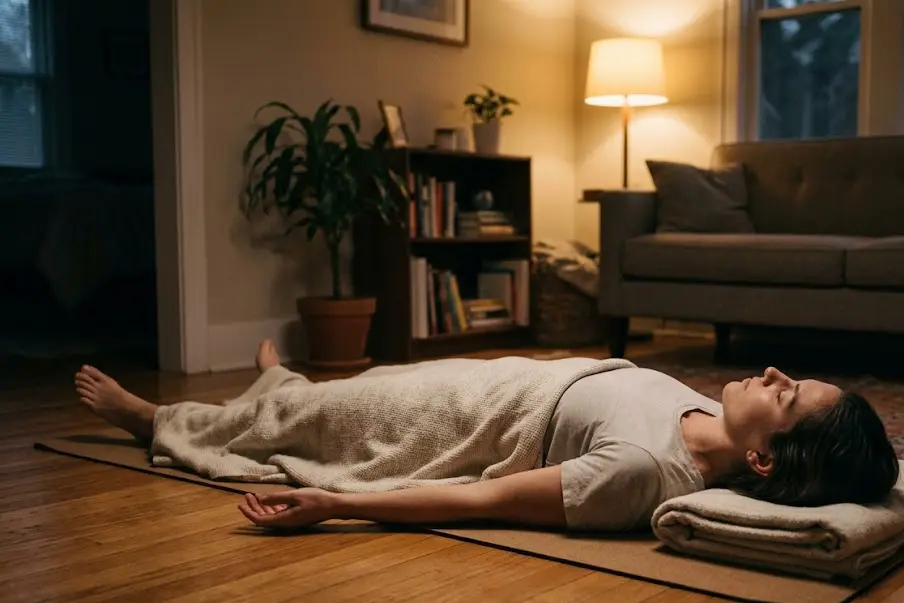
Yoga nidra is a guided practice you do lying down. A voice, a teacher's or a recording, walks your attention through a set series of steps: settling in, an intention, a slow tour of the body, the breath, a few paired sensations, some simple images, and a gentle return. You don't move, stretch or hold poses. The idea is to let your body rest deeply while part of you stays aware.
It's popular for winding down and for a midday reset, and it has been rebranded lately as "NSDR." This guide explains what it is, how it compares with meditation and NSDR, how to set up, and what the research actually supports. If you want to try it right away, there are three read-aloud scripts (10, 20 and 30 minutes) on the companion scripts page.
Quick answers
- What it is: a structured, guided relaxation practice done lying on your back, usually 10 to 45 minutes.
- What it isn't: sleep, a treatment for a sleep disorder, or a substitute for therapy.
- What the research shows: many studies report less stress and anxiety, but most are small and at high risk of bias. Evidence for sleep is early and rated low to very low certainty.
- Who can do it: almost anyone who can lie down comfortably (or recline). People with a trauma history should read the safety section first.
What "yoga nidra" means, and where it comes from
"Yoga nidra" is Sanskrit and is usually translated as "yogic sleep." The name describes a state between waking and sleeping: the body is very still and heavy, but you can still hear the voice and follow along.
A 2022 narrative review in Sleep and Vigilance traces references to this in-between state back to older Indian texts, including the Upanishads and tantric writings. Most of what's taught today, though, is modern. The review notes that an "updated and systematized" practice was introduced in the 1960s by Swami Satyananda Saraswati of the Bihar School of Yoga. His sequence (intention, body rotation, breath, opposite sensations, imagery) is the template most scripts still follow.
Another widely used version is iRest (Integrative Restoration), developed in the US by psychologist Richard Miller. Cleveland Clinic describes his framework as a 10-step practice that adds steps such as finding an "inner resource," a felt sense of safety in the body. In a 2025 meta-analysis of yoga nidra research, 38 of 73 studies followed Bihar School guidelines and 11 used iRest, so those two styles account for most of the evidence.
Worth knowing: the older-texts story is a lineage claim, not something you need to accept to practice. What matters for you is the structure, which is simple and easy to learn.
How yoga nidra differs from meditation and from NSDR
All three overlap, and the labels are used loosely online. Here is how they usually differ.
| Yoga nidra | Seated mindfulness meditation | NSDR (non-sleep deep rest) | |
|---|---|---|---|
| Position | Lying on your back (or reclined) | Usually sitting upright | Usually lying down |
| Guidance | Almost always guided by a voice | Guided or silent | Usually guided audio |
| Structure | Fixed sequence: intention, body rotation, breath, opposites, imagery, return | Open: rest attention on breath, sounds or thoughts | Varies by recording; often body scan plus slow breathing |
| Main aim | Deep physical rest while staying aware | Training attention and awareness | Deep rest without falling asleep |
| Effort | Very little; you follow cues | Some effort to return attention | Very little |
| Spiritual framing | Optional; traditional versions include it | Optional | None; secular label |
| Where the term comes from | Yogic tradition, systematized in the 1960s | Buddhist traditions, adapted in the West | Coined by neuroscientist Andrew Huberman |
| Research base | Dozens of studies, mostly small and low quality | Large research base | Very little research on "NSDR" as such; most cited studies are on yoga nidra |
A closer look at NSDR
"NSDR" was coined by Stanford neuroscientist Andrew Huberman. According to the Sleep Foundation, he first used it as a more approachable name for yoga nidra, without the spiritual associations. The term has since widened to include hypnosis and some forms of meditation. The Sleep Foundation also notes that "most research has centered on yoga nidra in particular, rather than NSDR in general."
So when you see claims about NSDR, it helps to check what they're based on. One example: the Huberman Lab NSDR page says an hour-long session raised baseline dopamine "by as much as 65%." That figure appears to come from a 2002 brain-imaging (PET) study of yoga nidra. That study had eight experienced male practitioners and compared yoga nidra with a resting condition. A 2020 review of yoga neuroimaging in Frontiers in Integrative Neuroscience describes it as the only PET study of dopamine release during yoga meditation, which means the finding hasn't been replicated. It's an interesting result, but it doesn't tell you what a 10-minute NSDR track does for an average listener.
In plain terms: NSDR and yoga nidra are close cousins, and any recording that helps you rest is fine to use. Just treat specific NSDR claims (dopamine, "replacing lost sleep") as unproven.
What the research does and doesn't show
Stress, anxiety and low mood
The largest review so far is a 2025 systematic review and meta-analysis by Ghai and colleagues in the Annals of the New York Academy of Sciences. It pooled 73 studies with 5,201 participants. Compared with active comparison groups, yoga nidra was linked to lower stress, anxiety and depression scores, with moderate-to-large effect sizes.
The catch is study quality. Of the 22 randomized trials, none was rated low risk of bias, and 17 were rated high risk. The 50 non-randomized studies were all rated "poor" or "fair." The authors themselves say the effects "should be interpreted cautiously, as they likely reflect inflated estimates."
A better-designed example: a 2025 randomized trial by Moszeik and colleagues in Stress and Health gave 362 adults online recordings of an 11-minute or a 30-minute yoga nidra to use ideally every day for two months. Compared with a waitlist, the 11-minute version reduced stress, anxiety, depression and rumination, but the effects were small. The 30-minute version was not clearly better than the 11-minute one on most measures.
Fair summary: yoga nidra probably helps some people feel calmer, and short daily sessions are enough to try it. The size of the benefit is likely smaller than many websites suggest.
Sleep
This is where yoga nidra gets the most attention, and where the evidence is thinnest.
- A 2026 systematic review and meta-analysis by Singh and colleagues in Sleep and Breathing looked at adults with poor sleep or insomnia. When they pooled the randomized trials, the effects on sleep quality and insomnia severity were not statistically significant. The authors rated the certainty of evidence as very low and called the findings "preliminary."
- A 2026 systematic review by Dutta and colleagues found six randomized trials with 244 participants. Most reported improvements in time to fall asleep, total sleep time or sleep efficiency, but most trials had moderate-to-high risk of bias, and harms were poorly reported.
- The most cited single trial, Datta and colleagues (2021, National Medical Journal of India), compared yoga nidra with CBT-I in 41 people with chronic insomnia. Both groups slept better. It was a small pilot study, and follow-up sleep lab tests were done only on volunteers.
For context, the National Center for Complementary and Integrative Health (NCCIH) notes that guidelines strongly recommend cognitive behavioral therapy for insomnia (CBT-I) for chronic insomnia, and that relaxation techniques "on their own don't seem to be especially promising for sleep."
Fair summary: yoga nidra is a reasonable part of a wind-down routine, and some people find it helps them drift off. It is not a proven insomnia treatment. If you've had trouble sleeping for months, see a clinician about CBT-I.
What the research doesn't show
- That yoga nidra replaces sleep. The "one hour equals four hours of sleep" line comes from practitioners, not trials, as the 2022 Sleep and Vigilance review points out.
- That it treats PTSD, depression, anxiety disorders or insomnia. Benefits in the review literature come from mostly small studies, and the 2022 review notes benefits were not shown for severe depression or severe anxiety.
- Anything specific about "NSDR" as its own practice. Almost all the evidence is on yoga nidra.
How to practice
Set up (5 minutes, once)
- Pick a time. Before bed if you want to drift off. Mid-afternoon or after work if you want to stay awake and feel rested.
- Pick a place where you won't be interrupted. Silence your phone, or put it in airplane mode if you're playing audio from it.
- Get warm. Your body cools as you rest. Put on socks and keep a blanket within reach, or cover yourself before you start.
- Dim the light. An eye pillow or a folded cloth over your eyes helps.
Position
The usual position is Savasana (corpse pose): on your back, legs a little apart, arms a little away from your sides, palms up or resting on your belly.
Small changes make a big difference:
- Low back feels tight? Put a bolster or rolled blanket under your knees. See corpse pose with a bolster.
- Neck or upper back uncomfortable? A thin folded blanket under your head.
- Lying flat isn't comfortable (late pregnancy, reflux, breathing difficulty, back pain)? Lie on your side with a pillow between your knees, or recline in a chair or propped up in bed. Lying flat isn't required. Constructive rest, with your knees bent and feet on the floor, is another option.
- Practicing in bed? That's fine, especially at night. See bed or couch yoga.
What happens in a session
Most scripts follow the same stages. Knowing them helps you relax into the voice instead of wondering what comes next.
- Settling. You get comfortable, notice the room and the points where your body touches the floor.
- Intention (sankalpa). A short, positive phrase you repeat silently, like "I can rest" or "I am at ease." Keep it simple and in the present tense.
- Body rotation. The voice names body parts quickly, one after another: right thumb, index finger, middle finger, and so on. You just move your attention to each spot. You don't need to relax it or picture it.
- Breath awareness. You notice your breath without changing it, sometimes counting breaths backward.
- Opposite sensations. You recall paired feelings, such as heavy and light, or warm and cool, one at a time and then together.
- Imagery. The voice names a few simple images (a candle, a path, a sky at dusk). You let each one come and go.
- Return. You repeat your intention, notice the room again, move slowly, and sit up.
The body rotation is close to a body scan, but faster, and you don't try to release tension at each point. The breath stage is close to mindfulness of breath.
How to choose a length
| If you have... | Try | Notes |
|---|---|---|
| A few minutes, or you're brand new | 10 minutes | Short daily practice was enough to show small benefits in the 2025 online trial. |
| A lunch break or late afternoon | 20 minutes | A common middle ground. Cleveland Clinic suggests starting with 15 to 20 minutes. |
| An evening with time to unwind | 30 minutes or more | Longer sessions give the body rotation and imagery more room. You may fall asleep, which is fine at night. |
Consistency matters more than length. Three 10-minute sessions a week you actually do beat one 45-minute session you keep putting off.
Tips for your first few sessions
- Falling asleep is normal. Staying aware is a skill. If you want to stay awake, practice earlier in the day, rest your head a bit higher, or use a shorter session.
- Your mind will wander. When you notice, pick up wherever the voice is now. You don't need to catch up.
- Don't try to feel something. The instructions are invitations. If you can't picture an image or feel a sensation, just hear the word and move on.
- Come back slowly. Roll to your side before sitting up, especially if you get lightheaded when you stand quickly.
- Pair it with a routine. Some people do a few gentle poses first, like legs up the wall or our evening wind-down. For more ideas, see yoga for better sleep: 7 poses before bed.
Safety
Yoga nidra is gentle and low risk for most people. NCCIH describes relaxation techniques as "generally considered safe for healthy people," but notes that people occasionally report increased anxiety, intrusive thoughts, or fear of losing control. There have also been rare reports of relaxation techniques worsening symptoms in people with epilepsy, certain psychiatric conditions, or a history of abuse or trauma.
If you have a history of trauma. Turning attention inward, especially to the body, or following imagery with your eyes closed, can sometimes bring up difficult memories or feelings. A 2025 analysis of two mindfulness programs found that childhood trauma and PTSD symptoms predicted more meditation-related side effects. That study wasn't on yoga nidra, but the practices overlap. Some things that help:
- You can keep your eyes open, with a soft gaze at the ceiling or the floor.
- You can skip any part of the script, including the imagery.
- You can move, change position, or stop at any time. Rest is the point, and you are in charge of it.
- If you're working with a therapist, ask them before you start. Our trauma-informed practice page has more on this.
It's not a substitute for treatment. If you have insomnia, sleep apnea symptoms (loud snoring, gasping, daytime sleepiness), depression, anxiety or PTSD, yoga nidra may be a pleasant addition to care, but it doesn't replace it. NCCIH advises seeing a health care provider for "severe or long-lasting symptoms of any kind."
Stop and get help if a session leaves you feeling much worse, panicky, or disconnected from your surroundings, and the feeling doesn't pass soon after you get up.
Where to go next
- Try it now: our three original scripts for 10, 20 and 30 minutes.
- New to meditation in general? Start with our meditation hub or introduction to meditation for beginners.
- Want something even shorter? A few minutes of slow breathing with a long exhale, using our wave breathing pacer, can be a quick reset.
- Sleep routine: yoga for better sleep: poses and breathing techniques to wind down.
- Restful poses: restorative sequence.
Sources
- Ghai S, Odyniec P, Ghai I. Effects of yoga nidra on stress, anxiety, and depression: a systematic review and meta-analysis. Annals of the New York Academy of Sciences. 2025. https://pmc.ncbi.nlm.nih.gov/articles/PMC12917937/
- Moszeik EN, Rohleder N, Renner KH. The effects of an online yoga nidra meditation on subjective well-being and diurnal salivary cortisol: a randomised controlled trial. Stress and Health. 2025. https://pmc.ncbi.nlm.nih.gov/articles/PMC12080877/
- Singh S, Dhanlika D, Singh U, Haldar P, Sharma G. Effect of yoga nidra (yogic sleep) in sleep disturbances and insomnia: systematic review and meta-analysis. Sleep and Breathing. 2026. https://doi.org/10.1007/s11325-026-03685-0 (abstract read via Europe PMC)
- Dutta A, Mooventhan A, Nivethitha L, Dharani E. Efficacy of yoga nidra in managing sleep disorders: a systematic review of randomized controlled trials. Journal of Integrative and Complementary Medicine. 2026. https://doi.org/10.1177/27683605251390728 (abstract read via Europe PMC)
- Datta K, Tripathi M, Verma M, Masiwal D, Mallick HN. Yoga nidra practice shows improvement in sleep in patients with chronic insomnia: a randomized controlled trial. National Medical Journal of India. 2021. https://nmji.in/yoga-nidra-practice-shows-improvement-in-sleep-in-patients-with-chronic-insomnia-a-randomized-controlled-trial/
- Pandi-Perumal SR, et al. The origin and clinical relevance of yoga nidra. Sleep and Vigilance. 2022. https://pmc.ncbi.nlm.nih.gov/articles/PMC9033521/
- van Aalst J, et al. What has neuroimaging taught us on the neurobiology of yoga? A review. Frontiers in Integrative Neuroscience. 2020. https://www.frontiersin.org/journals/integrative-neuroscience/articles/10.3389/fnint.2020.00034/full
- Sleep Foundation. What is non-sleep deep rest (NSDR)? Updated 2026. https://www.sleepfoundation.org/meditation-for-sleep/what-is-non-sleep-deep-rest
- Sleep Foundation. Yoga nidra for sleep. https://www.sleepfoundation.org/meditation-for-sleep/yoga-nidra
- Cleveland Clinic. What is yoga nidra? https://health.clevelandclinic.org/what-is-yoga-nidra
- Huberman Lab. Non-sleep deep rest (NSDR). https://www.hubermanlab.com/nsdr
- NCCIH. Relaxation techniques: what you need to know. https://www.nccih.nih.gov/health/relaxation-techniques-what-you-need-to-know
- NCCIH. Mind and body practices for sleep disorders (clinical digest, 2024). https://www.nccih.nih.gov/health/providers/digest/psychological-and-physical-approaches-for-sleep-disorders
- Canby NK, et al. Childhood trauma and subclinical PTSD symptoms predict adverse effects and worse outcomes across two mindfulness-based programs for active depression. PLoS One. 2025. https://pmc.ncbi.nlm.nih.gov/articles/PMC11781677/
Want new practices by email?
We email now and then when we publish a new routine, practice or guide. No spam, unsubscribe any time.
Join the YogaMag newsletterFrequently Asked Questions
Popular posts
Related posts




No comments yet. Be the first to comment!