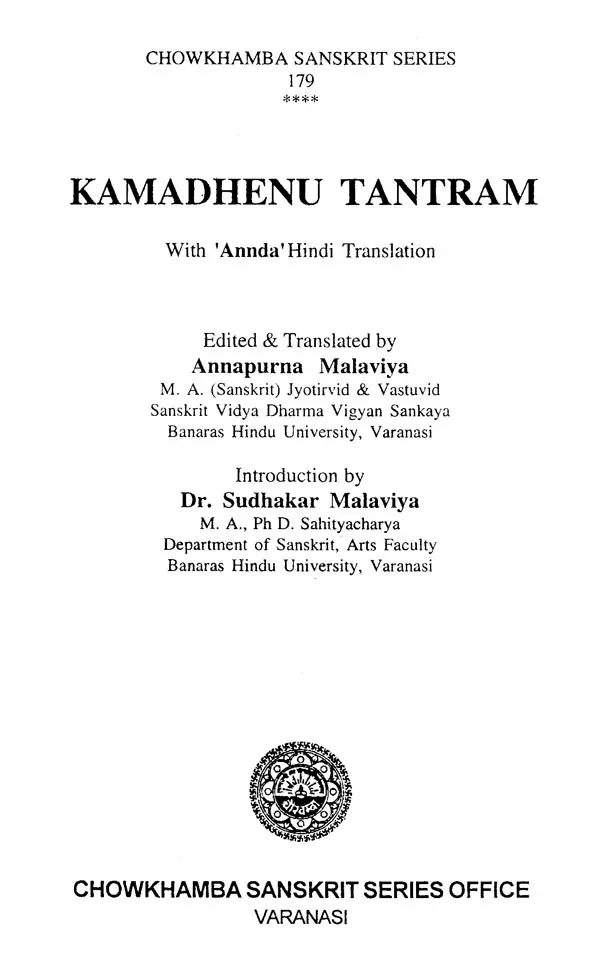
Kamadhenu Tantra
The "Kamadhenu Tantra," consisting of 24 chapters, explores the letters of the Sanskrit alphabet and their spiritual significance in relation to the goddess Sarasvati, who embodies sound and eloquence. Presented as a dialogue between Parvati and Shiva, the text reveals how understanding these letters can lead to liberation (jivanmukta). Each letter represents various deities and energies, with rituals involving meditation and...
The Kamadhenu Tantra is a sacred text divided into 24 chapters, which explores the spiritual significance of the Sanskrit alphabet and its letters, deeply intertwined with the concept of liberation (jivanmukta). The dialogue primarily features Parvati (Shakti) and Mahadeva (Shiva), highlighting the importance of the 50 letters of the alphabet and their connection to the divine, particularly the goddess Sarasvati, who embodies eloquence and knowledge.
Each letter is imbued with unique qualities and energies, representing different aspects of the divine, including Brahma, Vishnu, and Shiva. Through understanding these letters, practitioners can attain spiritual enlightenment and achieve liberation while still alive.
The text emphasizes the need for careful worship and meditation on these letters, with various chapters detailing rituals, visualizations, and the correlation of letters with bodily senses, elements, and deities. The concepts of bindu (point) and bija (seed) mantras are also integral to the practice. Ultimately, the Kamadhenu Tantra serves as a guide for spiritual practitioners to harness the power of letters as a means to connect with the divine and reach spiritual fulfillment, emphasizing the transformative potential of sound and mantra in spiritual practices.
95 important points derived from the Kamadhenu Tantra:

- Divine Dialogue: The text is structured as a conversation between Parvati and Shiva.
- Vision of Sound: The letters of the alphabet are seen as manifestations of divine sound.
- Sarasvati's Role: Goddess Sarasvati represents speech, knowledge, and the essence of the letters.
- Matrikas' Significance: The letters represent the Matrikas, or female deities.
- Tattvas Explained: Each letter is associated with particular tattvas or elements.
- Liberation Principle: Understanding the letters leads to liberation while alive (jivanmukta).
- Five Pranas: Most letters are associated with the five vital breaths or pranas.
- Divine Qualities: Letters possess qualities of Brahma, Vishnu, and Shiva.
- Color Symbolism: Each letter is associated with specific colors representing their energies.
- Sanskrit Alphabet: The teaching revolves around the 50 letters of the Sanskrit alphabet.
- Paramakundali: The first letter, a, represents supreme Kundalini.
- Self of Brahma: The letter 'aa' embodies Brahma, Vishnu, and Rudra.
- Effulgence: Many letters are described as effulgent, symbolizing divine radiance.
- Mahakundalini: The letter 'ai' is identified as Mahakundalini, radiating immense power.
- Four Aims of Life: Many letters are associated with the four aims of mankind: dharma, artha, kama, and moksha.
- Consort to Brahma: Sarasvati is viewed as the shakti or consort of Brahma.
- Bija Mantras: Letters also function as bija (seed) mantras with transformative powers.
- Vitality and Energy: The self of food is pervaded by vital energy.
- Relationship with Mantras: Each letter can represent different mantras and spiritual practices.
- Meditative Practices: Detailed meditative techniques are included for spiritual growth.
- Kundalini Energy: The concept of Kundalini and its relation to letters is central.
- Color Associations: Letters are often linked with specific colors representing their attributes.
- Jiya Nyasa: Reciting the letters with breaths during twilight impacts spiritual energy.
- Body and Letters: Each letter corresponds to specific parts of the human body.
- Nadis: The text discusses the chief nadis in the body and prana flow.
- Universal Symbolism: The letters are seen as representing larger cosmic principles.
- Pranayama Connection: There’s a correlation between letter pronunciation and breath control (pranayama).
- Visualizing Deities: Practicing visualization of deities associated with letters is encouraged.
- Effulgent Devi: The Matrika Devi is depicted as radiant and adorned.
- Sadhaka's Path: Following this knowledge can make a practitioner (sadhaka) successful.
- Relationship to Elements: Letters are correlated with aether, air, fire, earth, and water.
- Secret Teachings: Some aspects of the teachings are considered esoteric and require initiation.
- Rituals for Success: Various rituals are prescribed for attaining spiritual success.
- Mental Focus: The act of meditation requires intense focus on sound and meaning.
- Divine Attributes: Each letter is described with unique divine attributes.
- Maha Mantra: There are references to the ultimate mantra in the text.
- Chakras and Letters: The relationship between letters and the chakras is implicit.
- Transmitting Power: Recitation of letters is believed to transmit spiritual power.
- Traditional Symbolism: The text adheres to traditional Hindu symbology and practices.
- Spiritual Realization: Engaging with the letters leads to profound spiritual insights.
- Attributes of Devi: The Devi has qualities both with (saguna) and without form (nirguna).
- Sound Effects: The power of sound in shaping reality is emphasized.
- Nature of the Mind: Mind is influenced by the self of vital energy and food.
- Interdependence: The letters represent interdependent aspects of spirituality.
- Purities and Dangers: Warnings about misuse of power associated with letters may be present.
- Elemental Associations: Each letter supports elemental energies.
- Form and Space: Emphasis on how letters create forms and space in meditation.
- Consciousness Levels: Different letters resonate at varying levels of consciousness.
- Understanding Reality: Knowledge of letters aids in understanding the nature of reality.
- Mantra Efficacy: Repeated mantra practice is seen as essential for success.
- Daily Practices: Engaging with letters is encouraged as part of daily spiritual practice.
- Dhyanas: Specific meditations related to each letter and its divine forms are outlined.
- Feminine Principle: The omnipresence of the feminine divine in the Matrikas is noted.
- Visual Representation: Copper plates are suggested for inscribing letters during rituals.
- Seasonal Timing: Certain rituals may be linked with lunar or seasonal cycles.
- Flower Symbolism: Letters are often linked with flowering plants to signify their beauty and essence.
- Elevating Consciousness: Letters help elevate individual consciousness towards divinity.
- Transformation: The letters are tools for transforming the practitioner's spiritual state.
- Community Worship: Teaching may encourage communal rituals and practices.
- Access to Knowledge: Understanding the letters grants access to deeper spiritual knowledge.
- Frequencies and Vibration: Letters are linked to cosmic frequencies that affect reality.
- Compressed Energy: Letters are described as condensed forms of greater cosmic energies.
- Self-Realization: Emphasizes that through understanding of letters, self-realization is attainable.
- Sacred Geometry: There may be implicit connections between letters and sacred geometry.
- Divine Feminine: The text uplifts the importance of the divine feminine in spiritual philosophy.
- Paths to Liberation: Elaborates on various paths (yogas) one can take through the letters.
- Puja Rites: Specific pujas are dedicated to letters and their divine representations.
- Symbol of Wholeness: Letters symbolize completeness in the cosmic order.
- Purification Techniques: Focus on letters serves as a method for spiritual purification.
- Bonding Elements: Letters act as bridges among the elemental forces in the universe.
- Nature of Reality: Understanding letters provides insights into the fabric of reality itself.
- Experiential Learning: Practitioners are encouraged to experience rather than merely intellectually understand.
- Celebration of Sound: The sacredness of sound and letter vibration is highlighted.
- Principle of Motion: Dynamics of letters correspond to cosmic motion and cycles.
- Spiritual Hierarchy: Letters are positioned within a spiritual hierarchy of creation.
- Concept of Oneness: Recitation promotes a sense of oneness with the universe.
- Chakra Activation: Each letter can activate specific chakras or energy centers in the body.
- Customized Practice: Suggests that practitioners tailor their practice according to personal needs.
- Cycle of Creation: Letters illustrate the cycles of creation and dissolution in the cosmos.
- Symbolism of Water: Water representations in letters signify purification and flow.
- Role of Intent: Emphasizes the role of intent in invoking the power of letters.
- Deity Correspondences: Discussion of deity relationships with each letter and its significance.
- Vibration and Healing: Explores how letter vibrations can lead to healing.
- Awareness Expansion: Engaging with letters can expand the practitioner’s awareness.
- Guidance for Generations: The teachings provide guidance for future generations of seekers.
- Cultural Tradition: Emphasis on the cultural importance of the alphabet in Hindu spirituality.
- Divine Reflection: Letters reflect the qualities of the divine in human experience.
- Ritual Tools: The necessity of specific tools and materials for rituals involving letters.
- Transcendental Practices: Discussion of practices aimed at spiritual transcendence through sound.
- Devotional Aspect: The practice is deeply devotional, fostering love and reverence for the goddess.
- Color-Coded Meditations: Instructions often correlate colors with meditation practices related to letters.
- Teachings on Observation: Mindful observation and connection to letters guide spiritual growth.
- Unity in Diversity: The alphabet represents the unity found within the diverse expressions of divinity.
- Synergy of Energies: The interconnectedness of energies represented by letters in the universe.
- Sacred Sound Frequencies: Discusses the sacred frequencies associated with each letter.