

Yoga for runners: a 10-minute post-run stretch with a timer

This routine is for right after your run, when your muscles are warm. It starts standing, for the calves and quads, then moves to the floor for the hip flexors, hamstrings and hips, and ends with your legs up the wall. Every hold has a time, and the timer tells you when to switch sides.
Move slowly and skip anything that hurts. This isn't medical advice.
After your run, not before
Save the long holds for after. A large review of stretching studies found that static stretches held for 60 seconds or more per muscle group caused small drops in performance when tested soon afterward, while shorter holds had little effect and dynamic stretching gave a small boost [1]. Before a run, warm up with easy jogging, leg swings and walking lunges instead.
What stretching can and can't do for runners
Stretching after a run can help you feel looser and give you a few minutes to cool down and breathe. Range of motion improves after stretching, though the short-term change typically lasts less than half an hour [1].
It probably won't prevent injuries on its own. A meta-analysis of 25 trials found that stretching programs had virtually no effect on sports injury rates, while strength training cut them substantially [2]. If injury prevention is your goal, add strength work for the hips, legs and core, such as the holds in our 20-minute strength and mobility routine.
The 10-minute post-run stretch
| # | Stretch | Time | Breath |
|---|---|---|---|
| 1 | Standing quad stretch, one hand on a wall | 30 s per side | Breathe slowly; knees side by side |
| 2 | Standing calf stretch against a wall, back heel down | 30 s per side | Exhale to lean in a little more |
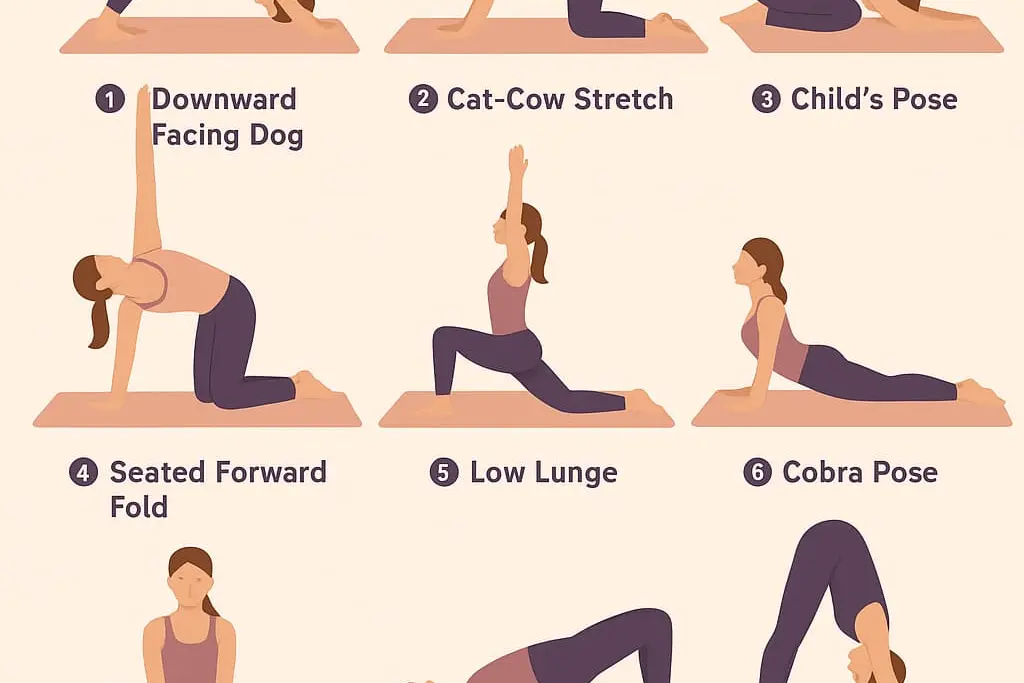
| 3 | Downward Dog, pedal the feet | 45 s | Breathe steadily; bend the knees as needed |
| 4 | Low Lunge, back knee down | 30 s per side | Exhale to ease the hips forward |
| 5 | Half split: straighten the front leg, hips back | 30 s per side | Inhale lengthen, exhale fold a little |
| 6 | Pigeon, or Figure Four on your back | 45 s per side | Ease off if the knee complains |
| 7 | Lying hamstring stretch with a strap or towel | 30 s per side | Exhale to draw the leg in |
| 8 | Butterfly | 45 s | Sit tall; breathe into the inner thighs |
| 9 | Lying knees-bent twist | 30 s per side | Exhale as the knees lower |
| 10 | Legs Up the Wall | 60 s | Let your breathing slow down |
| Total | 10:00 |
How-to notes
- Quad stretch: hold your ankle (or your sock, or a strap around the ankle) and keep the knees side by side. Tuck the tailbone slightly instead of arching your back.
- Calf stretch: hands on a wall, one foot back with the heel down and the knee straight. Bend the back knee slightly for the lower calf.
- Half split: from Low Lunge, shift your hips back over the back knee and straighten the front leg, toes up. Keep your back long; hands on blocks help.
- Pigeon: if your front knee or hip complains, lie on your back and do Figure Four instead: cross one ankle over the opposite knee and draw both legs in.
- Hamstring stretch: lie on your back, loop a strap or towel around one foot and raise the leg until you feel the back of the thigh. The other knee can stay bent.
Who should check first
- A current running injury such as a stress fracture, Achilles or hamstring strain: skip stretches that pull on it and ask your physical therapist.
- Herniated or bulging disk, or other lower back problems: use bent knees and a flat back in the half split and Downward Dog.
- Glaucoma or severe high blood pressure: ask your doctor before Downward Dog, which puts your head below your heart.
- Recent hip or knee replacement: skip Pigeon, and do Figure Four only if your surgeon has cleared it.
More options
- The difference between two common lunges: Warrior I vs Crescent Lunge
- A longer plan: Free 28-day yoga plan
- Every timed routine: Routines
Sources
- Behm DG, Blazevich AJ, Kay AD, McHugh M. Acute effects of muscle stretching on physical performance, range of motion, and injury incidence in healthy active individuals: a systematic review. Appl Physiol Nutr Metab, 2016;41(1):1-11.
- Lauersen JB, Bertelsen DM, Andersen LB. The effectiveness of exercise interventions to prevent sports injuries: a systematic review and meta-analysis of randomised controlled trials. Br J Sports Med, 2014;48(11):871-877.
Want new practices by email?
We email now and then when we publish a new routine, practice or guide. No spam, unsubscribe any time.
Join the YogaMag newsletterFrequently Asked Questions
Popular posts
Related posts




No comments yet. Be the first to comment!