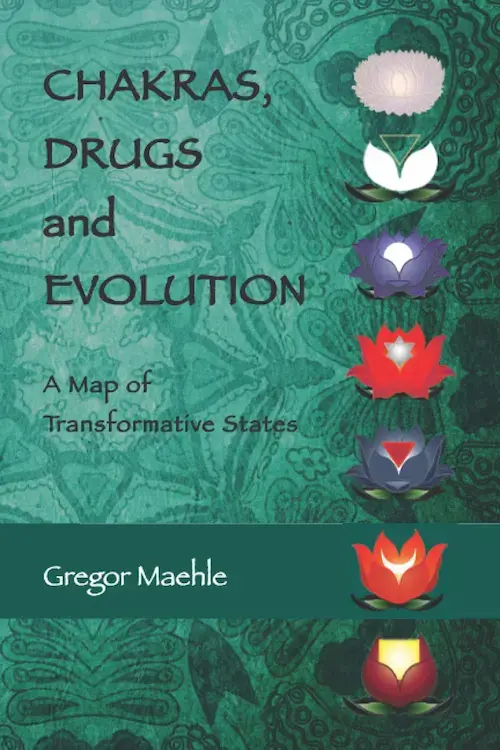
Chakras, Drugs and Evolution by Gregor Maehle is an in-depth exploration of how psychedelic and recreational drugs influence human consciousness, spirituality, and the chakra system—understood here as evolutionary brain circuitry. Maehle draws on over 40 years of yoga practice, personal experimentation with substances, and spiritual study to map the effects of drugs onto the seven primary chakras, while contrasting them with the outcomes of dedicated yoga and meditation.
The book opens by referencing the Yoga Sutra’s teaching that empowerment can arise from various sources, including drugs, but emphasizes that integration of such experiences varies greatly. Maehle explains that while drugs can temporarily activate specific chakras and produce mystical states, these are often unsustainable without disciplined spiritual practice. He addresses the recurring modern question of whether psychedelics can act as shortcuts to enlightenment, ultimately concluding that they may offer glimpses but not the stability or maturity of consciousness gained through sustained effort.
In the introductory chapters, Maehle recounts formative mystical experiences from his youth, some spontaneous and others drug-induced, illustrating both their transformative power and the challenge of integrating them. He also describes his immersion in the 1970s–80s counterculture, encounters with figures like Timothy Leary, and eventual disillusionment with both drugs and guru-centered spiritual movements.
The book’s core is organized into seven chapters, each focused on a chakra, its evolutionary function, and the drugs typically associated with it. For example, the base chakra, linked to survival and the reptilian brain, is influenced by opiates, which can contract awareness and sever spiritual connection. The sacral chakra, tied to family bonds and mammalian brain circuitry, is examined alongside alcohol’s effects. Higher chakras—associated with leadership, love, communication, insight, and cosmic consciousness—are paired with substances like cocaine, MDMA, plant hallucinogens, and LSD. Maehle details the risks of activating higher chakras prematurely through drugs, which can result in paranoia, psychosis, or energetic imbalance.
Beyond the physiological and psychological effects, Maehle addresses the societal implications of drug use. He critiques both prohibitionist and overly romanticized pro-drug narratives, highlighting the hypocrisy of condemning illegal substances while widely consuming addictive legal ones like alcohol and nicotine. He stresses that addiction is more a mental health and spiritual issue than a criminal one, pointing to trauma, disconnection, and lack of purpose as root causes.
In later chapters, Maehle integrates his findings into a “map of transformative states,” showing parallels between mystical experiences in various religious traditions, indigenous practices, and drug-induced states. He connects this to broader themes such as Maslow’s hierarchy of needs, Aldous Huxley’s Perennial Philosophy, and Sri Aurobindo’s vision of human evolution.
Ultimately, Maehle argues that humanity faces a spiritual crisis underlying ecological, political, and social breakdowns. The solution, he asserts, is an intentional evolution of consciousness, best achieved through yoga, meditation, and selfless living—methods that offer the same heights as psychedelics but without their instability or dangers. By awakening the chakras naturally and sequentially, individuals can achieve inner peace, harmony with nature, and a cooperative, sustainable future for humanity.
100 important points from Chakras, Drugs and Evolution by Gregor Maehle.
Purpose & Scope
- The book examines how drugs influence mind, chakras, and spirituality.
- Chakras are seen as evolutionary brain circuitry, not just mystical symbols.
- The Yoga Sutra lists drugs as one of five avenues to empowerment, but with integration challenges.
- Empowerment without integration can be destabilizing.
- Drugs may open temporary spiritual states but rarely make them sustainable.
- Yoga and meditation provide safer, lasting alternatives to drug-induced states.
- The author draws on 40+ years of yoga practice and 3 years of psychedelic use.
- The work aims to create a map linking drugs, chakras, and transformative states.
- It targets spiritual seekers, ex-drug users, and those curious about psychedelics.
- The author connects personal experience with historical, scientific, and yogic frameworks.
Personal Journey & Mystical Experiences
- Maehle had mystical experiences as early as age 7.
- First was a non-drug, Advaita-like experience of the deeper Self.
- Second was a devotional vision of the Virgin Mary.
- Both pointed to different but valid mystical dimensions—jnana and bhakti.
- Early spiritual curiosity led him to study world religions.
- Dissatisfaction with slow progress in youth made psychedelics appealing.
- Influences included Timothy Leary, John Lilly, Terence McKenna, and Ram Dass.
- Psychedelics gave glimpses of higher states but lacked permanence.
- Integration often lagged decades behind experiences.
- Eventually rejected guru-centered cults after witnessing exploitation.
Chakra–Drug Mapping
- Base chakra = survival, reptilian brain. Drug: opiates.
- Opiates contract awareness, closing higher chakras.
- They can sever spiritual connection for over a year post-use.
- Addiction risk linked to early maternal bonding issues.
- Sacral chakra = mammalian brain, family bonds. Drug: alcohol.
- Alcohol disrupts empathy and family stability.
- Navel chakra = power, leadership. Drug: cocaine.
- Cocaine inflates ego and promotes dominance behavior.
- Heart chakra = love, compassion. Drug: MDMA/ecstasy.
- MDMA simulates love chemically but is neurotoxic with overuse.
- Throat chakra = expression, truth. Drug: plant hallucinogens (Ayahuasca, Psilocybin).
- Can enhance communication with “spirit realms” but risk delusion.
- Third-eye chakra = insight, mystical vision. Drug: LSD.
- LSD can trigger profound visions but also psychosis.
- Crown chakra = cosmic consciousness. Drug: high-dose LSD/DMT.
- Premature opening risks schizophrenia or paranoia.
Integration & Risks
- Skipping lower chakras when opening higher ones causes instability.
- Drugs bypass natural sequencing, leading to imbalance.
- Fear, trauma, and war keep people stuck at lower chakras.
- Extreme fear can regress awareness to base chakra survival mode.
- Political leaders exploit base chakra fears for control.
- Societies in permanent war normalize survival-brain behavior.
- Competition-driven education reduces children to lower chakra functioning.
- Indigenous cultures foster cooperation, supporting higher chakras.
- Psychedelic highs fade without daily practice.
- Some drugs make spiritual practice harder for years afterward.
- Drug use is often a symptom of spiritual void or alienation.
- Trauma is a major driver of addiction.
- Addiction is a mental health issue, not just criminal behavior.
- The war on drugs often targets marginalized groups disproportionately.
Philosophical & Cultural Insights
- Human evolution can be mapped through chakras—from reptilian survival to cosmic consciousness.
- Science describes the past but not future evolution.
- The chakra model offers a vision for humanity’s next steps.
- Mystical states occur in all traditions but vary in expression.
- Indigenous spirituality and organized religion differ but overlap in mystical roots.
- Materialism fuels environmental destruction.
- Spiritual awakening leads to ecological harmony.
- Consumerism is incompatible with planetary well-being.
- Real spiritual growth reduces selfishness and competitiveness.
- Every chakra level expands the sense of self to include more beings.
Alternatives to Drugs
- Yoga activates chakras naturally and sequentially.
- Kundalini energy fuels each chakra’s function.
- Stable awakening requires daily discipline.
- Meditation refines awareness and integrates mystical insight.
- Pranayama (breathwork) supports chakra activation.
- Service and selflessness help anchor higher states.
- Spiritual experiences must be embodied, not just visited.
- Integration is often a lifelong process.
- Asceticism can sharpen willpower but must be balanced.
- True teachers emphasize techniques, not personal worship.
Warnings & Lessons Learned
- Drug-induced experiences are not inherently “bad” but unstable.
- Ecstasy caused the most physical damage to the author’s body.
- Opiates most strongly sever connection to the Divine.
- High-dose psychedelics risk destabilizing mental health.
- Premature crown chakra opening can lead to delusion.
- Gurus and leaders can abuse spiritual authority.
- Avoid blind surrender to charismatic figures.
- Cultural memes like “selfish gene theory” reinforce lower-chakra living.
- Urban displacement and broken communities breed addiction.
- Healing requires restoring purpose and meaning in life.
Practical Applications
- Assess which chakra is active when using or recovering from drugs.
- Avoid bypassing chakras; sequence matters.
- Recognize political or media attempts to trigger survival brain.
- Use spiritual practice to counteract fear-driven behavior.
- Replace competition with cooperation in education and community.
- Protect family and social bonds to strengthen sacral chakra.
- Practice leadership ethically from navel chakra development.
- Cultivate heart chakra love beyond chemical stimulation.
- Anchor insights from throat chakra visions into grounded communication.
- Pursue third-eye visions only after emotional and ethical maturity.
Vision for Humanity
- Humanity is in a deep spiritual crisis.
- Ecological collapse is a symptom of spiritual imbalance.
- Collective evolution is possible through inner work.
- Awakening individuals can influence societal transformation.
- The chakra model integrates scientific and mystical worldviews.
- Each person’s awakening fuels collective progress.
- True evolution moves from survival toward unity consciousness.
- Yoga offers a drug-free path to that evolution.
- The goal is harmony with self, others, and nature.
- Without spiritual evolution, humanity risks self-destruction.
. . .