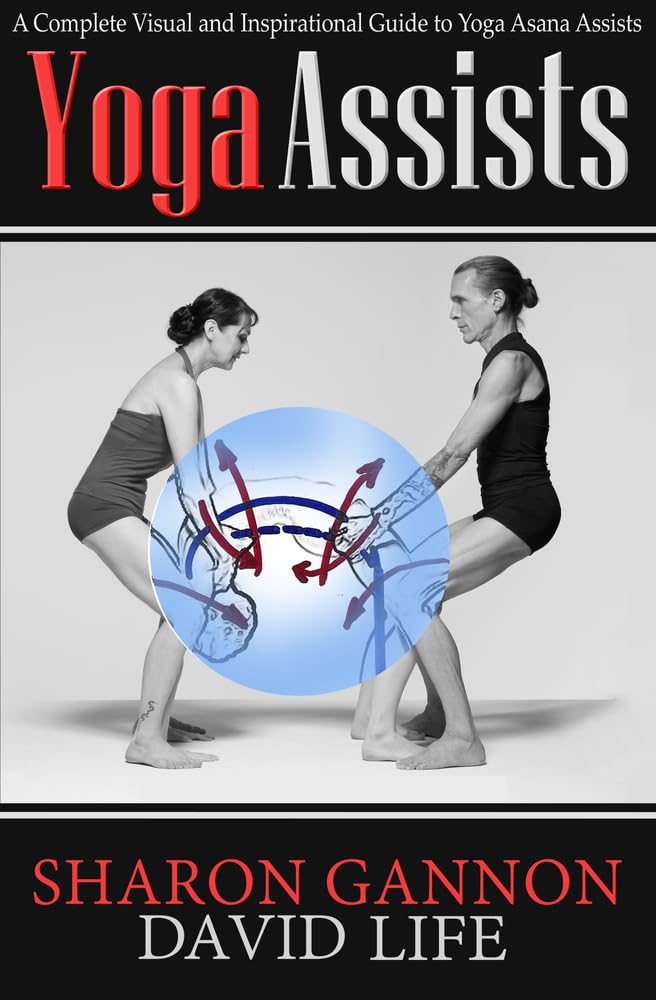
Yoga Assists offers a comprehensive exploration of the philosophy and practice behind giving and receiving yoga assists. Rather than simply presenting physical corrections, the book emphasizes that a yoga assist is a sacred, dynamic exchange that fosters awareness, connection, and spiritual insight. Sharon Gannon and David Life, founders of Jivamukti Yoga, weave together practical guidance with profound spiritual context, underscoring that all assists should be grounded in compassion, intention, and the teacher-student relationship.
The book explains the evolution of assists, moving from the notion of "corrections" to "adjustments" and finally to "assists," a term that honors the mutual journey toward greater clarity and self-awareness. Assists are described as tools to help reduce avidya (mis-knowing) and support the rise of vidya (wisdom). A good assist is never imposed but arises from a relationship rooted in trust, receptivity, and the vision of mastery in each student.
Key concepts include the role of intention, energy flow, and alignment. The authors draw from classical texts like Patanjali’s Yoga Sutras and Shantideva’s Guide to the Bodhisattva’s Way of Life to connect physical practice to deeper spiritual goals, such as self-realization and the alleviation of suffering. They stress that true progress in yoga involves not just perfecting postures but resolving karmic patterns and cultivating compassion.
The text discusses the teacher’s responsibility to establish a safe and supportive environment where the spiritual intention of yoga is prioritized. Assists are not merely mechanical movements but involve tuning into the breath, energetic currents, and the student's mental and emotional state. The book includes guidance on how to observe a student, listen through both intuition and physical signs, and approach each body with humility and skill.
Chapters are divided by posture categories—standing poses, forward bends, twists, backbends, inversions, and relaxation—with detailed descriptions and visual guides for each assist. Practical techniques are paired with inspirational commentary and poetic verses from Master Shantideva, reinforcing the sacredness of the practice.
Gannon and Life also stress the karmic implications of different types of asanas. For example, forward bends relate to unresolved issues with romantic and creative relationships, while backbends relate to opening the heart and healing from past hurts. Every assist becomes an opportunity to help the student access and heal deeper layers of their being.
The book closes with an affirmation of the importance of lineage, humility, and living transmission. Touch is seen as a powerful tool when used with love and clarity. Ultimately, Yoga Assists is not just a manual for physical guidance, but a spiritual roadmap, encouraging teachers and students alike to approach yoga as a path of service, transformation, and union with all beings.
100 important points from Yoga Assists by Sharon Gannon and David Life:
Concept & Philosophy of Assists
- Assists are not corrections—they are compassionate interactions.
- The term "assist" reflects mutuality and respect.
- A good assist reduces avidya (mis-knowing) and fosters vidya (wisdom).
- Assists must be rooted in intention, awareness, and alignment.
- Yoga is not about achieving perfection, but deepening self-awareness.
- The practice of yoga assists mirrors the practice of life.
- Assists are an energetic and spiritual exchange, not just physical.
- A teacher must see the student as already whole and perfect.
- A student’s breath is a key indicator of receptivity.
- Compassion is the foundation of all yoga assists.
Teacher-Student Relationship
- The teacher-student bond is central to spiritual growth.
- Trust between teacher and student takes time to build.
- A good teacher recognizes teaching as a sacred duty.
- Teachers assist not to control, but to empower.
- Assists should be offered with humility and non-attachment.
- The teacher must stay mindful of their own intentions.
- Both teacher and student benefit from the assist.
- Assisting requires deep listening and observation.
- Assisting can heal karmic patterns.
- Teaching and assisting are opportunities for selfless service.
Energetics of Asana
- Energy flows up the front and down the back of the body.
- Ida and Pingala nadis spiral around the central channel (Sushumna).
- Asana is a dance of opposing forces—action and receptivity.
- The “seat” of an asana must be firmly established.
- Connection to the Earth is foundational for all poses.
- Upward energy equals the celestial force of levitation.
- Downward energy equals the terrestrial force of gravity.
- Misalignment often stems from energetic blockages.
- Energetic alignment precedes physical alignment.
- Every assist should support energy flow, not obstruct it.
Practical Principles
- Observe before touching—"Stop, Look, Listen."
- Never break the student’s connection to the Earth.
- Use props (belts, blocks) as supportive tools, not crutches.
- Understand anatomical and energetic alignment before assisting.
- Hands-on assists should be clear, firm, and non-threatening.
- Touch can be gentle, medium, or strong—each has a purpose.
- The breath should remain calm, steady, and rhythmic.
- The student should feel supported, not forced.
- Align from the ground up—feet to skull.
- Visualize the body’s alignment as a multidimensional grid.
Intention and Karma
- Good intentions plant karmic seeds that ripen over time.
- Impure intentions can lead to failed assists.
- Asana helps resolve karmic relationships and energetic patterns.
- Standing poses relate to money, home, and parents.
- Forward bends connect to romantic and creative partnerships.
- Twists relate to those we’ve harmed or been harmed by.
- Backbends open the heart and heal emotional wounds.
- Inversions relate to ego and the Divine.
- Shavasana reflects our relationship with death.
- Assisting is a practice of karma yoga—selfless action.
Categories of Assists
- Standing asanas begin with foot alignment and grounding.
- Trikonasana involves creating a single plane of alignment.
- Warrior poses require balance and strength in both legs.
- Side angle pose engages energy from heel to fingertips.
- Forward bends involve merging front and back body energies.
- Twists need spiral energy and opposing force awareness.
- Backbends require trust, heart-opening, and spinal extension.
- Inversions need careful spotting and balance of prana/apana.
- Shavasana requires a calm, sacred touch—or none at all.
- Neck, hand, and foot massage in Shavasana enhances surrender.
Safety and Ethics
- Never assist without student consent.
- Watch for signs of discomfort, hesitation, or injury.
- Avoid over-assisting or manipulating beyond natural range.
- Do not project personal emotions during an assist.
- Touch should always be non-sexual and respectful.
- Use verbal instructions when hands-on is inappropriate.
- Match the depth of assist with the student’s breath.
- Never experiment—use tried and true techniques.
- Each student requires a unique approach.
- Support students emotionally, physically, and spiritually.
Voice & Demonstration
- Voice should be calm, clear, and authoritative.
- Demonstrations should be visible and intentional.
- Avoid performing your own practice while teaching.
- Words should align with the energy of the room.
- Silence is sometimes the best teacher.
- Speak from presence, not ego.
- Use visual, auditory, and kinesthetic methods to teach.
- Cue from extremities inward (hands, feet → spine).
- Breathing cues help deepen the effect of an assist.
- Refer to the Earth or sky, not abstract directions.
Spiritual and Ethical Foundations
- Assisting is a form of seva (selfless service).
- Non-harming (ahimsa) is essential to every touch.
- Veganism supports yogic principles of compassion.
- Asana is a path to liberation, not just fitness.
- Lineage provides sacred context for assisting.
- The teacher should embody yogic values off the mat.
- The inner attitude matters more than external technique.
- Assisting is a way to honor Divine in others.
- See every student as a manifestation of the Self.
- Real assists happen beyond the physical.
Integration and Mastery
- Mastery begins with one posture done with depth.
- Assisting refines your own understanding of asana.
- Use breath and awareness as primary tools.
- Learn from a living lineage—not just books.
- You must feel the asana in your own body first.
- Assisting is a lifelong practice—not a quick skill.
- Stay humble—always be a student.
- Assist with love, not ego.
- Create space, not control.
- The ultimate assist is helping another realize their true nature.
. . .