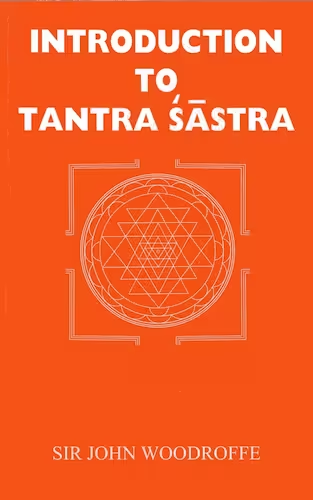
Imagine a world where divine energies dance in harmony, unlocking hidden pathways to enlightenment. In Introduction to Tantra Śāstra, Sir John Woodroffe (Arthur Avalon) guides readers through the mystical and ancient tradition of Tantra—a philosophy often misunderstood yet brimming with wisdom for those bold enough to explore it.
The journey begins in the sacred Himalayas, where the towering Mount Kailasa is said to be the abode of Lord Shiva, the embodiment of pure consciousness. Together with Shakti, the dynamic goddess of creation, they reveal the profound secrets of existence, spirituality, and human potential. Through mesmerizing dialogues, the essence of Tantra unfolds: energy, balance, and ultimate liberation.
Woodroffe masterfully unveils complex ideas with poetic elegance, delving into the awakening of Kundalini energy, the mysteries of the chakras, and the sacred power of mantras. He demystifies the intricate rituals and emphasizes the importance of inner transformation rather than mere outer practices.
This is not just a book—it’s an invitation to explore the limitless realms of your consciousness. Whether you’re a seeker or simply curious about the spiritual heritage of India, Woodroffe’s work offers a bridge between ancient wisdom and modern understanding. It reminds us that Tantra is not about indulgence but transcendence—a journey inward to realize the divine spark within.
A must-read for spiritual adventurers and those yearning to tap into their deepest potential. Are you ready to embark on this sacred journey?
Why You Should Read Introduction to Tantra Śāstra
If you're curious about unlocking the secrets of ancient Indian spirituality, Sir John Woodroffe's Introduction to Tantra Śāstra is a must-read. This book serves as a bridge between traditional Tantric wisdom and the modern world, making esoteric concepts accessible to both seekers and scholars alike.
Tantra is often misunderstood as being purely ritualistic or indulgent, but this book reveals its profound spiritual and philosophical depth. It explores transformative ideas such as the awakening of Kundalini energy, the significance of chakras, and the dynamic interplay between Shiva and Shakti. These teachings offer practical guidance on achieving inner balance, spiritual growth, and self-realization.
Reading this book is like embarking on a mystical journey to the heart of consciousness itself. It helps dispel myths about Tantra and emphasizes its holistic approach, which integrates body, mind, and spirit. You'll gain a deeper understanding of cosmic principles, the role of devotion, and the spiritual dimensions of daily life.
For those interested in yoga, meditation, or personal transformation, Woodroffe’s work provides a profound philosophical foundation. His meticulous research and poetic storytelling make it both enlightening and engaging.
Whether you're a spiritual adventurer, a yogi seeking deeper insights, or simply someone fascinated by ancient wisdom, Introduction to Tantra Śāstra offers timeless teachings that can transform your perspective and elevate your consciousness. Don't just read it—immerse yourself in its mystical wisdom.
100 key points from Introduction to Tantra Śāstra by Sir John Woodroffe:
General Overview
- Tantra is an ancient Indian spiritual system focusing on the unity of consciousness and energy.
- The text seeks to dispel misconceptions about Tantra as purely esoteric or sensual.
- Tantra emphasizes self-realization through ritual, meditation, and yogic practices.
- The philosophy integrates spiritual and practical aspects of daily life.
- Mount Kailasa is described as the sacred abode of Shiva, a central figure in Tantra.
Philosophy and Metaphysics
- The ultimate reality is represented by Shiva (consciousness) and Shakti (energy).
- Their union symbolizes the dynamic creation and sustenance of the universe.
- Brahman, the supreme consciousness, is both transcendent and immanent.
- The interplay between Prakriti (nature) and Purusha (consciousness) is a key concept.
- The text highlights the importance of realizing the divine within oneself.
Spiritual Practice and Sadhana
- Kundalini energy lies dormant in the base of the spine and can be awakened through Tantra.
- The practice of awakening Kundalini involves breath control, meditation, and mantras.
- Chakras are energy centers within the human body that must be balanced for spiritual growth.
- There are seven primary chakras, each with unique functions and symbolic meanings.
- Mantras are sacred sounds used to activate divine vibrations within the practitioner.
The Role of Guru (Teacher)
- A guru plays a crucial role in guiding practitioners through Tantra.
- Proper initiation (Diksha) is essential to safely practice advanced Tantra techniques.
- Misguided practice without a guru can lead to confusion and spiritual harm.
- The relationship between guru and disciple is one of trust and spiritual transmission.
- Gurus are seen as living embodiments of divine wisdom.
Sacred Symbols and Rituals
- Yantras are sacred geometric diagrams used in meditation.
- The Sri Yantra is one of the most revered symbols in Tantra.
- Rituals involve offerings, mudras (hand gestures), and recitations of mantras.
- Worship in Tantra can be internal (mental) or external (physical offerings).
- Devotional practices often involve invoking specific deities for blessings.
Shiva and Shakti Relationship
- Shiva represents stillness, while Shakti embodies creative energy.
- Their cosmic dance signifies the balance between destruction and creation.
- The text emphasizes that neither can exist without the other.
- Understanding the union of Shiva and Shakti leads to spiritual liberation.
- Parvati, a form of Shakti, is often depicted as the divine consort of Shiva.
Key Concepts in Tantra
- The triad of gunas—Sattva, Rajas, and Tamas—defines the qualities of existence.
- Sattva symbolizes purity and enlightenment.
- Rajas represents activity and passion.
- Tamas denotes darkness and ignorance.
- Spiritual progress involves balancing and transcending these gunas.
Role of Devotion (Bhakti)
- Devotion to deities is a path to connect with the divine.
- The text emphasizes the importance of sincerity in worship.
- Bhakti dissolves ego and leads to divine union.
- Devotees are encouraged to surrender their desires to the divine.
- Worship can be personalized according to the practitioner’s temperament.
Cosmology in Tantra
- The universe consists of multiple Lokas (worlds).
- The earthly realm is called Bhurloka, while Satyaloka is the highest spiritual plane.
- The text describes celestial beings and their roles in cosmic order.
- Time is cyclical, marked by the creation and dissolution of worlds.
- The concept of karma governs rebirth and spiritual evolution.
Kundalini and Chakras
- Kundalini energy is coiled like a serpent at the base of the spine.
- When awakened, it ascends through the chakras to the crown.
- The Muladhara chakra is associated with stability and grounding.
- The Sahasrara chakra represents spiritual enlightenment.
- Balanced chakras lead to physical, emotional, and spiritual harmony.
Importance of Purification
- Purifying the body and mind is essential for spiritual growth.
- Pranayama (breath control) helps cleanse energy channels.
- Fasting and disciplined living are recommended practices.
- Meditation purifies thoughts and emotions.
- Ethical living is foundational in Tantra.
Misconceptions about Tantra
- Tantra is often wrongly perceived as focused on sensuality.
- True Tantra emphasizes discipline, devotion, and self-transformation.
- It is a comprehensive spiritual science, not just ritualistic practices.
- The text clarifies that Tantra is open to both men and women.
- Tantra does not reject the material world but seeks to spiritualize it.
Chakras and Their Meanings
- Muladhara: Stability and survival
- Swadhisthana: Creativity and pleasure
- Manipura: Power and confidence
- Anahata: Love and compassion
- Vishuddha: Communication and truth
- Ajna: Intuition and insight
- Sahasrara: Enlightenment and divine connection
Mantras and Sound Energy
- Om is the primal sound representing universal consciousness.
- Mantras align the practitioner with divine vibrations.
- Specific mantras are associated with different deities and energies.
- Chanting mantras creates a protective spiritual shield.
- Silence after chanting allows absorption of divine energy.
Tantra and Daily Life
- Tantra encourages mindful living and conscious actions.
- Every act can be a form of worship when done with awareness.
- Tantra integrates spirituality into relationships and work.
- Practicing gratitude aligns one with divine abundance.
- Compassion and service are essential virtues in Tantra.
Sacred Texts and References
- The Mahānirvāna Tantra is a central scripture in Tantra.
- The Skanda Purana praises Mount Kailasa as a divine abode.
- The Lalita Sahasranama describes the glories of the goddess.
- The Vedas and Upanishads are foundational sources.
- The Bhagavad Gita also echoes Tantric principles.
The Path to Liberation (Moksha)
- Moksha is freedom from the cycle of birth and death.
- Tantra emphasizes experiential knowledge over blind faith.
- Liberation is achieved by realizing one’s divine nature.
- Meditation on Shiva and Shakti accelerates liberation.
- Detachment from material desires is essential.
Ethics and Morality in Tantra
- Compassion and non-violence are core principles.
- Truthfulness and self-discipline are emphasized.
- Respect for all living beings is paramount.
- Ethical conduct creates a strong foundation for spiritual progress.
- The practitioner must act in harmony with cosmic laws.
Practical Guidance for Practitioners
- Begin with simple meditation and breathwork.
- Seek guidance from an experienced guru.
- Gradually incorporate rituals and mantras.
- Maintain a disciplined and ethical lifestyle.
- Approach Tantra with humility and devotion.
Final Insights
- Tantra is a journey of inner transformation.
- It harmonizes the body, mind, and spirit.
- The text serves as a timeless guide for spiritual seekers.
. . .