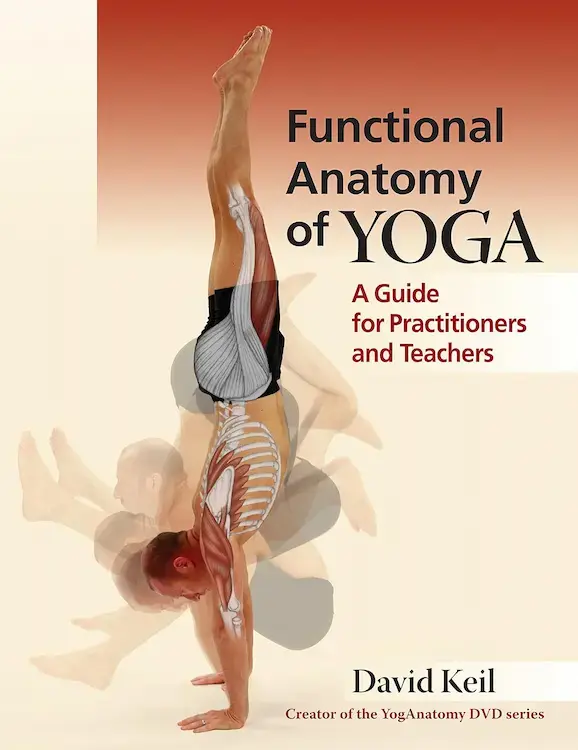
Functional Anatomy of Yoga by David Keil is a comprehensive guide that connects the science of anatomy with the ancient practice of yoga. Written for both yoga practitioners and teachers, the book explores how the body’s structure influences movement, breath, flexibility, and strength during asana practice. Unlike traditional anatomy texts, Keil emphasizes the body as a unified system, showing how muscles, bones, fascia, joints, and connective tissues work together in yoga.
The book begins with the basics of functional anatomy, introducing connective tissue, the muscular system, and the role of the nervous system in movement. Keil explains concepts like isotonic and isometric contractions, eccentric and concentric movements, and the critical role of gravity in shaping asana practice. This scientific foundation helps readers understand why some postures feel challenging, why injuries occur, and how mindful alignment can prevent strain.
Each chapter of the book focuses on key regions of the body, including the foot and ankle, knee, hip joint, pelvis, spine, shoulder girdle, and upper extremities. Keil highlights how these areas interact dynamically during yoga poses, offering insights into alignment, stability, and range of motion. For example, he explains how tight hamstrings affect forward bends, how hip rotation influences balance, and how the spine adapts in backbends. Teachers can use this knowledge to better observe their students’ unique anatomy and provide safe, effective adjustments.
Part two of the book explores anatomical patterns in asanas such as forward bends, twists, arm balances, and backbends. Keil integrates detailed anatomical explanations with practical yoga applications, showing how practitioners can enhance flexibility, strength, and awareness while minimizing injury risk. He encourages teachers and students to experiment on the mat, treating the body as a personal laboratory for exploration.
One of the unique strengths of Functional Anatomy of Yoga is its accessible language. Instead of overwhelming readers with medical terminology, Keil translates anatomy into practical terms that yogis can immediately apply. He also stresses the importance of individual differences: not every body is built the same, and what works for one student may not work for another. This perspective empowers yoga teachers to adapt their instruction to diverse students and encourages practitioners to honor their own bodies.
Beyond anatomy, Keil discusses the philosophical connection between yoga and the human body. He frames asana as a tool not just for physical conditioning but for cultivating awareness, presence, and stillness of mind. He links anatomy with Patanjali’s definition of yoga as “the cessation of the fluctuations of the mind,” showing how physical practice leads to deeper self-knowledge.
Overall, Functional Anatomy of Yoga is more than a technical manual—it is a bridge between science and spirituality. It equips yoga teachers with the tools to guide students safely, inspires practitioners to deepen their self-inquiry, and enriches yoga practice with a clear understanding of how the body functions. This book is essential for yoga teacher training, anatomy workshops, and anyone seeking a mindful, injury-free practice.
100 Key Points from Functional Anatomy of Yoga.
- Functional anatomy explains how yoga asanas affect the human body.
- Yoga anatomy integrates muscles, joints, bones, and fascia into movement.
- The body must be studied as a unified system, not isolated parts.
- Connective tissue links every structure in the body.
- Fascia supports flexibility and strength in yoga.
- Collagen provides structural strength to tissues.
- Elastin allows tissues to stretch and return to shape.
- Tendons connect muscles to bones for movement.
- Ligaments stabilize joints and restrict excessive motion.
- Scar tissue affects range of motion after injuries.
- The muscular system produces movement and stability.
- Muscles also generate heat during yoga practice.
- Isometric contractions maintain poses like plank.
- Isotonic concentric contractions shorten muscles.
- Isotonic eccentric contractions lengthen muscles under tension.
- Gravity shapes how muscles work in yoga poses.
- Hamstrings often resist forward folds in yoga.
- Quadriceps activation deepens forward bends.
- Muscles never work alone; they function in coordination.
- Nervous system signals control muscular contractions.
- Opposing muscles release tension during stretching.
- Fine motor skills rely on fascial independence.
- Poor movement habits create muscular imbalances.
- Yoga practice rewires neuromuscular coordination.
- The spine is central to yoga alignment.
- Healthy posture depends on balanced spinal curves.
- The pelvis is a foundation for all yoga poses.
- Hip mobility influences forward folds and backbends.
- The knee depends on hip and ankle alignment.
- Ankles provide balance and stability in standing poses.
- Feet are the base of yoga postures.
- Arches of the feet affect balance and energy flow.
- Shoulder stability is essential in arm balances.
- Wrist alignment prevents injury in yoga practice.
- Breath connects anatomy and yoga awareness.
- Bandhas support stability and energy flow.
- Sthira (steadiness) and sukha (ease) define yoga practice.
- Flexibility varies based on genetics and activity history.
- Injury history impacts yoga alignment.
- Emotional history influences practice approach.
- Learned parental habits affect posture and movement.
- Nutrition shapes tissue health and flexibility.
- Spiritual beliefs can influence physical practice.
- Converging histories shape every body differently.
- Yoga anatomy respects individuality in practice.
- No single alignment cue fits all students.
- Teachers must adapt yoga poses for unique bodies.
- Yoga anatomy helps prevent injuries.
- Misalignment often causes joint strain.
- Fascia can bind muscles together, limiting flexibility.
- Movement maintains healthy fascia.
- Lack of movement stiffens fascia and muscles.
- Overuse creates adhesions in connective tissue.
- Scar tissue heals but may reduce range of motion.
- Rehabilitation requires movement to realign scar tissue.
- Mindful yoga practice heals connective tissues.
- Hamstrings are prone to tightness in daily life.
- Hip openers release stored tension.
- Forward folds lengthen fascia in the back body.
- Backbends open the chest and spine.
- Twists improve spinal rotation and organ health.
- Arm balances demand core and shoulder strength.
- Functional anatomy explains why yoga is therapeutic.
- Yoga helps realign skeletal posture.
- Balance in yoga depends on muscle coordination.
- Core muscles stabilize all yoga postures.
- Pelvic floor muscles integrate with breath and bandhas.
- Yoga anatomy links body, breath, and mind.
- Asanas prepare the body for meditation.
- Yoga increases proprioception (body awareness).
- Muscle names reveal function and location.
- The biceps brachii flexes and supinates the forearm.
- The trapezius stabilizes and moves the shoulder blades.
- Adductor longus brings the leg inward.
- Rhomboids retract the shoulder blades.
- Each asana involves concentric and eccentric contractions.
- Fascia surrounds every muscle fiber and fascicle.
- Healthy fascia enables fluid, unrestricted movement.
- Yoga stretches fascia as much as muscles.
- Tight fascia limits mobility in yoga poses.
- Functional anatomy emphasizes dynamic, not static, body mechanics.
- Muscles adapt to stress by adding connective tissue.
- Weight training affects fascial density.
- Yoga balances strength and flexibility.
- Anatomy knowledge improves yoga instruction.
- Teachers must learn to observe unique anatomy.
- Students should honor their body’s limits.
- Yoga anatomy improves injury recovery.
- Scar tissue remodels with mindful stretching.
- Yoga provides natural rehabilitation.
- Asana transitions involve complex muscle interplay.
- Forward bends involve eccentric hamstring contractions.
- Standing up from a fold uses concentric hamstrings.
- Balance poses require ankle and core coordination.
- Arm balances depend on wrist stability.
- Backbends demand spinal extension and hip opening.
- Twists improve spinal mobility and digestion.
- Functional anatomy connects yoga with everyday movement.
- Yoga anatomy teaches safe alignment principles.
- Functional Anatomy of Yoga bridges science and spirituality for deeper practice.
. . .