

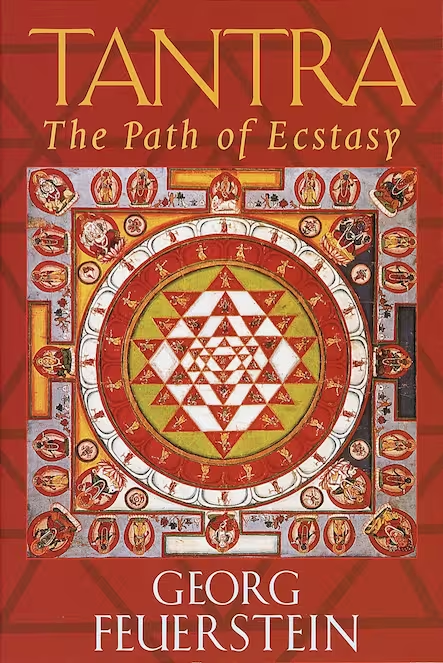
Tantra: The Path of Ecstasy by Georg Feuerstein Image
5/10 789 views Updated: 1 week ago

Tantra: The Path of Ecstasy by Georg Feuerstein

Georg Feuerstein’s Tantra: The Path of Ecstasy explores the authentic teachings of Tantra, clarifying its deep spiritual roots beyond the common misconceptions of mere sexuality. The book covers Tantra’s origins, philosophy, and practices, emphasizing the balance of Shiva and Shakti, Kundalini awakening, mantra chanting, and ritual worship. Feuerstein explains how Tantra integrates spiritual discipline with everyday life, offe...

Georg Feuerstein's Tantra: The Path of Ecstasy is an in-depth exploration of Tantra, an esoteric spiritual tradition rooted in Hinduism and Buddhism. The book dispels common misconceptions, clarifying that Tantra is not merely about sexuality but a comprehensive system of spiritual enlightenment. Feuerstein traces the origins, philosophy, and practices of Tantra, explaining its key concepts like Kundalini energy, the Guru principle, the interplay of Shiva and Shakti, and the use of rituals, mantras, and meditation. He highlights the transformative power of Tantra, which views all aspects of life—including the body, emotions, and desires—as pathways to spiritual awakening. The text provides guidance on initiation, discipleship, and self-transformation, while also discussing the dangers of misusing Tantric practices. By bridging ancient wisdom with modern understanding, Feuerstein presents Tantra as a path to higher consciousness and ultimate liberation.



Why You Should Read This Book

  1. Authentic Perspective – Feuerstein is a respected Indologist, ensuring a scholarly yet accessible take on Tantra.
  2. Clears Misconceptions – It debunks Western stereotypes that reduce Tantra to mere sexual practices.
  3. Comprehensive Guide – Covers Tantra’s philosophy, history, rituals, and spiritual disciplines.
  4. Deepens Spiritual Practice – Useful for those exploring Kundalini Yoga, meditation, or energy work.
  5. Applicable to Modern Life – Provides insights into integrating Tantra’s principles into daily existence.


100 Important Points from the Book

  1. Tantra is a complex spiritual tradition, not just a sexual practice.
  2. It originated in Hinduism and later influenced Buddhism and Jainism.
  3. The word "Tantra" means "expansion" or "weaving together."
  4. Tantra emphasizes the balance of masculine (Shiva) and feminine (Shakti) energies.
  5. It views the body as a sacred vessel for spiritual awakening.
  6. Kundalini energy is central to Tantra, representing dormant spiritual potential.
  7. The goal of Tantra is enlightenment and liberation (moksha).
  8. Mantras, yantras, and mudras are key elements in Tantric rituals.
  9. Tantra teaches that Samsara (worldly life) and Nirvana (liberation) are one.
  10. The Guru is essential for initiation and spiritual guidance.
  11. Tantra integrates asceticism with enjoyment of the material world.
  12. The practice of "Maithuna" (ritualized sexual union) is symbolic and not always literal.
  13. Tantra recognizes the Divine in all aspects of existence.
  14. It has both Right-Hand (conservative) and Left-Hand (radical) paths.
  15. The Left-Hand Path involves breaking taboos to transcend duality.
  16. Shakti is the dynamic power that manifests the universe.
  17. Rituals help align the practitioner with cosmic forces.
  18. Tantra acknowledges and utilizes desires instead of suppressing them.
  19. Tantra includes visualization techniques to internalize divine forms.
  20. It incorporates elements from Vedic, Yogic, and Shaivite traditions.
  21. The Chakras are important energy centers in the body.
  22. The Ajna (Third Eye) Chakra represents higher intuition.
  23. The practice of Nyasa involves placing mantras in different body parts.
  24. Shiva symbolizes pure consciousness, while Shakti represents energy.
  25. The concept of "Spanda" refers to the divine pulsation of the universe.
  26. Tantra does not reject the senses but refines them.
  27. The Five M’s (Madya, Mamsa, Matsya, Mudra, Maithuna) symbolize elements of ritual.
  28. Tantra is meant for those prepared for deep transformation.
  29. The Kula-Arnava-Tantra is a key scripture in the tradition.
  30. Breath control (Pranayama) is used to regulate life force (Prana).
  31. The central channel (Sushumna) must be activated for spiritual awakening.
  32. Yantras are geometric diagrams used in meditation.
  33. Some Tantric sects emphasize devotion (Bhakti) alongside knowledge (Jnana).
  34. Shakti-pata is the descent of grace from a Guru to a disciple.
  35. Tantric meditation can lead to Samadhi (spiritual absorption).
  36. Deities in Tantra are seen as archetypes of consciousness.
  37. The secret language (Sandhya Bhasha) hides deeper meanings in scriptures.
  38. Tantra involves rituals to purify the body and mind.
  39. The Guru-disciple relationship is considered sacred.
  40. Self-discipline and ethical conduct (Yama and Niyama) are foundational.
  41. The eight limbs of Yoga are incorporated into Tantra.
  42. Mudras (hand gestures) channel energy and intention.
  43. The Shiva-Sutra is an important text in Kashmiri Shaivism.
  44. Tantra respects feminine energy and the role of the Goddess.
  45. The Kaula path is a radical approach to liberation.
  46. Internalized rituals (Antaryaga) are more advanced than external ones.
  47. Many Tantric texts were lost or hidden due to secrecy.
  48. Tantra acknowledges the power of sound through Nada Yoga.
  49. The aim of Tantric practice is spontaneous awareness (Sahaja).
  50. Tantric adepts (Siddhas) attain supernatural powers (Siddhis).
  51. Tantra uses fire rituals (Homa) for transformation.
  52. The human mind is seen as a microcosm of the universe.
  53. Certain forms of meditation involve gazing at a flame or a Yantra.
  54. The Kula system organizes Tantra into different lineages.
  55. The integration of sexuality is only for spiritually mature individuals.
  56. The use of intoxicants in Tantra is symbolic, not indulgent.
  57. The breath is linked to the movement of energy in the body.
  58. Tantra teaches acceptance rather than renunciation.
  59. Visualization of deities merges practitioner with divine forces.
  60. The concept of the Guru as Shiva incarnate is crucial.
  61. Awakening Kundalini prematurely can be dangerous.
  62. The Mahavidyas represent ten powerful aspects of the Goddess.
  63. Tantra encourages both personal experience and scriptural study.
  64. Celestial music (Nada) is experienced in deep meditation.
  65. Some practices involve fasting or sensory deprivation.
  66. Tantra exists in Buddhist and Jain traditions as well.
  67. The Trika system of Kashmiri Shaivism has deep Tantric roots.
  68. The universe is perceived as a manifestation of divine joy.
  69. Tantra suggests that enlightenment can happen in one lifetime.
  70. The left and right nostrils represent solar and lunar energies.
  71. The Kaula path uses direct transmission of spiritual energy.
  72. Enlightenment is described as "Bliss beyond pleasure."
  73. Mantras activate latent energies within.
  74. Ritual baths (Abhisheka) purify the practitioner.
  75. Tantric texts use metaphors to conceal higher truths.
  76. The Guru-disciple bond is likened to the transmission of a flame.
  77. Kundalini energy rises through the Chakras during deep practice.
  78. Initiation (Diksha) marks the formal entry into Tantric practice.
  79. The body is considered a temple in Tantra.
  80. Tantric practices cultivate fearlessness and equanimity.
  81. Sound vibrations alter consciousness.
  82. Tantra sees the material world as sacred, not illusory.
  83. Each syllable in a mantra has deep significance.
  84. The ultimate goal is recognizing oneself as divine.
  85. Symbols like the Sri Yantra represent the cosmos.
  86. Certain breathing techniques balance the body's energies.
  87. Tantra respects traditional Indian cosmology.
  88. The practice of Pratyahara withdraws attention from distractions.
  89. Ritualized dance is sometimes used as meditation.
  90. Tantra acknowledges the mind-body connection.
  91. True Tantra requires years of dedicated practice.
  92. Symbols and colors have specific spiritual meanings.
  93. Many Tantra teachings were passed orally.
  94. The concept of "Spanda" emphasizes vibrational energy.
  95. Tantra acknowledges multiple paths to liberation.
  96. The right teacher is essential for serious practice.
  97. Tantra influences modern yoga and spirituality.
  98. The ultimate realization is the union of Shiva and Shakti.
  99. True Tantra leads to self-transcendence.
  100. The highest teaching is recognizing that everything is divine.


. . .

Related Books Reviews